
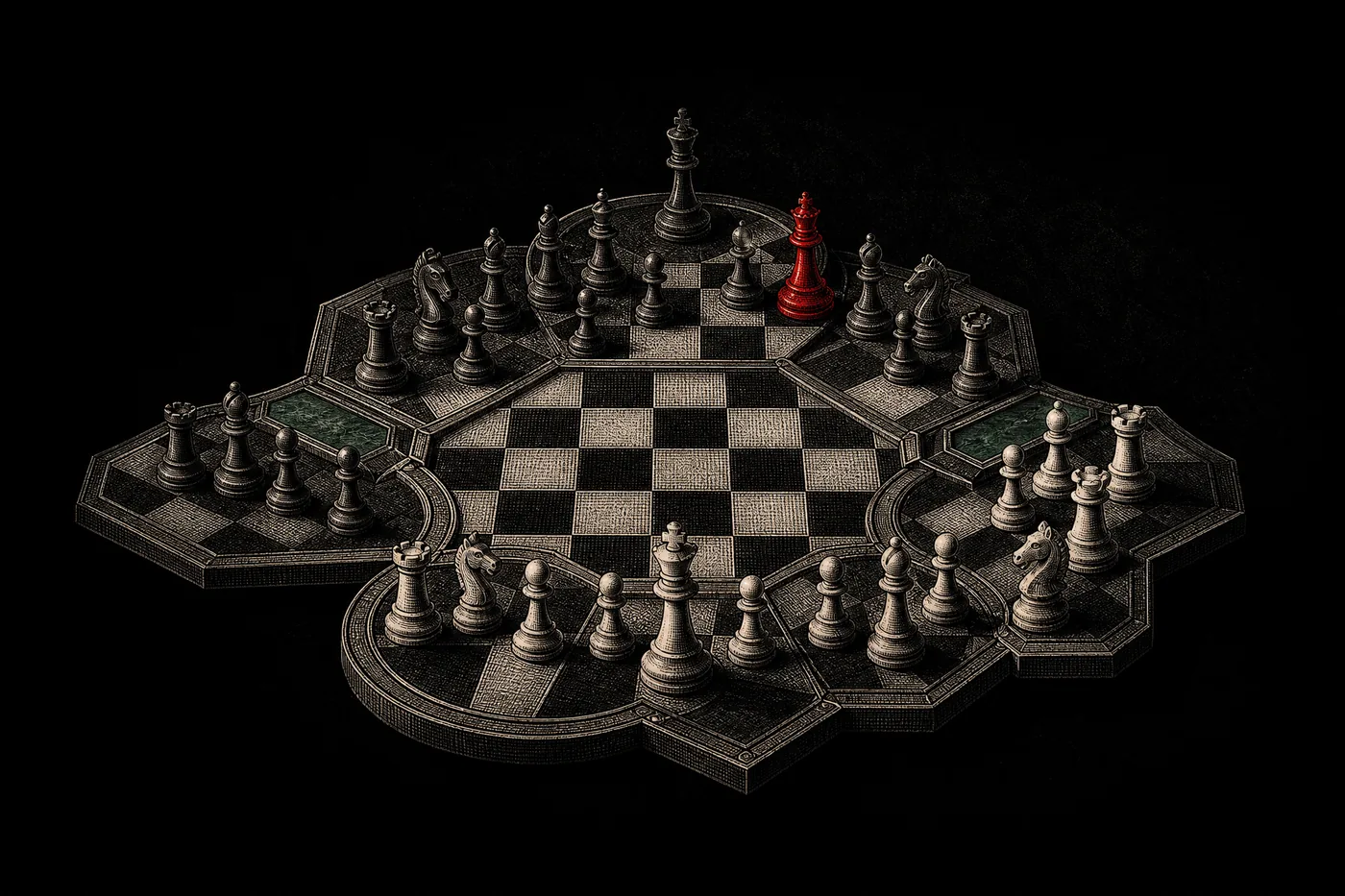
Horde chess is the ultimate David-versus-Goliath board. On one side: a completely normal chess army. On the other: 36 pawns and absolutely nothing else — no king, no pieces, just a relentless wall of foot soldiers marching forward. It’s asymmetric, it’s a little bit unfair-looking, and it’s one of the most fun variants to try when you want something totally different.
The two sides don’t even win the same way. Black wins by capturing every last pawn. White wins by checkmate. Let’s set up the board.
Horde in 10 seconds
- Players: 2 (one side plays the pawns, one plays the pieces)
- The twist: White has 36 pawns and no king; Black has a standard army.
- How you win: Black captures all the pawns; White checkmates Black.
- Where to play: Lichess (native variant).
The starting position
Here’s what you’re staring at when a Horde game begins:
White (the Horde) fills the entire bottom four ranks with pawns — that’s 32 — plus four more pushed up onto the fifth rank (b5, c5, f5, g5), for 36 pawns total. Notice there’s no white king anywhere. Black, meanwhile, has the ordinary 16-piece setup on the top two ranks. White moves first and starts pushing the swarm forward.
The rules of Horde chess
Almost everything plays like standard chess — but the two win conditions and a couple of pawn quirks make all the difference.
Two completely different goals
Lichess spells it out: the pieces “win by capturing all the Pawns,” and White wins by “checkmating the King of the Pieces.”
- Black (The Pieces) wins by capturing every single pawn — including any pawn that promotes into a bigger piece. Wipe the Horde off the board and you win.
- White (The Horde) wins by delivering checkmate to Black’s king, exactly as in normal chess. White has no king of its own, so it can never be checkmated — the only way White loses is by being fully captured.
The pawns get a special move
Because White’s pawns start on the first rank as well as the second, there’s an extra rule so those back rows aren’t stuck: “Pawns on the first rank may move two squares, similar to Pawns on the second rank.” So a first-rank pawn can jump two squares forward on its first move, just like a normal second-rank pawn.
One follow-on detail for the rules lawyers: Black can’t en passant a first-rank pawn that just leapt two squares — Lichess notes that “it is not a valid en passant capture.” En passant still works normally against second-rank two-square jumps.
Everything else is normal chess
Pawns still promote when they reach the far side (a very real danger for Black — a promoted Horde pawn becomes a queen!), pieces move and capture as usual, and a move is legal if it would be legal in standard chess, aside from that first-rank pawn exception. Black can still castle; White has no king, so castling never comes up for the Horde.
How to win at Horde chess
The two sides need almost opposite game plans.
Playing Black (the army — you’re trying to capture everything):
- Trade pawns off efficiently. You have limited firepower against a giant wall, so make every capture count. Grab pawns you can take safely and avoid getting pieces trapped inside the swarm.
- Blockade before you attack. A pawn that can’t advance is a pawn that can’t promote. Plant knights and bishops on squares that freeze the front line, then dismantle it at your leisure.
- Watch for promotions. The scariest thing that can happen to you is a Horde pawn reaching the eighth rank and becoming a queen. Keep the dangerous runners covered.
- Your king is a fighter here. With no enemy king and (usually) no enemy pieces to deliver checks once the swarm thins out, your king can march forward and help mop up pawns.
Playing White (the Horde — you’re trying to checkmate):
- Push as a connected mass. Pawns defend each other diagonally. Advance in a phalanx so captures cost Black material, and open lines toward the enemy king.
- Aim everything at the king. You can’t be checkmated, so play fearlessly — throw pawns forward to pry open Black’s king and force a mate before your numbers run out.
- Promotion is your trump card. Getting even one pawn to the end turns the swarm into a swarm-plus-queen. Create a runner Black can’t stop.
Where to play Horde chess
Lichess offers Horde as a built-in variant — rated or casual, any time control, against humans or the computer. It’s a longtime favorite in the site’s variant lineup. Chess.com doesn’t feature Horde in its variant menu, so Lichess is the place to go. You can set it up over the board, but wrangling 36 pawns onto one side takes some borrowing from a second set.
Horde chess FAQ
Is Horde chess balanced? Reasonably — the exact 36-pawn setup was tuned so neither side has an overwhelming edge. It plays as a genuine contest rather than a gimmick, though the two sides feel wildly different to play.
How does White win if it has no king? By checkmating Black’s king, just like normal chess. Because White has no king, it can never be put in check or checkmated itself — White only loses if every pawn gets captured.
Why can first-rank pawns move two squares? So the pawns that start on the very back rank aren’t dead weight. The special rule lets them make the same two-square opening jump as ordinary second-rank pawns.
Which side is easier to play? Opinions differ. Many beginners find the piece side (Black) more intuitive because it plays closer to normal chess; commanding the Horde takes a feel for pawn-storm attacks. Try both.
Try another odd army
Horde is the great asymmetry experiment. For more rule-bending fun, try Atomic chess (captures explode), the backwards world of Antichess, or the flat-out sprint of Racing Kings — all in the variants hub.
Written and fact-checked by the Chess Lab Academy Editorial Team (AI-assisted, human-edited) · Rules verified against the Lichess Horde variant rules; starting position legality-verified with python-chess · Last verified 2026-07-13 · Sources · How we verify content.
