
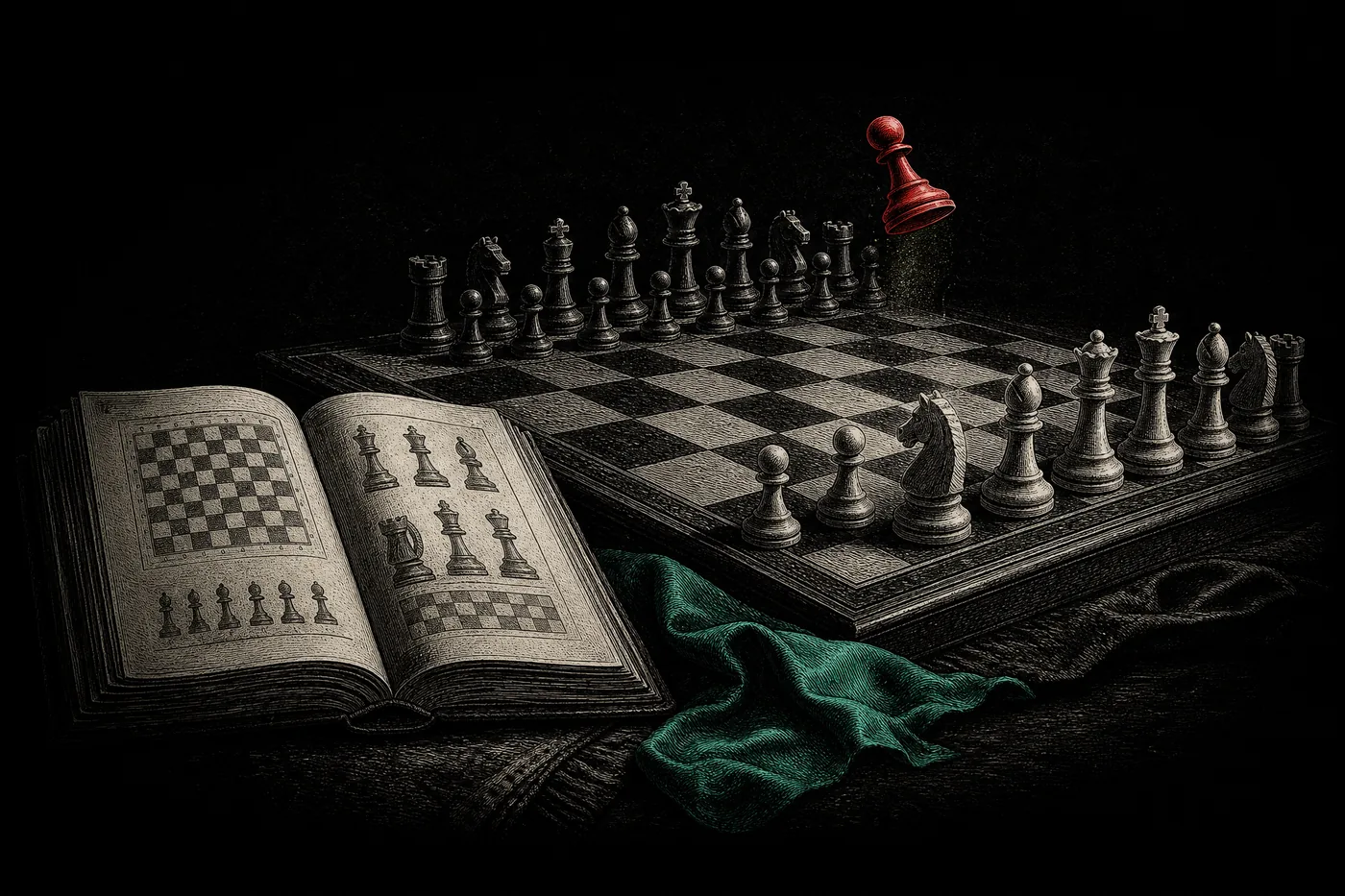
Checkmate is the move that wins a game of chess. It happens when a player’s king is in check and there is no legal move to escape it — the king can’t run, the attack can’t be blocked, and the attacker can’t be captured. The game ends instantly. No more moves, no take-backs, no comeback.
In short: checkmate is just a check with the doors locked. Let’s break down exactly how it works and how to recognize it on the board.
The 10-second version
- Checkmate = king in check + zero legal escapes.
- The three normal escapes (move, block, capture) are all unavailable.
- The king is never actually captured — the game ends the instant escape becomes impossible.
- Deliver checkmate and you win, no matter how much material is left.
How does checkmate actually work?
Remember the three ways out of check? You can move the king, block the attack, or capture the attacker. Checkmate is simply the situation where none of those three work:
- Every square the king could flee to is also attacked (or blocked by its own pieces).
- There’s no piece you can throw in the way to block.
- You can’t capture the checking piece (or capturing it would still leave you in check).
When all three doors slam shut at once, that’s mate. The king is cornered, the game’s decided, and you’ve won.
Here’s the key mental shift for beginners: checkmate isn’t about taking the king. You never literally capture it. The instant a player has no legal way to save the king, the game is over by rule. The king dies of “no escape,” not of capture.
What does a checkmate look like?
The cleanest example for beginners is the famous back-rank mate — and it punishes the exact mistake new players make most.
White plays the rook to a8. The black king is in check from the rook along the back rank (the 8th rank). Can it escape? Let’s run the checklist: it can’t move forward to f7, g7, or h7 because its own pawns are sitting there. It can’t capture the rook (too far). And there’s no Black piece available to block. Three doors, all locked. Checkmate. Those three friendly pawns that felt so safe just became prison bars — which is exactly why experienced players make “luft” (a little escape hole for the king) by nudging a pawn forward.
What’s the fastest possible checkmate?
Meet Fool’s Mate — checkmate in just two moves, the fastest possible in all of chess. It only happens if White plays catastrophically, but it’s a perfect illustration of mate.
White carelessly pushed the f- and g-pawns, opening a highway straight to the king. Black’s queen swooped to h4 — check! Now look: the white king on e1 has no safe square, nothing can block the diagonal, and nothing can take the queen. Game over in two moves flat. The lesson burned into every beginner’s memory: don’t fling the pawns in front of your king for no reason.
A close cousin is Scholar’s Mate, the four-move “beginner trap” that targets the weak f7 square:
The queen lands on f7 with check, protected by the bishop on c4 — so the king can’t capture it. And it has nowhere else to go. Checkmate. Knowing this pattern means nobody ever pulls it on you twice.
Checkmate vs check vs stalemate: don’t mix these up
This is the most important distinction for any beginner, so let’s nail it:
| Situation | King in check? | Legal moves available? | Result |
|---|---|---|---|
| Check | Yes | Yes (at least one) | Game continues |
| Checkmate | Yes | No | Attacker wins |
| Stalemate | No | No | Draw |
See the trap? Checkmate and stalemate both mean “no legal moves” — but one is a win and the other is a draw. The only difference is whether the king is currently in check. In check with no moves = you lose. Not in check with no moves = it’s a draw. Get this backwards in a winning position and you can throw away a whole game, which is exactly how stalemate breaks beginners’ hearts.
Why does checkmate matter? (It’s literally the goal)
Everything in chess points toward this moment. You’re not trying to capture the most pieces or control the most squares for their own sake — those are just tools to corner the enemy king. Capturing material, controlling the center, castling for king safety: all of it is in service of eventually delivering mate (or being so far ahead your opponent resigns).
That’s also why protecting your own king is non-negotiable. The whole game is a race to mate, so king safety is your defense in that race. Castle early, keep your king tucked away, and watch your back rank.
Do you have to announce checkmate?
Nope. Just like with check, you’re not required to say “checkmate” under the official FIDE rules. When mate hits the board, the game is simply over — the position decides it. Saying “checkmate” is a friendly tradition (and admittedly very satisfying), but it carries no legal weight.
Common mistakes to dodge
- Confusing mate with stalemate. The classic blunder: you’re crushing your opponent, you go for the kill, and you accidentally leave them with no legal moves while not in check — instant draw. Always give a trapped king at least one square unless you’re delivering actual mate.
- The back-rank trap. Leaving your king boxed in by its own pawns with no escape hole. Make a little air for your king once the queens come off.
- “Walking into” a defended check. Trying to capture a checking piece that’s protected — your king can’t legally take it. Check whether the attacker has a bodyguard.
- Assuming any check is mate. Most checks are easily escaped. Before you celebrate, confirm the king truly has no legal move.
Key takeaways
- Checkmate = king in check with no legal escape. It ends the game and wins it.
- The three escapes from check (move, block, capture) are all impossible in mate.
- The king is never captured — the game ends the moment escape becomes impossible.
- Checkmate (win) and stalemate (draw) both mean “no legal moves.” The difference is whether the king is in check.
- Watch your back rank and king safety to avoid getting mated yourself.
Keep climbing
You now know the move that wins chess. Make sure you also know the move that accidentally draws it — stalemate — and brush up on the warning shot that leads to mate.
Next up: What is stalemate? · Also essential: what is check and why king safety wins games.
Written and fact-checked by the Chess Lab Academy Editorial Team (AI-assisted, human-edited) · Rules verified against the FIDE Laws of Chess and every position checked with Stockfish 17 · Last verified 2026-06-25 · Sources · How we verify content.
