

Controlling the center in chess means owning the four squares in the middle of the board — e4, d4, e5, and d5 — usually by planting pawns there and aiming your pieces at them. It matters because pieces in the center reach far more squares and can swing to either side of the board. Center control is the foundation of nearly every good opening.
Let’s see exactly which squares count, why they’re so valuable, and the two different ways to grab them.
Center control in a nutshell
- The center = e4, d4, e5, d5 (the four middle squares).
- Pieces in the center are stronger — a knight there hits up to 8 squares vs. 2 in the corner.
- Best first moves: 1. e4 or 1. d4 (push a center pawn).
- Two ways to control it: occupy with pawns, or attack it from afar with pieces.
- Don’t over-extend — a center you can’t defend just becomes a target.
What are the center squares?
The board has 64 squares, but four of them are VIPs: e4, d4, e5, and d5 — the little 2x2 block right in the middle. Some players also count the ring around them (the “extended center,” c3 through f6), but those four are the real prize.
Why these four and not, say, the corners? Because they’re the crossroads of the board. Whatever stands there touches both halves of the battlefield at once.
Why does controlling the center matter so much?
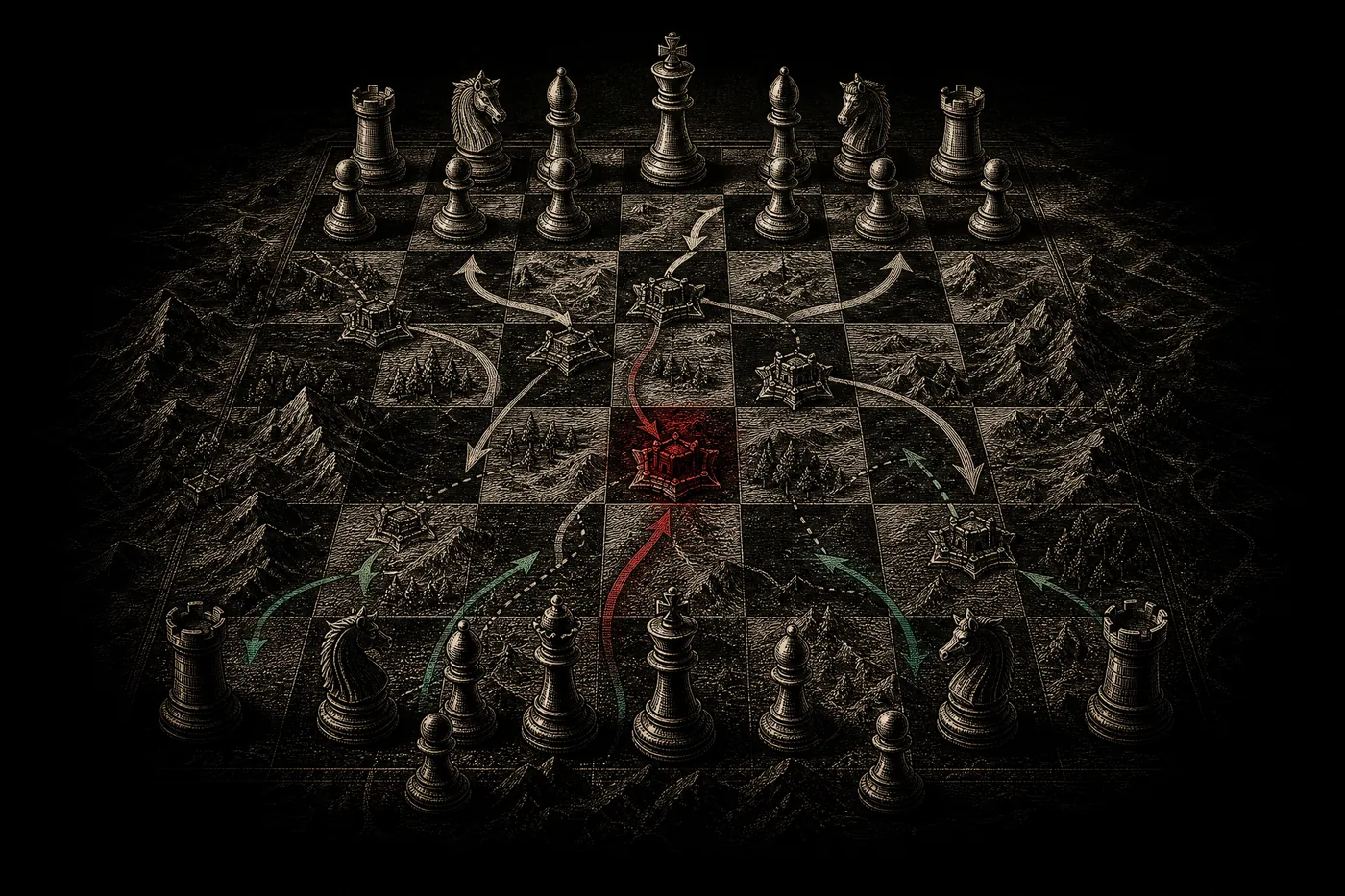
Here’s the mental image that makes it click: the center is the high ground. An army that holds the hilltop sees everything and can strike in any direction; an army stuck in the valley reacts to whatever comes.
Concretely, center control gives you three things:
- Mobility. A knight on e4 reaches up to eight squares. The same knight shoved into the corner on a1 reaches two. Centralized pieces are simply worth more because they do more.
- Flexibility. From the middle, your pieces can rush to the kingside or queenside in a move or two. You can attack wherever your opponent is weakest.
- Space. Pawns in the center push the enemy back, cramping their pieces so they trip over each other. Cramped opponents make mistakes.
This is the bedrock of opening principles — and the reason 1. e4 and 1. d4 are the two most popular opening moves in the world. Both instantly stake a claim in the middle.
How do I actually control the center?
There are two legit styles, and good players mix them.
Way 1: Occupy it with pawns
The direct approach — plant pawns on the central squares and dare your opponent to challenge them. A pawn duo on d4 and e4 is a textbook “big center” that hogs space and cramps the other side.
Pawns are perfect occupiers because they’re cheap (worth only 1 point), so the enemy can’t easily trade a valuable piece to remove them. A wall of central pawns is annoying to deal with.
Way 2: Control it from a distance
The modern, sneaky approach — don’t stand in the center, aim at it. You let your opponent build a big pawn center, then attack it with pieces and pawns from the flanks until it cracks.
Both styles work. As a beginner, start with the simple occupy-it-with-pawns approach — push a center pawn, develop toward the middle, and you’re already doing it right. The fancy “hold back and counterattack” stuff comes later.
How does center control help me win?
Center control isn’t a goal in itself — it’s a launchpad. Here’s the chain reaction it sets off:
- Pawns in the center open lines for your bishops and queen to develop quickly.
- Centralized pieces coordinate better, so your attacks hit harder.
- Controlling the middle lets you shift forces to whichever wing your opponent castled to.
- A cramped opponent runs out of good squares and blunders under the pressure.
In short, good center control means your pieces are better than your opponent’s pieces — and better pieces win games. It pairs directly with fast piece development, since the two go hand in hand: you develop pieces toward the center, and a strong center supports your developed pieces.
A fun bit of history
For a long time, everyone agreed: you must jam pawns into the center, end of story. Then in the early 1900s a group of rebels — the “Hypermoderns,” led by players like Aron Nimzowitsch and Richard Réti — flipped the script. They argued you could let your opponent build a giant pawn center on purpose, then blow it up with pieces from the sides. It looked crazy. It also worked, and openings born from that idea (like the King’s Indian and the Réti) are mainstays today. The takeaway: there’s more than one way to own the middle.
Common mistakes to dodge
- Ignoring the center entirely. Pushing edge pawns or developing toward the rim leaves the middle to your opponent — and the high ground decides battles.
- Over-extending your center. A pawn duo you can’t defend isn’t a fortress; it’s a buffet. If your central pawns get attacked more times than they’re defended, they fall.
- Blocking your own center. Putting a knight or bishop in front of an undeveloped center pawn jams everything up. Let your center pawns breathe.
- Trading your good center away for nothing. Don’t swap off a strong central pawn just because you can. Keep the space advantage if it’s working for you.
Key takeaways
- Controlling the center in chess means owning e4, d4, e5, and d5 — the four middle squares.
- The center is the high ground: centralized pieces reach more squares and can attack either wing.
- Push a center pawn (1. e4 or 1. d4) and develop toward the middle to grab it.
- You can occupy the center with pawns or control it from afar with pieces — both are valid.
- Don’t over-extend: a center you can’t defend becomes a target.
Frequently asked questions
What are the center squares in chess? The four central squares are e4, d4, e5, and d5 — the 2x2 block in the middle of the board. The ring around them (c3–f6) is sometimes called the “extended center,” but those four are the most valuable.
Why is controlling the center important? Because centralized pieces reach far more squares and can swing to either side of the board fast. Controlling the center gives you mobility, flexibility, and space, which translate into better-coordinated, more dangerous pieces.
What’s the best first move to control the center? 1. e4 and 1. d4 are the two best — each plants a pawn in the center and opens lines for your pieces. As Black, respond with …e5, …d5, or …c5 to fight for your share of the middle.
Do I have to put pawns in the center? No. You can also control the center “from a distance” by aiming pieces and flank pawns at it (the hypermodern style). For beginners, though, occupying with a central pawn is the simplest, most reliable approach.
Can my center be too big? Yes. An over-extended center — pawns pushed far forward without enough support — becomes a target. If your central pawns are attacked more often than they’re defended, they’ll fall and leave holes. Build a center you can actually hold.
How does center control connect to development? Tightly. You develop your pieces toward the center, and a strong center supports those pieces. Pushing a central pawn also opens lines so your bishops and queen can come out. They reinforce each other every move.
Keep climbing
You’ve claimed the high ground. Now get your army up there — the natural next step is learning to develop your pieces quickly and toward the middle.
Next up: Developing your pieces · Also great: basic strategy, how the pieces move, and opening principles. Back to the hub: Learn chess.
Written and fact-checked by the Chess Lab Academy Editorial Team (AI-assisted, human-edited) · Positions verified with Stockfish 17 and rules checked against the FIDE Laws of Chess · Last verified 2026-06-25 · Sources · How we verify content.
