
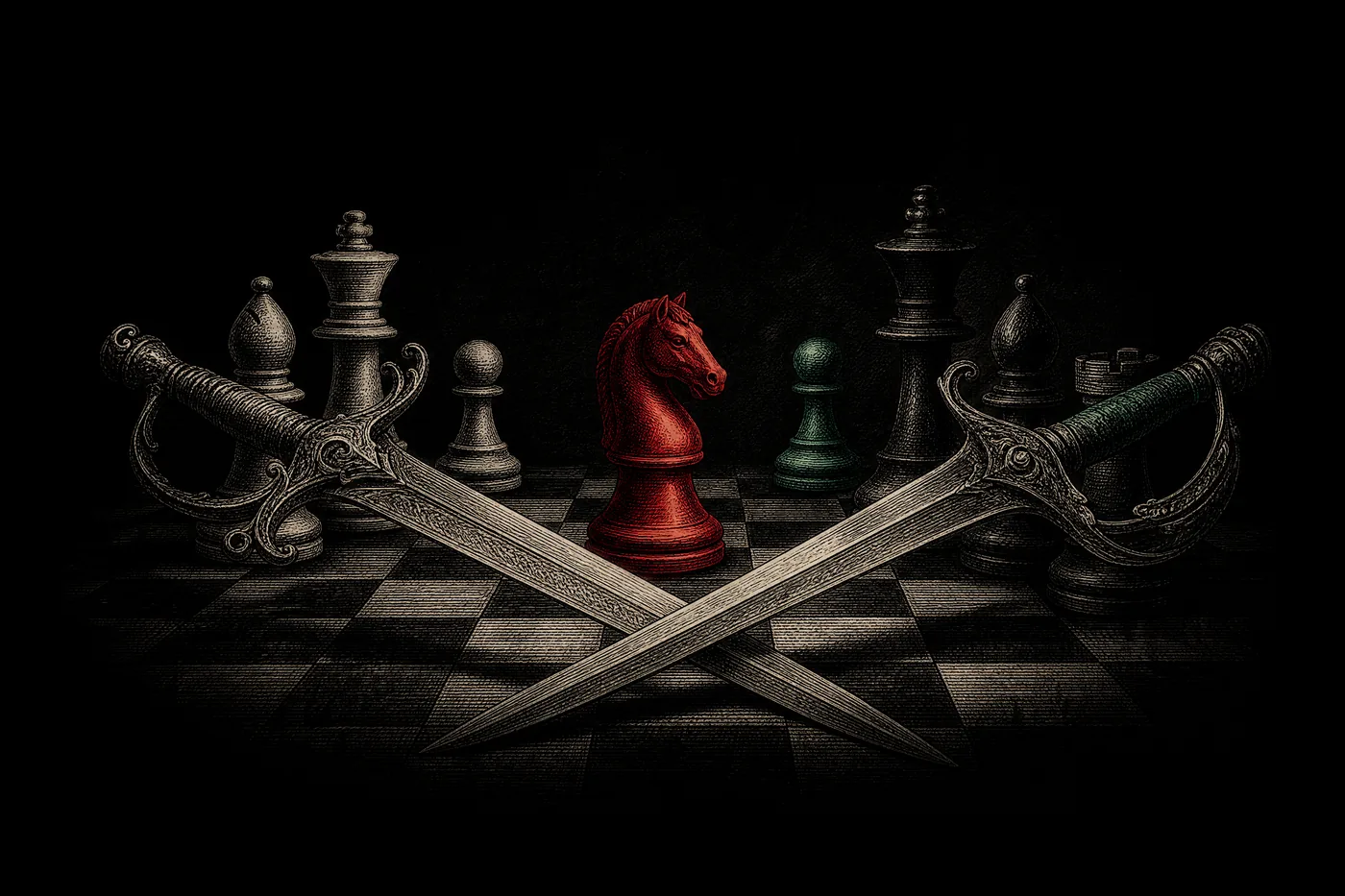
A discovered attack is when you move one piece out of the way and the piece behind it suddenly attacks something — so you get two threats from a single move. Think of it like opening a curtain: the piece you move makes its own threat, while the long-range attacker hiding behind it (a bishop, rook, or queen) is finally unleashed on a target. One move, two punches.
It’s one of the deadliest tactics in chess precisely because your opponent often only sees the piece that moved — and completely misses the silent killer that was lurking the whole time.
The 10-second version
- A discovered attack needs a back piece (long-range: rook, bishop, queen), a front piece sitting in front of it, and a target on that line.
- When the front piece moves, the back piece’s attack is “discovered.”
- The moving piece can also make a threat — that’s the two-for-one.
- If the discovered attack is a check, it’s nearly impossible to escape, because your opponent must answer the check first and can’t save the other piece.
How does a discovered attack actually work?
Every discovered attack has three ingredients lined up on a single line — a file, a rank, or a diagonal:
- The hidden attacker (the “back” piece). This is a rook, bishop, or queen — something that attacks along a line. It’s the gun.
- The blocker (the “front” piece). It’s standing right in front of the gun, plugging the barrel. This is the piece you’ll move.
- The target. The enemy piece (or king) sitting at the far end of that line, about to get hit the instant the blocker steps aside.
The magic is that the blocker doesn’t just clear the line — it goes off and does its own thing, like capturing a piece or threatening a fork. So your opponent faces two problems at once and usually can only solve one.
Look at the position above. White’s bishop on b2 is aimed straight down the long diagonal at Black’s king on g7 — but the knight on e5 is in the way, blocking the line. Now watch: Nc6. The knight steps aside, the bishop’s check is discovered on the king, and the knight simultaneously attacks the black queen on d8. Black has to deal with the check (it’s not optional — you must respond to check). And while Black is busy saving the king, White scoops up the queen.
That’s a clean win of a whole queen for nothing. The opponent never got a say — that’s the brutal beauty of a discovered check.
What’s a discovered check (and why is it so nasty)?
A discovered check is a discovered attack where the unmasked piece gives check. It’s the scariest version because check is a forced response: your opponent must address it immediately and legally has no time to rescue whatever your moving piece is attacking.
That means your front piece can do something outrageous — like grab the queen, or even hang itself somewhere — and it doesn’t matter, because the opponent is legally obligated to deal with the check first. Discovered check basically gives you a free move. Strong players treat “is there a discovered check here?” as one of the first questions in any sharp position.
What’s a double check?
A double check is the boss-level version: the moving piece and the discovered piece both give check at the same time. Now your opponent has two checks to deal with simultaneously — and here’s the kicker: you can’t block or capture your way out of a double check. Blocking one checking piece leaves the other still checking. Capturing one still leaves the other.
The only legal reply to a double check is to move the king. That’s it. This makes double checks the rocket fuel behind some of the most famous mating attacks in history — if the king has nowhere to run, it’s checkmate, no matter how many defenders are standing around uselessly.
How is a discovered attack different from a double attack?
People mix these up constantly, so let’s nail it down:
| Discovered attack | Double attack | |
|---|---|---|
| How many pieces attack? | Two pieces (the mover + the hidden one) | Usually one piece hitting two targets |
| The trick | Unmasking a hidden line | One piece attacking two things at once (like a fork) |
| Mental image | Opening a curtain | A two-pronged spear |
Both are “two threats at once,” which is why they get confused. The difference: a discovered attack uses two different pieces (one steps aside, one fires), while a classic double attack is usually one piece threatening two targets. A fork is the most famous double attack.
How do you set up a discovered attack?
You usually can’t just play one out of nowhere — you arrange the pieces first. Here’s the recipe:
- Get a long-range piece (rook, bishop, queen) pointed at a juicy target, even if the line is currently blocked.
- Notice your own piece sitting in the way. That blocker is your loaded spring.
- Find a move for the blocker that also threatens something — a capture, a fork, a check. The more your front piece threatens, the more painful the discovery.
- Spring it. The blocker leaves with a threat, the back piece fires, and your opponent can only stop one.
The dream scenario is when the discovered attack is a check and the moving piece grabs the biggest thing it can reach. Always ask: “If I move this piece, what does the piece behind it suddenly see?”
A bit of history
Discovered attacks have been wrecking opponents for centuries, but one of the most legendary examples is Réti vs. Tartakower, 1910 — a miniature where White unleashed a double check (Qd8+!! after a knight cleared the line) and forced a stunning quick mate. It’s still taught today as the gold standard of “the king has nowhere to hide.” Players have been chasing that same feeling — the hidden-piece-springs-to-life surprise — ever since the modern bishop and queen got their long-range powers back in the 1400s.
Common mistakes to dodge
- Only looking at the piece that moves. When your opponent moves a knight or pawn, ask what opened up behind it. Half of all discovered-attack victims simply never looked at the line.
- Forgetting it’s your turn to get hit, too. Discovered checks work both ways. Before you make a move, glance at whether you’re unblocking your opponent’s hidden attacker.
- Wasting the free tempo. With a discovered check, your moving piece gets a “free” action — don’t move it somewhere boring. Grab the most valuable thing it can reach.
- Confusing it with a pin. A pin freezes a piece in place; a discovered attack unfreezes yours to deadly effect. They’re cousins, not twins.
Key takeaways
- A discovered attack unmasks a hidden long-range piece by moving the blocker in front of it — two threats from one move.
- A discovered check is especially deadly because check is forced, so the moving piece gets a “free” action like capturing the queen.
- A double check can only be answered by moving the king — no blocking, no capturing.
- It differs from a double attack (one piece, two targets) because it uses two pieces.
- To set one up: aim a long-range piece at a target, then find a blocker move that also threatens something.
Keep climbing
Discovered attacks are one branch of the big “two threats at once” family. The other major branch is the double attack — and the most famous double attack of all is the fork.
Next up: What is a double attack? · Also essential: the fork, the pin, and the skewer. New to tactics overall? Start at the tactics hub.
Written and fact-checked by the Chess Lab Academy Editorial Team (AI-assisted, human-edited) · Every position verified with Stockfish 17 and rules checked against the FIDE Laws of Chess · Last verified 2026-06-25 · Sources · How we verify content.
