
A chess endgame is the final phase of the game, when most pieces have been traded off and only a handful remain — usually kings, a few pawns, and maybe a rook or queen. With the board nearly empty, the king stops hiding and becomes a fighting piece, pawns race to promote, and tiny details decide everything. It’s where games are won and lost.
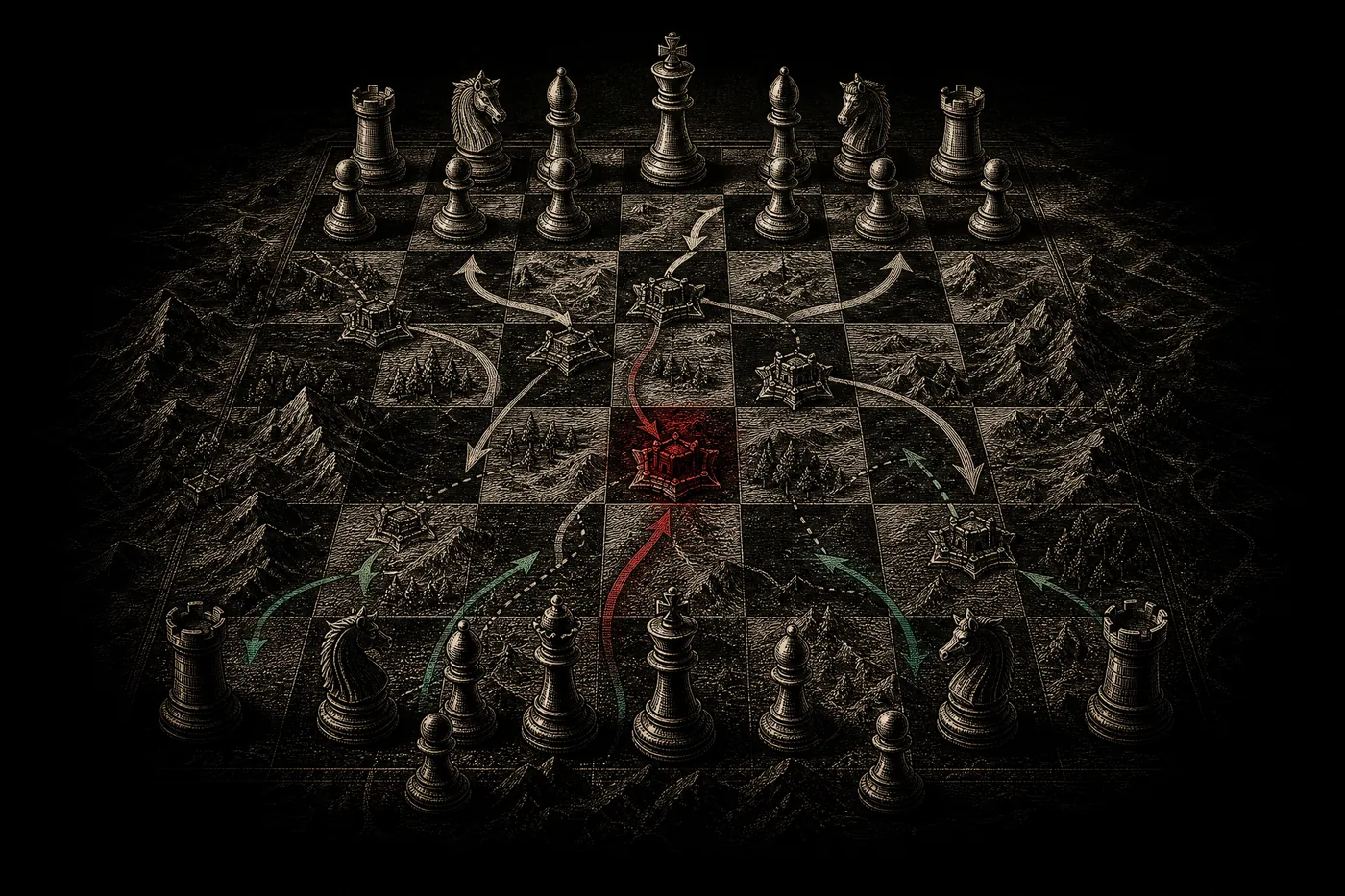
This page is your map. Below you’ll find the must-know endings, what order to learn them in, and a one-click path to each lesson.
The 30-second version
- Endgame = the last phase, few pieces left, kings get active.
- Learn the basic checkmates first (queen, rook, two bishops, bishop+knight).
- Then learn king-and-pawn endings — opposition is the key idea.
- Small things (one tempo, one square) win or draw whole games here.
What is the endgame in chess?
Chess has three loose phases: the opening (developing pieces, castling), the middlegame (the big fight, tactics flying everywhere), and the endgame (the cleanup, when the dust settles and few pieces remain).
There’s no exact move number where the endgame “starts” — it’s about what’s left on the board. The rough signal: most of the heavy hitters are gone, queens are often off, and suddenly your king — which spent the whole game cowering in the corner — can march into the middle and start bossing pawns around. That role reversal is the heartbeat of endgame play.
Endgames feel intimidating because the board looks empty and there’s “nothing to attack.” But that emptiness is exactly what makes them learnable — there are fewer possibilities, so the right moves follow clear, repeatable patterns. Master a handful of patterns and you’ll convert wins your opponents fumble.
What endgames should beginners learn first?
Here’s the climbing order we recommend. Each link is a full lesson:
- Why endgames matter — the motivation. Read this if you’ve ever thought “I’ll just learn endgames later.”
- Basic checkmates you must know — the overview of every fundamental mate.
- King & queen vs king — the friendliest forced mate; learn the box method.
- King & rook vs king — slightly trickier; learn the “staircase.”
- The opposition — the single most important king-and-pawn idea.
- King and pawn endgames — where opposition pays off: turning one extra pawn into a queen.
- Two bishops checkmate and bishop & knight checkmate — the advanced (and famously hard) mates, for when you want to flex.
Don’t try to swallow it all at once. Nail the queen mate, then the rook mate, then opposition. Those three alone will win you more games than any opening trick.
Why are endgames so important?
Because most games between beginners are still close when the queens come off — and the player who actually knows how to finish walks away with the point. You can play a shaky opening and a messy middlegame, but if you can convert a winning endgame cleanly, you win.
The flip side hurts: countless beginners reach a totally winning king-and-rook ending, can’t deliver the mate, and stumble into a draw (or even lose on time). We’ve got a whole page on this — see why endgames matter — but the short version is: endgame skill is the highest-return study you can do as a beginner.
What’s the most important endgame skill?
If we could hand you one idea, it’d be king activity. In the opening you protect your king like it’s made of glass. In the endgame you do the opposite — you shove it forward into the action. A centralized king in an endgame is worth roughly a minor piece’s worth of influence.
The second idea is the opposition: a king face-off (one square between them) where whoever does not have to move wins the standoff. It’s the engine behind almost every king-and-pawn win. We cover it fully on the opposition page.
A fun bit of history
Endgame theory is genuinely ancient. The earliest chess writers — going back to medieval manuscripts and the 1500s Spanish and Italian masters — obsessed over basic mates and pawn endings precisely because that’s where games were decided. Centuries later, the great José Raúl Capablanca famously taught chess backwards: he insisted students learn endgames first, before openings, arguing you can’t understand what the pieces are worth until you’ve seen them in a near-empty board. Modern coaches still swear by it.
Common mistakes to dodge
- Skipping endgames to memorize openings. Openings get you to a playable middlegame; endgames win the point. Beginners have this backwards.
- Keeping your king passive. In the endgame, a king hiding in the corner is a wasted piece. March it toward the center.
- Rushing the checkmate and stalemating. The classic heartbreak — see what is stalemate. When you’re up material, always check the enemy king still has a move before you give check.
- Trading into a “winning” endgame you don’t know how to win. Up a piece? Great — but make sure you can actually deliver the mate before you simplify.
Key takeaways
- The endgame is the final phase: few pieces, active kings, pawns racing to promote.
- Learn the basic checkmates first, then opposition, then king-and-pawn endings.
- King activity and the opposition are the two highest-value ideas in all of endgame play.
- Endgame skill is the best bang-for-buck study for any beginner — it directly converts to wins.
Keep climbing
You’ve got the map — now pick a trail. The natural first step is understanding why this stuff is worth your time.
Start here: Why endgames matter (even for beginners) · Then learn the basic checkmates and the opposition.
Written and fact-checked by the Chess Lab Academy Editorial Team (AI-assisted, human-edited) · Positions verified with Stockfish 17 and rules checked against the FIDE Laws of Chess · Last verified 2026-06-25 · Sources · How we verify content.
