
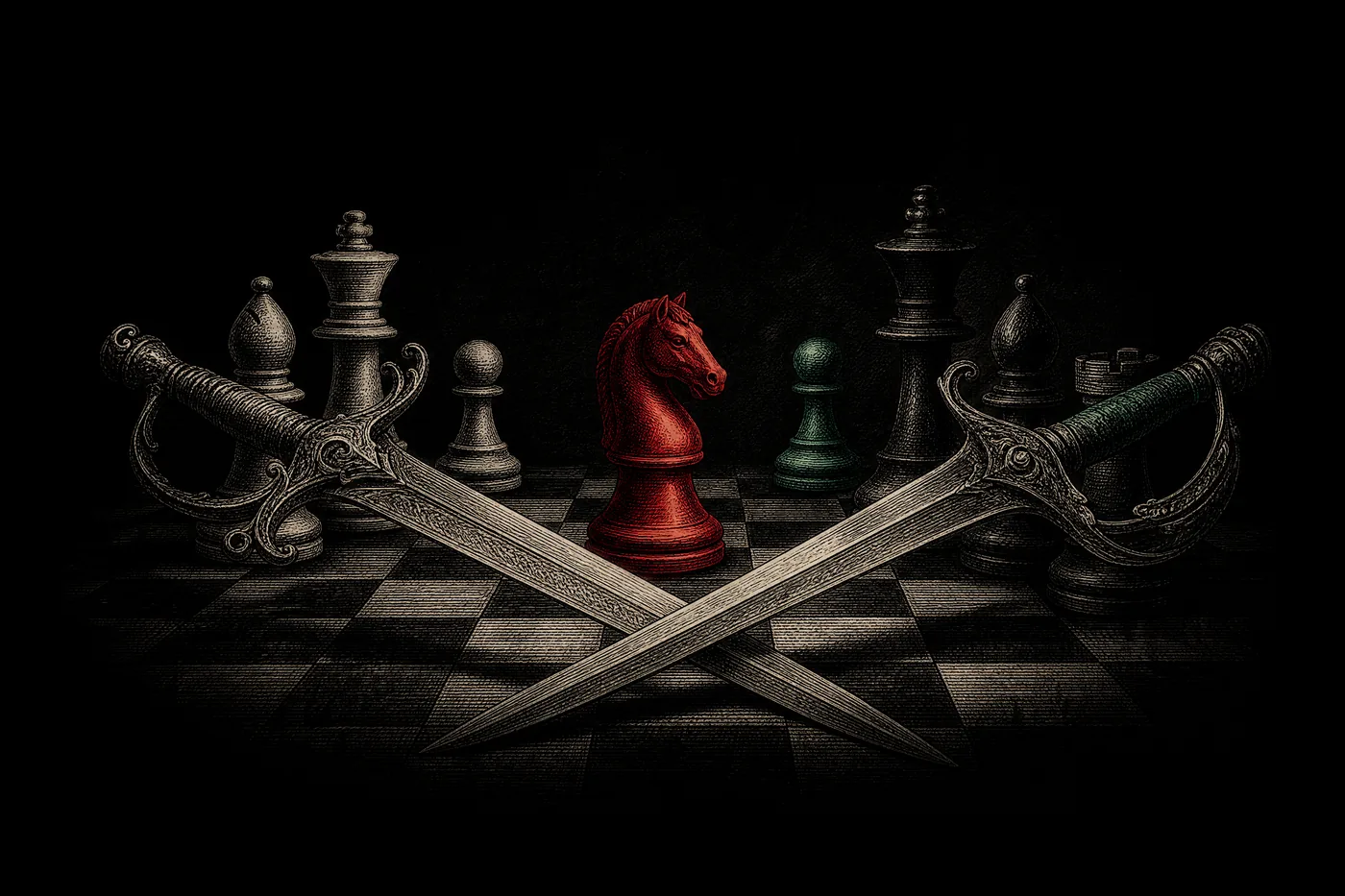
A fork in chess is a single move where one piece attacks two (or more) enemy pieces at the same time. Your opponent can only rescue one — so you grab the other for free. The knight is the most feared forker because it hits in eight directions at once, but pawns, bishops, rooks, and queens all fork too. It’s the simplest tactic and the deadliest at the beginner level.
Let’s break down how forks work, the famous knight forks (including the “royal fork”), and exactly how to dodge them.
The 10-second version
- A fork = one piece attacking two-plus enemy targets in one move.
- The opponent saves one target; you win the other.
- Knights fork best — they leap over everything and attack in all directions.
- A fork that includes a check is the strongest, because the king must respond first.
How does a fork actually work?
The magic of a fork is the double attack: you create two threats with one move, and your opponent only gets one move to answer. They can’t defend both, so something has to fall.
The most lethal forks include a check, because a check isn’t a suggestion — your opponent is forced to deal with the king first. While they’re busy saving the king, you swipe the other forked piece. Watch this:
White plays Nf6+. The knight checks the king on g8 and attacks the queen on e8. Black’s only sensible reply is to move the king out of check — and the moment they do, Nxe8 snaffles the queen. When a knight forks the king and queen like this, players call it the royal fork. (If it forks the king, queen, and a rook, it earns the nickname family fork — it nabs the whole family.)
Why is the knight the best forking piece?
Because of how it moves. The knight jumps in an L-shape and lands on squares no other piece covers — and from a central square it can attack up to eight squares at once, none of them in a straight line. That weird geometry is exactly what makes forks easy: it can hit a king and a rook that are nowhere near each other, and there’s no way to “block” a knight’s attack the way you’d block a bishop or rook.
There’s a bonus cruelty, too: the knight is worth only about three points. So when a knight forks your queen and king, you’re forced to let the knight take the queen — trading your most powerful piece’s life for a measly horse. Brutal. (If forks aren’t clicking yet, it’s worth nailing down exactly how the knight moves first — it’s the foundation.)
Can pieces other than knights fork?
Absolutely — any piece can fork. The double-attack idea works for everyone:
- Pawns make sneaky, cheap forks. A pawn attacks two diagonal squares, so if two enemy pieces sit on them, the lowly pawn forks both — and you can’t capture the pawn with a piece worth more without losing the exchange.
- Bishops and rooks fork along their lines — a rook on an open rank can hit two loose pieces; a bishop can skewer two on a diagonal.
- The queen is a forking monster because it moves like a rook and a bishop. The catch: the queen is so valuable that it can only safely fork undefended pieces — fork a defended one and it just gets captured.
Here’s the humblest fork of all, by a single pawn:
The e5-pawn attacks both d6 (the knight) and f6 (the bishop). Black can only move one to safety, and the pawn — worth a single point — happily takes a three-point minor piece. That’s the dream: maximum damage, minimum investment.
How do you defend against a fork?
Forks feel unfair when they hit you, but they’re very preventable. Your defensive toolkit:
- Don’t let your pieces line up on forkable squares. Most forks need two of your pieces a knight’s-move apart, or on the same line. Keep them spread out and well-defended.
- Watch the knight’s reach. Before you move, glance at every square an enemy knight could jump to next. If a hop would hit two of your pieces, you’ve spotted the fork before it lands.
- Defend the fork target. If a fork wins a defended piece, the forking piece may just get captured back. A guarded piece is a safe piece.
- Capture or chase the forker. Sometimes you can take the forking piece outright, or kick it away with a pawn before it does damage.
- Spot it a move early. The best defense is foresight. Run your CCT scan — Checks, Captures, Threats — and you’ll catch forks in the planning stage.
A fun bit of fork history
The knight fork is so iconic it’s got nicknames in just about every chess culture. English speakers say “royal fork” (king + queen) and “family fork” (king, queen, and rook all at once). The Italian tradition called a knight’s double attack a forchetta — literally “little fork,” the same word you’d use at dinner. The image is perfect: the knight skewers two pieces like a fork spearing two olives. Once you’ve lost a queen to a single horse, trust us — you’ll never forget to check the knight’s squares again.
Common fork mistakes to dodge
- Lining up king and queen near an enemy knight. Classic royal-fork bait. Keep them apart, especially when a knight is roaming.
- Forgetting pawns fork too. Players watch the knights and queens and get clipped by a pawn push they never considered.
- Forking a defended piece with your queen. If the target is guarded, your queen just trades down. Only fork what you can actually win.
- Missing your own fork. Half of fork training is offensive — always ask, “can any of my pieces hit two things at once?”
Key takeaways
- A fork in chess is one move that attacks two or more enemy pieces at once — they save one, you take the other.
- The knight is the deadliest forker thanks to its eight-direction, unblockable jumps.
- A fork with a check is strongest — the king must move first, so the other target is doomed.
- Royal fork = king + queen; family fork = king + queen + rook.
- Defend by keeping pieces spread out, defended, and off the knight’s landing squares — and always scan ahead.
Keep climbing
The fork is the first member of the tactics family — next, meet its relatives.
Next up: What is a pin in chess? and its evil twin, the skewer · Drill it: fork puzzles · Brush up on how the knight moves · Back to the hub: chess tactics explained.
Written and fact-checked by the Chess Lab Academy Editorial Team (AI-assisted, human-edited) · Every position verified with Stockfish 17 and checked against the FIDE Laws of Chess · Last verified 2026-06-25 · Sources · How we verify content.
