

The Vienna Game is what you get after 1.e4 e5 2.Nc3 — one of the most underrated, fun openings in all of chess. White develops a knight toward the center and quietly prepares the punch f4, giving the whole thing a “delayed King’s Gambit” flavor. It looks calm, it stays flexible, and it can suddenly explode into a kingside attack. If you like aggressive chess but want it to be sound, the Vienna is your kind of opening.
The 30-second version
- Moves: 1.e4 e5 2.Nc3 · ECO: C25–C29 · You play it as: White.
- The idea: develop the knight, then crash in with f4 (a King’s Gambit you got to prepare).
- Two big personalities: the sharp Vienna Gambit (3.f4) and the quiet g3 fianchetto builds.
- Best for: attacking players who want a dangerous, low-traffic weapon that’s still fully sound.
Step through the line
Move by move — press Next to advance, Back to rewind.
The Vienna Game — White develops the knight and quietly prepares an f4 push.
What’s the big idea behind the Vienna Game?
The Vienna is sneaky. Move two, 2.Nc3, looks like the most boring developing move on the board — and that’s the point. It develops a piece, supports the e4-pawn, and keeps all of White’s options open. Then comes the twist: very often White wants to play f4, blasting open the f-file and challenging Black’s e5-pawn.
That’s why people call the Vienna a “delayed King’s Gambit.” In the King’s Gambit, White plays 2.f4 immediately and hangs a pawn. In the Vienna, White develops first with Nc3, and only then fires the f4 break — so the attack comes with a piece already out and the center better supported. It’s the romantic, attacking spirit of old-school chess, but with a safety net.
White’s whole game flows from two choices:
- Go for the throat with f4 (the Vienna Gambit), opening lines toward Black’s king.
- Build patiently with g3 and Bg2, fianchettoing the bishop for a slow, positional squeeze.
You get to pick the vibe every single game.
What are the main lines?
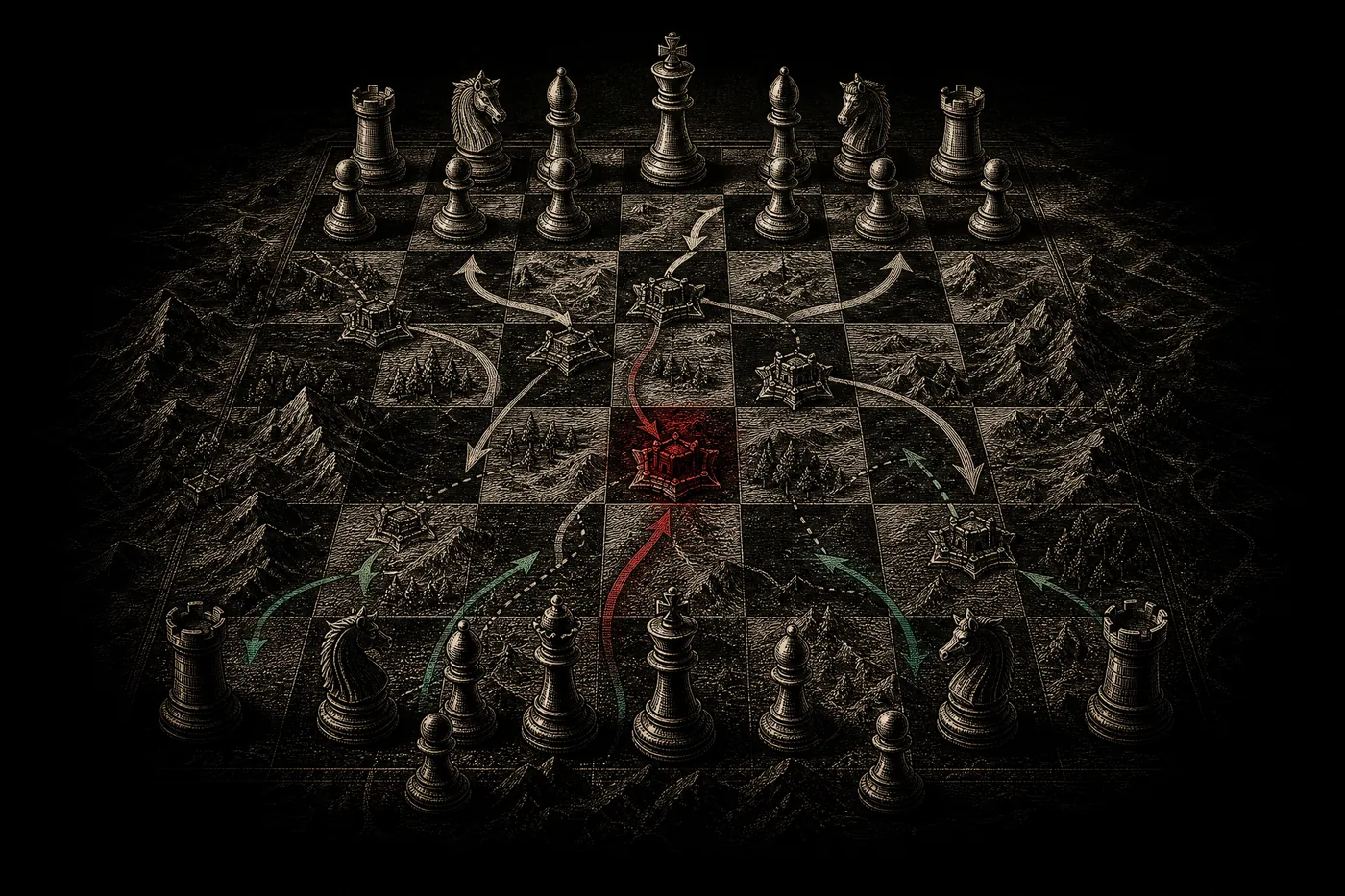
After 2.Nc3, the game branches based on what Black does and which plan White picks. Here’s the fork in the road — for the full menu, see our variations guide.
The Vienna Gambit (3.f4)
Against 2…Nf6, the most aggressive try is 3.f4 — the Vienna Gambit, hugely popular in online blitz. White offers the f-pawn to rip the center open.
Black’s best is the central counterpunch 3…d5!, and the main line runs 4.fxe5 Nxe4 with sharp, double-edged play. It’s tactical, fun, and dangerous for an unprepared opponent.
The quiet g3 fianchetto
Not in the mood for fireworks? Play 3.g3 and fianchetto the bishop to g2. This is a calm, modern, positional setup — White builds slowly, castles, and presses on the light squares.
The Bc4 lines and the Frankenstein–Dracula
White can also play 3.Bc4, aiming the bishop at f7 like in the Italian. This leads to one of chess’s most famously wild variations: after 3…Nxe4!?, the Frankenstein–Dracula Variation erupts — a genuinely crazy line where Black grabs a pawn and both sides go for broke. (We cover it in full on the variations and traps pages.)
What are the plans for both sides?
For White:
- Play f4 at the right moment to open lines and attack the king.
- Or fianchetto with g3, Bg2, 0-0 and press positionally on the light squares.
- Keep the knight on c3 active — it supports e4 and the d5 and b5 outposts.
For Black:
- The cleanest equalizer is 2…Nf6 followed by the freeing break …d5.
- Develop solidly with …Nc6, …Bc5 or …Bb4, castle, and challenge the center.
- Don’t grab gambit pawns greedily — return them for development when needed.
Strengths and weaknesses
Why you’ll love it:
- It’s a surprise weapon. Far fewer players know the Vienna than the Italian or Ruy Lopez, so opponents improvise.
- It’s flexible — play it as a wild gambit or a quiet positional build.
- It’s sound. Unlike some gambits, the Vienna holds up completely at club level and beyond.
The catch:
- A well-prepared Black plays …d5 and equalizes comfortably, especially against the gambit.
- The sharpest lines (Frankenstein–Dracula) require real homework.
Who plays the Vienna Game?
The Vienna has a rich attacking heritage — it was a favorite of 19th-century romantics in its namesake city, and Wilhelm Steinitz, the first world champion, played it on both sides. The Vienna Gambit in particular has had a massive online revival, popularized by streamers and content creators as a fun, aggressive way to play 1.e4. Even modern elites like Magnus Carlsen have dipped into Vienna setups for a fresh fight. It’s the opening you reach for when you want to play chess, not memorize 25 moves of theory.
A fun bit of history
The Vienna Game is named after the city of Vienna, the great 19th-century chess hub where it was analyzed and loved by the local masters. Its most famous game might be the Hamppe–Meitner “Immortal Draw” of 1872, where Black sacrificed nearly everything for a perpetual-check king hunt — pure romantic chaos. For a long time the Vienna was seen as a slightly offbeat sideline, overshadowed by the Italian and the Ruy Lopez. Then the internet rediscovered the Vienna Gambit, and suddenly this “old sideline” became one of the most-played attacking weapons in online chess. Underrated no more.
Is the Vienna Game right for you?
If you’re an attacking player who loves the idea of a King’s Gambit but wants something more solid, the Vienna is a dream. If you like positional chess, the g3 fianchetto gives you a calm, flexible build. It’s especially great as a surprise weapon, since most opponents have far less Vienna experience than Italian or Spanish experience. For the full honest verdict, see is the Vienna Game good?
Explore the Vienna Game
- Vienna Game: the main lines move by move
- Vienna Game variations (Gambit, g3, Frankenstein–Dracula & more)
- Vienna Game traps
- The Vienna Game for beginners
- Best Vienna Game master games
- How to beat the Vienna Game (as Black)
- Is the Vienna Game good?
Back to the full openings hub. Love the attacking style? Compare it with the King’s Gambit and the Italian Game.
FAQ
Is the Vienna Game good for beginners? Yes — it teaches good development and attacking ideas, and the move 2.Nc3 is dead simple to start with. The quiet g3 lines are especially forgiving. See our beginner’s guide.
Is the Vienna Game good for White or Black? It’s a White opening — White chooses it by playing 2.Nc3. Black then decides how to meet it (usually 2…Nf6 or 2…Nc6).
What’s the difference between the Vienna Game and the King’s Gambit? Both want to play f4, but the King’s Gambit plays 2.f4 immediately, while the Vienna develops with 2.Nc3 first and plays f4 later — a “delayed” King’s Gambit that’s better supported.
Is the Vienna Game aggressive or positional? It can be both! The Vienna Gambit (3.f4) is sharp and attacking; the g3 fianchetto lines are calm and positional. You choose the flavor.
What is the Frankenstein–Dracula Variation? It’s a famously wild line after 1.e4 e5 2.Nc3 Nf6 3.Bc4 Nxe4!?, where Black grabs a pawn and both sides launch into chaos. We cover it on the variations page.
Keep climbing
New to openings in general? Start with the opening principles — the Vienna Game is those ideas (develop, control the center, attack the king) turned into an aggressive 1.e4 weapon.
Written and fact-checked by the Chess Lab Academy Editorial Team (AI-assisted, human-edited) · Lines checked against mainstream opening theory and verified with Stockfish 17 · ECO C25–C29 · Last verified 2026-06-25 · Sources · How we verify content.
