
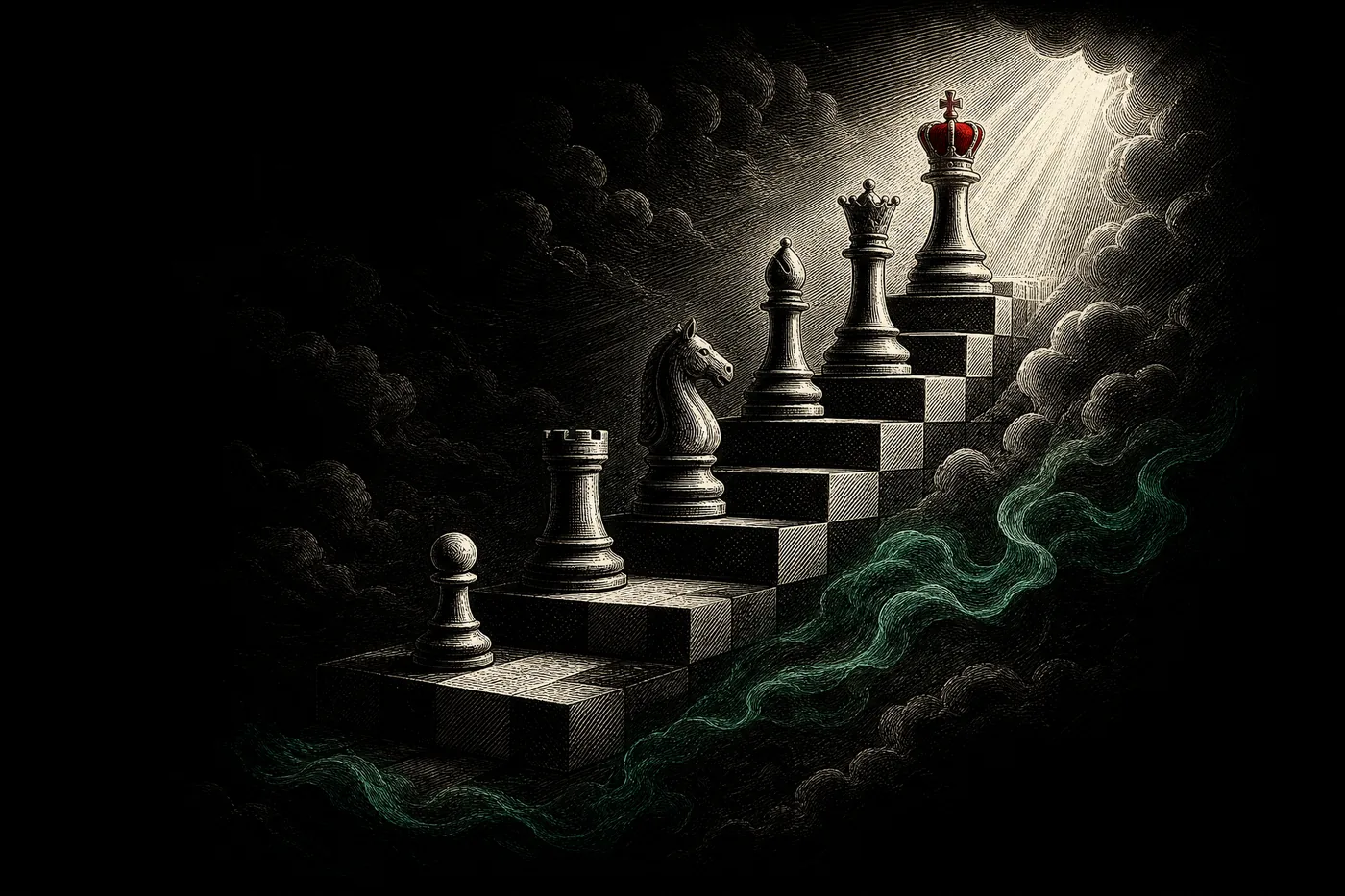
To climb from 1000 to 1200 Elo, you graduate from reacting to planning — and you stop throwing away winning endgames. Below 1000 you win by out-tacticking people. At 1000–1200, your opponents stop blundering as much, so games are decided by who has a plan and who can convert a small edge into a full point. Add real endgame technique — starting with the opposition — and 1200 is yours.
This is where chess starts feeling less like whack-a-mole and more like strategy.
The 10001200 cheat sheet
- Weeks 1–2: Learn to make a plan — target weak pawns and weak squares.
- Weeks 3–4: Drill king-and-pawn endgames (opposition + key squares).
- Ongoing: Keep solving tactics — they never stop mattering.
- Every position: Ask “what’s my opponent’s weakness, and how do I attack it?”
What separates 1000 from 1200?
At 1000, you mostly move based on what’s right in front of you. At 1200, you move with a purpose that spans several moves — “I’m going to pile up on that weak pawn” or “I’ll trade into a winning king-and-pawn endgame.” That’s a plan, and having one (even a simple one) puts you ahead of most opponents in this band who are still playing move-to-move.
The other big shift: at 1000, lots of games end in the middlegame because someone hangs a piece. At 1200, more games reach the endgame — and that’s exactly where 1000-rated players bleed points, by not knowing how to convert. Fix both and you climb.
The week-by-week plan to 1200
Weeks 1–2 — Learn to make a plan
A plan starts with finding a target. Scan the position and ask:
- Weak pawns — are any enemy pawns isolated (no friendly pawns beside them) or backward? Those can’t be defended by pawns, so you attack them with pieces.
- Weak squares — is there a square the enemy can never cover with a pawn? Plant a knight there; it becomes an immovable monster (an “outpost”).
- Open files — is there a column with no pawns? Put a rook on it.
Pick one target, aim your pieces at it, and you have a plan. It doesn’t need to be deep — it just needs to exist. Build the foundation with basic strategy and learn how the position type changes your plan in open vs closed positions.
Weeks 3–4 — Master the king-and-pawn endgame
This is the highest-value endgame study at your level, because king-and-pawn endings come up constantly and are exactly winnable or drawable with technique — no guessing. The key concept is the opposition.
When the kings stand directly facing each other with one square between, the side forced to move has to step aside — so the side that doesn’t have to move “has the opposition” and controls the dance. In the diagram, it’s White to move, so Black has the opposition and can hold White’s king back. Understanding this one idea decides a huge number of pawn endgames. Learn it properly in the opposition, and round out your finishing skill with basic checkmates so you never fumble a winning king-and-pawn race.
Ongoing — Never stop doing tactics
Even as you add strategy and endgames, keep solving puzzles. Tactics don’t stop mattering at 1200 — they decide more games than anything else, all the way up. A few a day, forever. Think of it as keeping your sword sharp.
How do you actually convert a winning position?
This is the skill that turns 1000 into 1200. When you’re ahead, the temptation is to attack and dazzle. Don’t. Simplify. The cleaner path is usually:
- Trade pieces (not pawns) to reduce the opponent’s counterplay. When you’re up material, fewer pieces on the board makes your advantage easier to steer.
- Activate your king in the endgame — it becomes a fighting piece once the queens are off.
- Push your extra pawn toward promotion, using the opposition and your king to escort it.
Boring wins are still wins. A clean, technical conversion beats a flashy attack that gives the opponent a chance to swindle you.
How do you spot a weak pawn or square?
Plans start with targets, so train your eye to find them. Three of the most common — and most attackable — weaknesses at 1000–1200:
- Isolated pawn. A pawn with no friendly pawns on either neighboring file. It can never be defended by a pawn, so it’s a magnet for your pieces. Pile a rook and a knight on it and watch your opponent tie themselves in knots defending it.
- Backward pawn. A pawn stuck behind its neighbors, unable to advance safely, sitting on a half-open file. Same idea — attack it with pieces, because pawns can’t help it.
- Hole / weak square. A square in the opponent’s camp that no enemy pawn can ever cover again. Drop a knight there (an outpost) and it becomes a permanent thorn — a piece they can’t kick away.
Here’s the mindset shift that defines this level: instead of asking “what’s a good move?”, ask “what’s my opponent’s weakest point, and how do I get my pieces pointed at it?” Once you have a target, good moves practically suggest themselves. You stop drifting and start steering.
And the flip side — protect your own weaknesses. If you’re about to create an isolated or backward pawn, ask whether the activity you get in return is worth it. Sometimes it is. But know what you’re trading.
A fun fact about the opposition
Top players think about the opposition so instinctively that whole grandmaster endgames are silent battles over a single square — kings shuffling back and forth, each trying to force the other to move first. It looks like nothing’s happening. In reality it’s a knife fight in a phone booth. The concept is ancient, too: endgame manuals from centuries ago already taught the opposition, because the underlying math of king-and-pawn play hasn’t changed since the modern rules settled. You’re learning a technique that’s outlived empires.
Common mistakes to dodge from 1000 to 1200
- Playing without a target. Wandering moves with no plan let your opponent take over. Always have one weakness in your sights.
- Resigning yourself to draws in won endgames. Most 1000s draw or lose winning endgames purely from not knowing the technique. Study them — it’s free rating.
- Trading pawns when you’re ahead. Up material? Trade pieces, keep pawns. Fewer pawns can let the opponent build a fortress.
- Forgetting the king in the endgame. Your king is a strong piece once the danger’s gone. March it into the action.
- Dropping tactics study. Strategy doesn’t replace tactics — it sits on top of them. Keep your puzzles going.
Key takeaways
- 1000 1200 is the jump from reacting to making plans and converting won positions.
- Find a target — a weak pawn, a weak square, an open file — and aim your pieces at it.
- Master king-and-pawn endgames, starting with the opposition; it’s pure, learnable rating.
- To convert a winning position: simplify, activate your king, and escort your extra pawn.
- Never stop doing tactics — they decide games at every level.
Keep climbing
Reaching 1200 means you’ve got the full beginner toolkit: clean play, sharp tactics, real plans, and solid endgame technique. From here, the climb is about deepening each of those — and there’s a whole game above waiting.
Where to go next: Revisit the improvement roadmap to see how far you’ve come · Sharpen your finishing with basic checkmates and the opposition · And if calculation ever wobbles, drop back to the 800–1000 plan.
Written and fact-checked by the Chess Lab Academy Editorial Team (AI-assisted, human-edited) · Positions verified with Stockfish 17, rules per the FIDE Laws of Chess · Last verified 2026-06-25 · Sources · How we verify content.
