
Chess tactics are short, forcing sequences of moves that win material or deliver checkmate — usually wrapped up in just one to three moves. They exploit a specific feature of the position right now: an undefended piece, two targets lined up, a trapped king. If strategy is the slow plan, tactics are the sudden knockout punch.
Let’s unpack what that really means, how tactics differ from strategy, and which patterns are worth learning first.
The 10-second version
- Tactic = a short, forcing move sequence that wins material or forces mate.
- Forcing means your opponent’s replies are limited — often to a single legal move.
- The starter pack: fork, pin, skewer, and basic checkmate patterns.
- Tactics are trainable through puzzles — they’re pure pattern recognition.
What does “tactic” actually mean in chess?
A tactic is a concrete, calculable shot. It works right now, in this position, because of how the pieces happen to be arranged. You can see it to the end: “I play this, they’re forced to play that, and I come out a piece up.”
The key word is forcing. Tactics lean on moves your opponent can’t ignore — checks, captures, and direct threats. A check is the most forcing move of all: your opponent must respond to it, which means you get to dictate the flow. String together a couple of forcing moves and you can march your opponent into a corner where they lose material no matter what they try.
Here’s a tactic doing its thing:
That’s a fork — one move, two targets. Black can only move the king out of check, and the queen is doomed. Forcing, concrete, and devastating. That’s a tactic in its purest form.
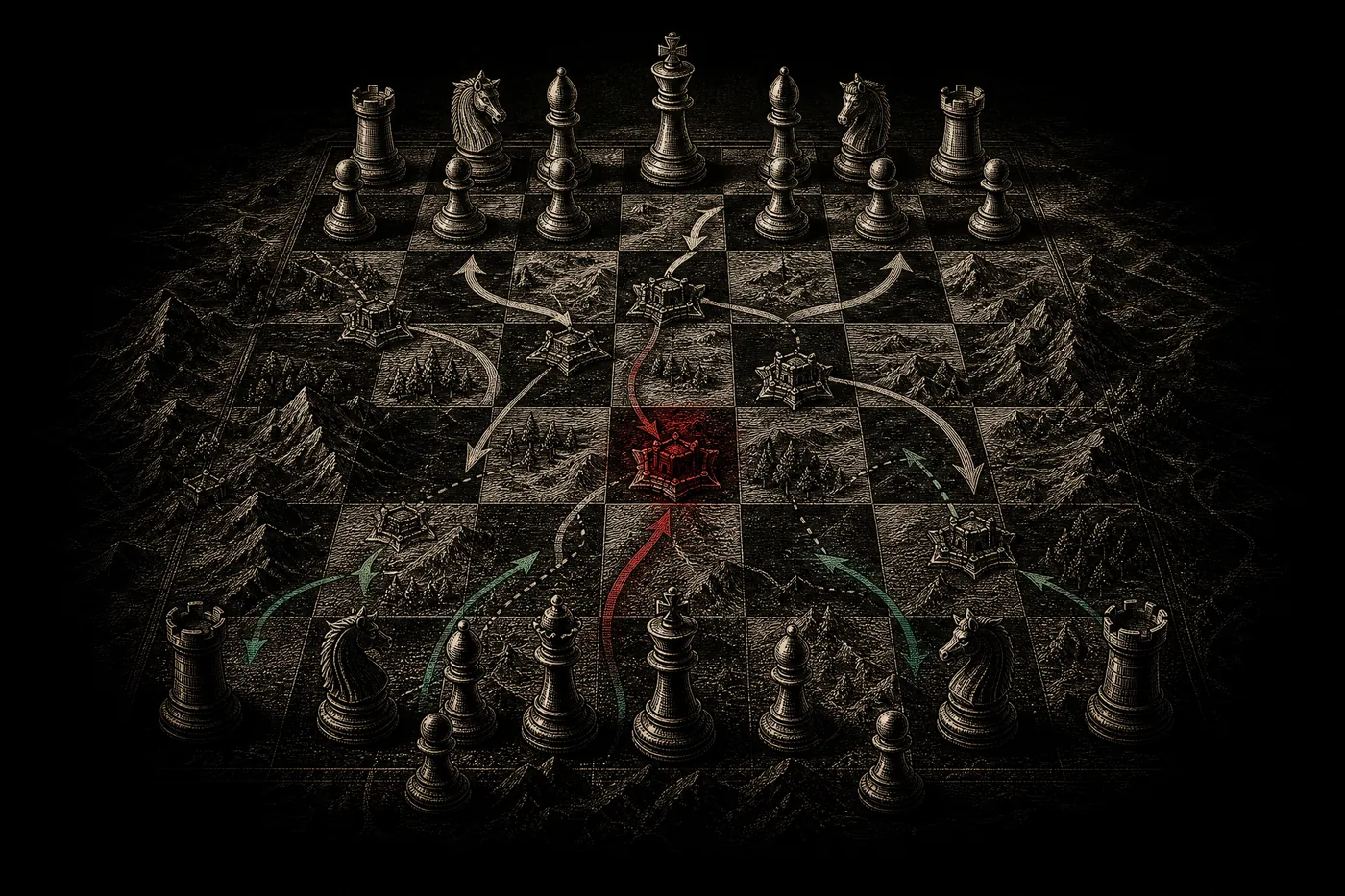
How are tactics different from strategy?
People mix these up constantly, so let’s nail it down. Both matter, but they live in different time zones:
| Tactics | Strategy | |
|---|---|---|
| Timescale | Right now — 1 to 3 moves | The long game — 10 to 40 moves |
| Nature | Concrete, forcing, calculable | Abstract, flexible, planning |
| Example | ”Nf6+ forks the king and queen" | "I’ll trade off his good bishop and target his weak d-pawn” |
| How you train it | Puzzles, calculation reps | Studying plans, pawn structures, classic games |
The famous line — often credited to the great teacher Savielly Tartakower — is: “Tactics is knowing what to do when there is something to do; strategy is knowing what to do when there is nothing to do.” When the position is quiet, you make plans (strategy). When pieces collide and something’s hanging, you calculate (tactics).
Crucially, tactics serve strategy. Good positional play creates the conditions where tactics appear — pile up enough small advantages and a winning tactic eventually falls into your lap. For the full comparison, see chess strategy vs tactics.
What are some examples of common tactics?
Here are the patterns you’ll meet first and most often:
- Fork — one piece attacks two or more enemy pieces at once. The opponent can only save one. Knights are the kings of forking because they hit in all directions. (Full guide )
- Pin — a piece can’t (or daren’t) move because something more valuable sits right behind it on the same line. (Full guide )
- Skewer — the reverse of a pin: the valuable piece is in front, gets attacked, must move, and exposes the piece behind it. (Full guide )
- Discovered attack — you move one piece and unveil an attack from another piece sitting behind it. Two threats from one move.
- Checkmate patterns — recurring shapes that trap the king for good, like the back-rank mate or the smothered mate. (Full guide )
Here’s a skewer in action — a close cousin of the pin:
Why are tactics so important?
Because they decide games — especially yours. At the amateur level, the overwhelming majority of games end when someone makes a tactical mistake: they hang a piece, miss a fork, or stumble into a mate. Deep strategy rarely gets the chance to matter if you drop a rook on move 15.
That flips into your superpower: if you’re tactically sharp, you punish every slip your opponent makes and you stop making your own. You don’t need to out-think people across 40 moves — you just need to never miss the free piece. That’s why coaches at every level say the same thing: train tactics first. It’s the fastest, most reliable way to gain rating.
And the best part? Tactics are learnable. They’re not mysterious genius — they’re patterns you’ve seen before, recognized faster each time.
How do you spot a tactic over the board?
Train your brain to run a quick scan before every move. Ask:
- What’s undefended? Loose pieces drop. Both yours and theirs — scan the whole board.
- Are any enemy pieces lined up? Two pieces on the same rank, file, or diagonal beg for a fork, pin, or skewer.
- What are my forcing moves? Every check, every capture, every direct threat. Tactics almost always start with one.
- What are their threats? Before you get greedy, make sure you’re not walking into a tactic yourself.
A handy mnemonic: CCT — Checks, Captures, Threats. Run that list every move and you’ll spot tactics you used to walk right past. It feels slow at first; within a few hundred puzzles it’s automatic.
A fun bit of history
In the 1800s Romantic era, tactics weren’t just a tool — they were the whole point. Players considered it almost rude to decline a sacrifice, and games were judged on beauty as much as result. The “combinations” (forcing tactical sequences, usually featuring a sacrifice) from that age are still studied today. Then along came players like Wilhelm Steinitz, who argued that you shouldn’t just hope for tactics — you should build positions that earn them. That insight created modern chess: strategy sets the table, and tactics deliver the meal.
Common mistakes beginners make with tactics
- Tunnel vision. Looking only at your own plan and missing the opponent’s reply. Always check their threats too.
- Stopping the calculation too early. A tactic is a sequence — play it out fully in your head, including their best defense.
- Grabbing “free” material. If a piece looks hanging, ask why. It might be bait.
- Memorizing shapes without the idea. Understand that a fork works because it’s a double attack the opponent can’t answer twice. The why transfers; the picture alone doesn’t.
Key takeaways
- A chess tactic is a short, forcing move sequence that wins material or forces checkmate.
- Forcing moves — checks, captures, threats — are where tactics live; they limit your opponent’s replies.
- Tactics differ from strategy: tactics are the now, strategy is the long-term plan.
- The starter patterns are the fork, pin, skewer, and basic checkmate patterns.
- Spot them with the CCT scan — Checks, Captures, Threats — every single move.
Keep climbing
Now that you know what tactics are, go master them one pattern at a time.
Next up: What is a fork in chess? · Then pins and skewers · Learn to finish with common checkmate patterns · Back to the hub: chess tactics explained · The big picture: chess strategy vs tactics.
Written and fact-checked by the Chess Lab Academy Editorial Team (AI-assisted, human-edited) · Every position verified with Stockfish 17 and checked against the FIDE Laws of Chess · Last verified 2026-06-25 · Sources · How we verify content.
