
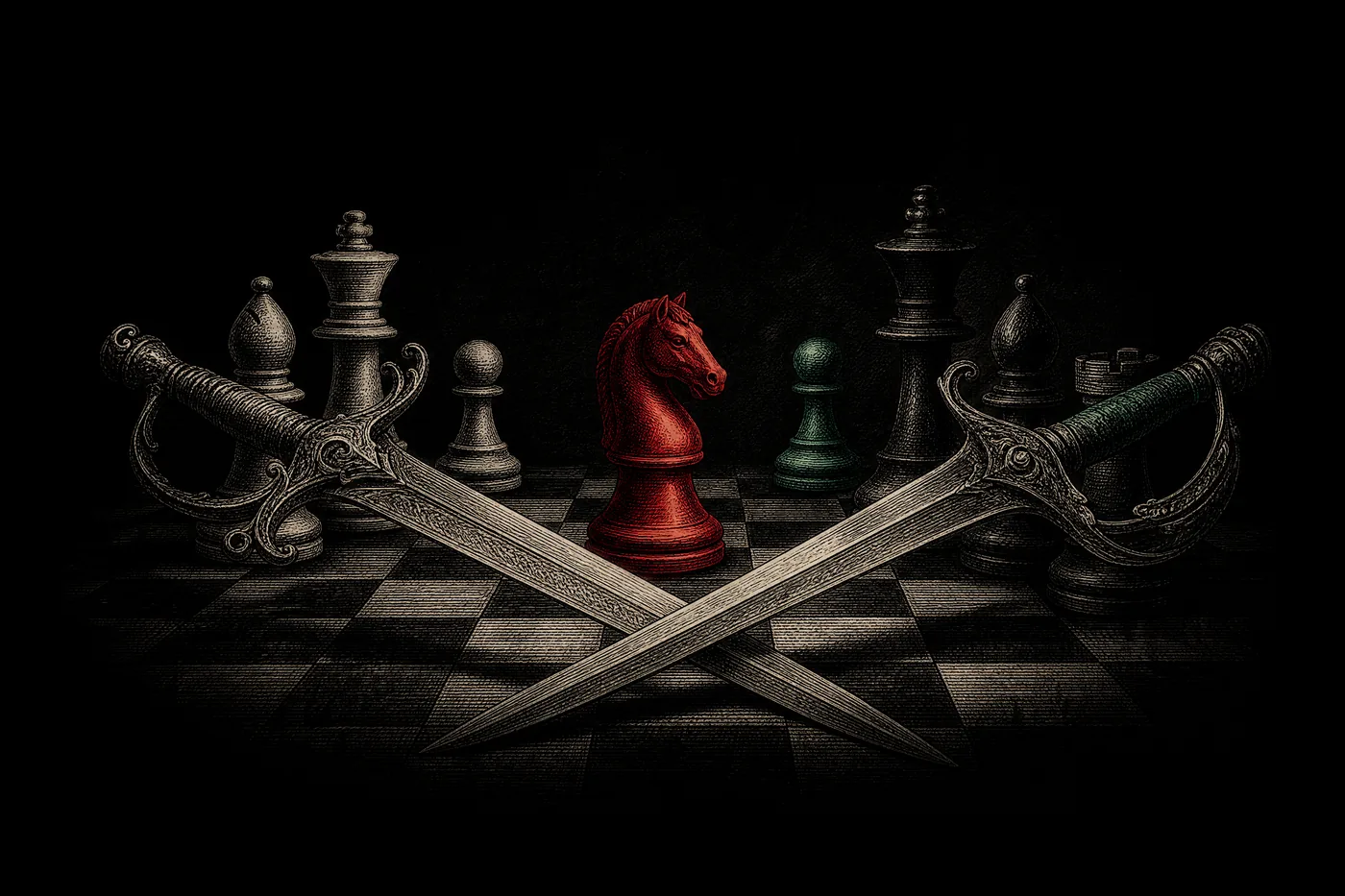
A double attack is when one move creates two threats at the same time, so your opponent can’t defend both — they save one target, you grab the other. It’s the engine behind a huge slice of all the material you’ll ever win in chess. The most famous flavor is the fork, where a single piece attacks two enemy pieces at once, but double attacks come in many shapes.
The whole idea rests on a simple truth: your opponent only gets one move to respond. If you’ve made two threats, one move can’t fix both. Math wins.
The 10-second version
- A double attack = two threats from one move.
- Your opponent can only answer one you win the other.
- A fork is a double attack by one piece on two targets.
- The best double attacks include a check (forcing) or hit something undefended.
- Knights and queens are the all-time double-attack champions.
How does a double attack work?
The logic is almost insultingly simple, which is exactly why it’s so powerful. You make a move that threatens two things. Your opponent, having only one move, deals with the more important threat. You take whatever they couldn’t save.
The two “things” you threaten can be:
- Two pieces (the classic fork — e.g., a knight hitting a rook and a bishop).
- A piece and the king (a check plus a hanging piece — super common and brutal).
- A piece and a mate threat (save your rook, or get mated? pick one).
- A piece and another threat, like a promotion or a winning capture.
The most reliable double attacks include a check, because check is forcing — your opponent must respond to it and literally cannot use their move to save the second target.
In the position above, White plays Qe6+. The queen checks the king on c8 (along the diagonal) and, on the very same move, attacks the undefended knight on a6 (along the rank). Black must move the king out of check — none of its escape squares can defend the knight, and the knight can’t capture the queen. Next move: Qxa6, and White’s up a knight for free. Two threats, one move, easy profit.
What’s the difference between a double attack and a fork?
Here’s the cleanest way to remember it: every fork is a double attack, but not every double attack is a fork.
A fork is the specific case where one piece attacks two (or more) enemy pieces at the same time. “Double attack” is the bigger umbrella — it includes forks, but also covers things like “check plus a separate mate threat” or two threats created by clearing a line.
| Fork | Double attack (general) | |
|---|---|---|
| What it is | One piece, two targets | Any move making two threats |
| Relationship | A type of double attack | The whole family |
| Classic example | A knight hitting a rook + bishop | A queen check that also threatens mate |
If you’re talking to a coach and you say “double attack,” you’re being general. Say “fork,” and you mean one piece spearing two targets. Both win material — they’re just different sizes of the same idea.
Which pieces make the best double attacks?
Some pieces are natural-born double-attackers:
- The knight is the king of forks. Because it jumps in that weird L-shape, it can attack two pieces that are nowhere near each other — and crucially, nothing can block a knight’s attack. The dreaded “family fork” hits the king, queen, and a rook all at once.
- The queen is a double-attack machine simply because it moves in every direction and covers enormous ground. A single queen move can hit targets on opposite corners of the board.
- Pawns punch above their weight: a pawn that lands attacking two pieces wins one of them, and your opponent can’t easily counterattack a measly pawn.
- Rooks and bishops fork along their lines too — a rook on an open rank can hit two loose pieces sitting on it.
Look at this knight fork. White plays Ne6+ — the knight leaps in, checks the king on g7, and simultaneously attacks the queen on d8. The king must move out of check, the knight cheerfully gobbles the queen, and a three-point knight just won a nine-point queen. This is why beginners are taught to fear the knight more than any other piece.
How do you spot a double attack?
Spotting double attacks is a skill you can train until it’s automatic. Here’s the checklist:
- Hunt for loose (undefended) pieces — your opponent’s and your own. Loose pieces are double-attack magnets. There’s an old saying: “loose pieces drop off.”
- Look for checks first. Every single move, ask “do I have a check?” Then ask “does that check also hit something else?” Checks that double-attack are the cleanest wins.
- Eye your knight’s reach. Imagine your knight on the squares it could jump to. Does any of those squares attack two enemy pieces? Knights see forks that humans miss.
- Notice pieces on the same line, rank, or color. Two enemy pieces lined up on a diagonal? A bishop might fork them. On a rank? A rook might.
The golden trigger phrase: “Can I attack two things at once?” Ask it every move and your tactical vision will rocket upward.
A bit of history
The knight fork is so iconic it has its own grim nickname — the “family fork” or “royal fork” — when it forks the king, queen, and a rook in one leap. Tactics like these have decided countless games at every level, from blitz between beginners to world championship matches. Even super-grandmasters lose pieces to overlooked forks under time pressure — proof that the humble double attack never goes out of style. If a 2800-rated player can hang a queen to a knight fork, you’re allowed to as well.
Common mistakes to dodge
- Leaving your pieces loose. The easiest way to avoid getting double-attacked is to keep your pieces defended. Loose pieces are the fuel for forks.
- Ignoring your opponent’s knight. Before each move, picture where their knight could jump next. Knights cause more “how did I miss that?!” moments than any other piece.
- Only checking for forks of pieces. A double attack can be “save your rook OR stop mate.” Threats don’t have to both be captures.
- Forking with an undefended piece. If your forking knight can simply be captured for free, the fork’s a dud. Make sure your forker is safe or supported.
Key takeaways
- A double attack is one move that makes two threats — the opponent can only stop one.
- A fork is a double attack by a single piece on two targets; every fork is a double attack, but not vice versa.
- Checks make the strongest double attacks because they’re forcing.
- Knights and queens are the best double-attack pieces; loose pieces are the best targets.
- Train the habit: every move, ask “can I hit two things at once?”
Keep climbing
Now that you’ve got the big picture, go deep on the most important double attack of all — the fork — and then learn how the “two threats” idea shows up in the discovered attack.
Next up: The fork, explained · Also essential: discovered attacks, the pin, and the skewer. Want the full map? Visit the tactics hub.
Written and fact-checked by the Chess Lab Academy Editorial Team (AI-assisted, human-edited) · Every position verified with Stockfish 17 and rules checked against the FIDE Laws of Chess · Last verified 2026-06-25 · Sources · How we verify content.
