
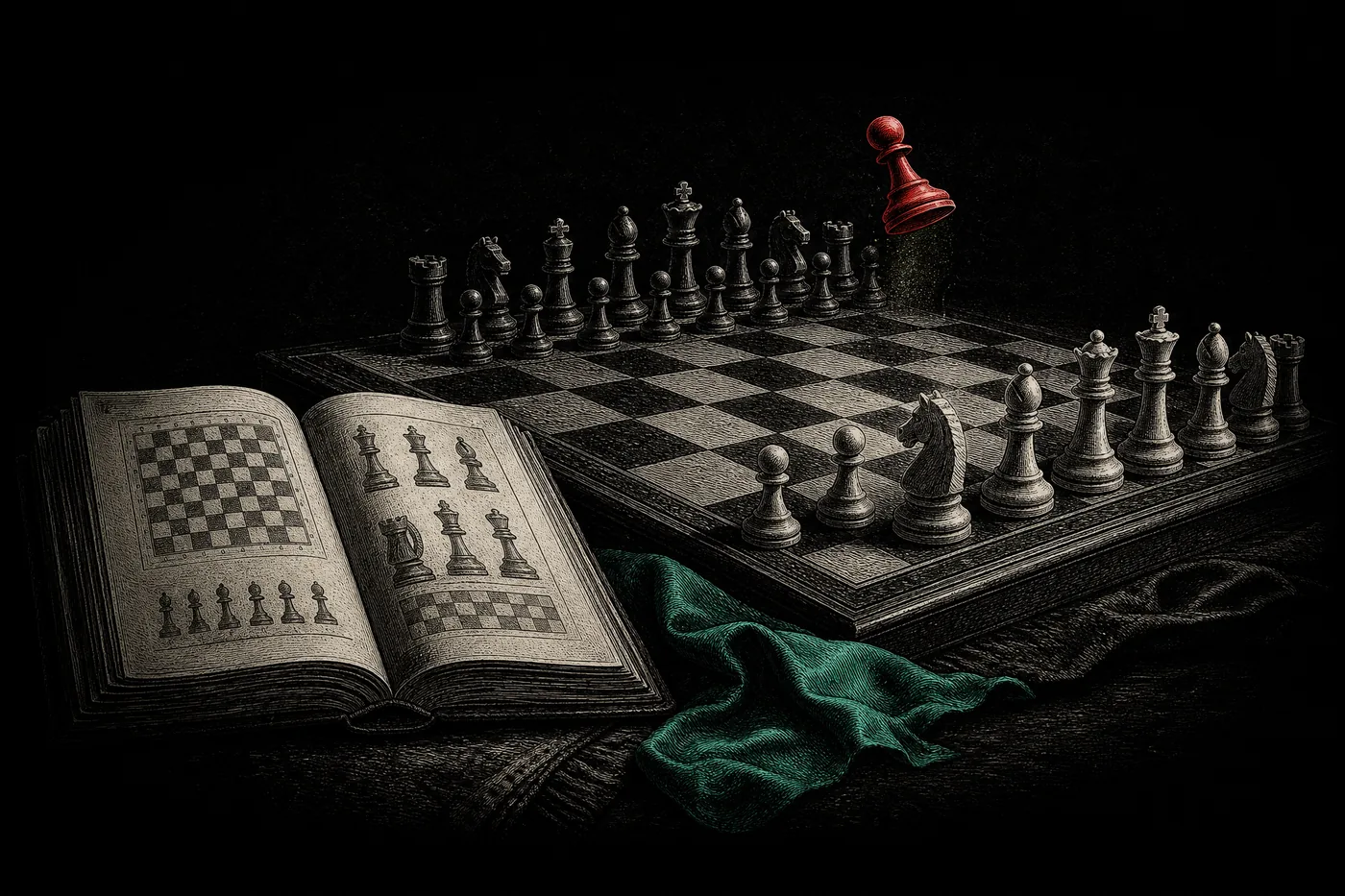
En passant (French for “in passing”) is a special pawn capture: if an enemy pawn uses its two-square opening dash to zip right past your pawn, you can capture it on your very next move as if it had only moved one square. Your pawn slides diagonally to the square the enemy pawn skipped over, and the enemy pawn is removed. It feels like cheating the first time you see it — but it’s 100% legal and over 500 years old.
The one catch that trips everyone up: you have to do it immediately. Wait even one move and the right vanishes forever. Let’s break it down.
The 10-second version
- Triggers only when an enemy pawn moves two squares and lands right beside your pawn.
- You capture it as if it moved one square — your pawn goes diagonally behind it.
- You must capture on your very next move, or you lose the right permanently.
- Only pawns can do it, and only against pawns. It’s the one capture where you don’t land on the captured piece’s square.
What is en passant in chess?
Normally a pawn captures by moving one square diagonally forward onto an enemy piece. En passant is the weird exception. It happens in one specific situation: an enemy pawn is on its starting square, it leaps forward two squares in a single move, and in doing so it lands directly alongside one of your pawns (on the same rank, in an adjacent file).
That two-square jump tried to sneak past your pawn’s capturing reach. En passant says: nope. You’re allowed to grab it anyway, as though it had only moved one square and stopped on the square right in front of your pawn’s diagonal.
Look at the board. White has a pawn on e5. Black just played f7-f5, trying to scoot the pawn safely past. But White’s e5-pawn would have been able to capture a pawn on f6. So White is allowed to capture “in passing”: the e5-pawn moves diagonally to f6, and the black pawn on f5 is lifted off the board.
Notice the strange part: White’s pawn ends up on f6, an empty square — not on f5 where the captured pawn was standing. This is the only capture in all of chess where your piece doesn’t land on the square of the piece it just captured. Wild, right?
How does en passant work, step by step?
Here’s the exact checklist. All of these must be true:
- Your pawn is on its 5th rank. (The 5th rank from your side — that’s rank 5 for White, rank 4 for Black.)
- An enemy pawn, on an adjacent file, moves two squares from its starting square in one go.
- It lands directly beside your pawn — same rank, next-door file.
- You capture immediately, on your very next move. Your pawn moves diagonally forward to the square the enemy pawn jumped over, and the enemy pawn is removed.
If you do anything else on that turn, the chance is gone. There are no second chances with en passant — it’s strictly a now-or-never deal.
When can you NOT use en passant?
Just as important as when you can. En passant is off the table if:
- The enemy pawn moved only one square. The two-square dash is the entire trigger. A one-square pawn move never enables en passant.
- You wait. Didn’t capture on the immediate next move? The right is gone for that pawn, permanently. If you play any other move first, you can’t come back to it later.
- It’s not a pawn doing the moving (or being captured). En passant is a pawn-versus-pawn rule, full stop. Knights, bishops, none of them apply.
- Your pawn isn’t positioned right. Your pawn must already be sitting beside where the enemy pawn lands — on the right rank and an adjacent file.
Is en passant forced? Do you have to take?
No. En passant is a choice, just like any other capture. You’re never obligated to take. Sometimes capturing en passant is the best move; sometimes it’s a mistake that opens lines you don’t want. But if you don’t take immediately, remember — that specific en passant opportunity is gone for good. (You could get a new en passant chance later from a different pawn dash, but never that same one.)
Why does en passant even exist?
Great question, and the history is genuinely interesting. For most of chess’s life, pawns could only move one square at a time. Then, around the 1400s–1500s in Europe, players introduced the optional two-square first move to speed the game’s slow opening along.
But that created a loophole: a pawn could now use the two-square jump to dash safely past an enemy pawn that would otherwise have captured it — dodging a fight it should’ve had to face. That felt unfair. So en passant was invented as the patch: you can still make the two-square leap, but your opponent gets one chance to capture it as if you’d only moved one square. It restores the balance. In short, en passant exists to stop the two-square move from being an exploit. It’s a 500-year-old bug fix.
Why does en passant matter for your games?
It’s rare-ish, but when it shows up it really matters:
- Pawn structure. Capturing (or declining) en passant changes which pawns you keep and where — and pawn structure quietly decides a huge number of games.
- Tactics. En passant can open a file, expose a king, or even be the move that delivers a check. Players who forget it exists miss real opportunities.
- Not getting fooled. Knowing the rule means an opponent can’t sneak a pawn past you when you had a legal capture. You stay in control.
If you’re still getting comfortable with how foot soldiers move, our how pawns move guide pairs perfectly with this one.
Common mistakes to dodge
- Trying it too late. The most common error by far. You see the chance, play something else, then try to take next turn — illegal. It’s strictly the immediate next move.
- Capturing onto the wrong square. Your pawn lands on the square the enemy pawn skipped, not where the enemy pawn currently sits. Empty square, diagonal move.
- Thinking it works after any pawn move. Only the two-square dash triggers it. A single step never does.
- Forgetting it’s legal at all. Plenty of casual players have never seen it and assume it’s a glitch. It’s in the official FIDE Laws of Chess — totally real.
Key takeaways
- En passant captures an enemy pawn that just dashed two squares past yours.
- Your pawn moves diagonally to the skipped square; the enemy pawn is removed — the only capture where you don’t land on the captured piece.
- You must do it on your immediate next move, or lose the right forever.
- It’s pawn vs pawn only, and it’s always a choice, never forced.
- It exists to stop the two-square pawn move from being an unfair dodge.
Keep climbing
En passant is one of pawns’ two superpowers — the other is becoming a queen. That’s the natural next read, along with a refresher on how pawns move.
Next up: Pawn promotion explained · Also handy: how pawns move and the full rules of chess.
Written and fact-checked by the Chess Lab Academy Editorial Team (AI-assisted, human-edited) · Rules verified against the FIDE Laws of Chess (Article 3.7.4) and every position checked with Stockfish 17 · Last verified 2026-06-25 · Sources · How we verify content.
