
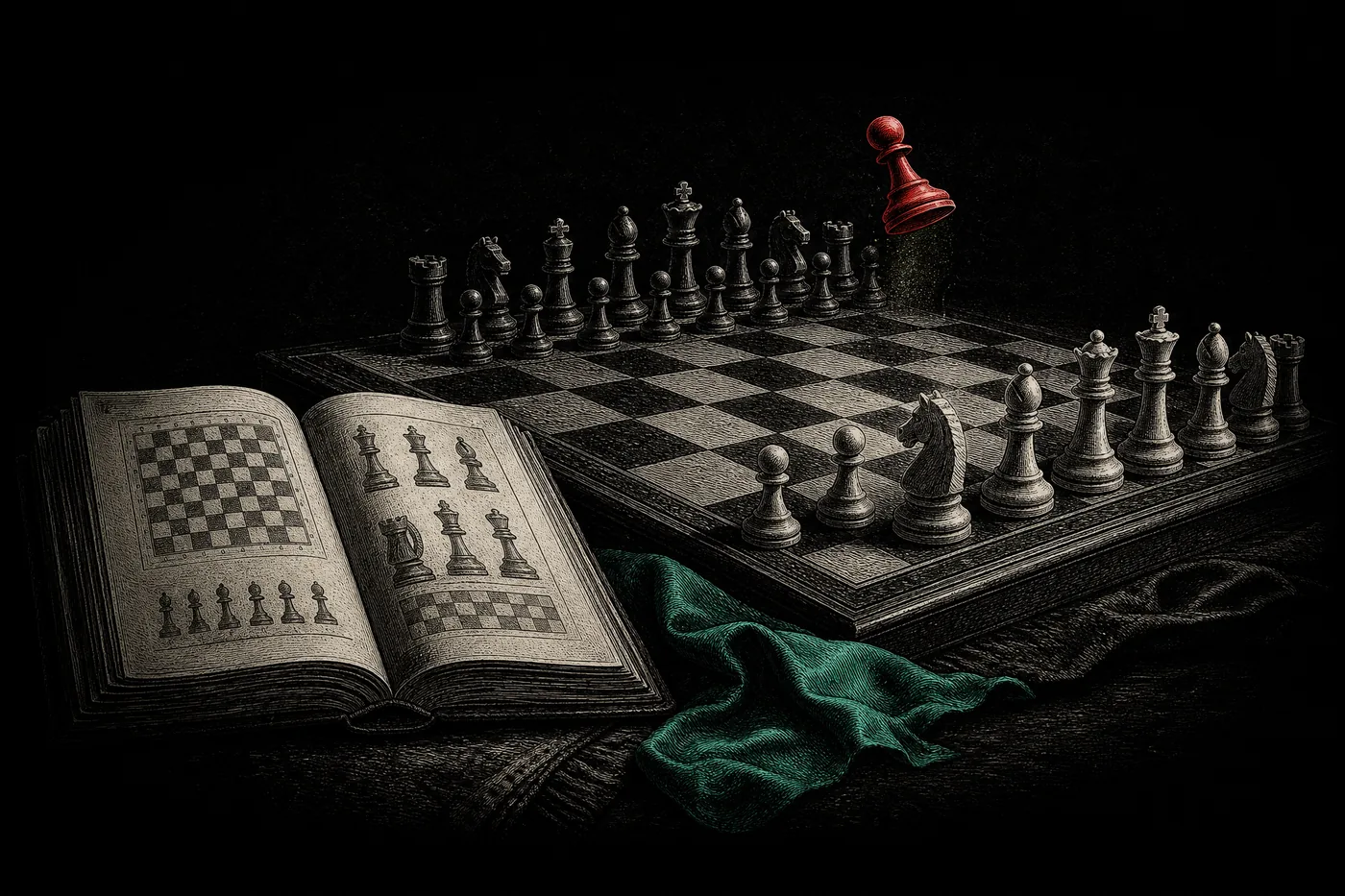
A pawn moves straight forward one square at a time — and on its very first move, it has the option to advance two squares instead. But here’s the catch every beginner trips on: a pawn captures diagonally, one square forward to the left or right. It moves one way and attacks another. Pawns also never move backward.
That little split personality — march straight, strike diagonally — is the whole secret to pawns. Let’s nail it down, then cover the two special powers pawns get: promotion and en passant.
Pawn cheat sheet
- Move: forward 1 square (never sideways, never backward).
- First move only: option to go forward 2 squares.
- Capture: 1 square diagonally forward (left or right).
- Promotion: reach the far end become a queen, rook, bishop, or knight.
- En passant: a special one-time diagonal capture (explained below).
How far can a pawn move?
Normally, just one square forward. That’s it. Pawns are slow — they’re the infantry, not the cavalry.
The one exception is a pawn’s first move. Any pawn that hasn’t moved yet may choose to spring two squares forward instead of one. After that, it’s back to one square at a time for the rest of its life.
A couple of things pawns absolutely cannot do:
- Move backward. Pawns only ever go forward, toward the enemy. They’re committed.
- Move sideways. No shuffling left or right.
- Capture straight ahead. If an enemy piece sits directly in front of a pawn, the pawn is stuck — it can’t move forward and it can’t capture the blocker. Two pawns nose-to-nose just freeze each other.
How do pawns capture?
Diagonally, and only diagonally. A pawn captures by moving one square diagonally forward onto an enemy piece, then taking its place.
This is the rule that confuses everyone at first, so let’s say it plainly: a pawn’s moving direction (straight) and its capturing direction (diagonal) are different. Picture a soldier marching straight ahead but jabbing a spear to the side. If there’s nothing to capture diagonally, the pawn simply can’t go diagonally — those diagonal squares are only for captures.
This is also why pawns form those famous diagonal “chains,” each one defending the one ahead of it. Pawn structure is a whole art, but it all starts with this single rule.
What is pawn promotion?
Here’s the pawn’s big dream. If a pawn fights its way all the way to the far end of the board (the 8th rank for White, the 1st rank for Black), it promotes — it instantly transforms into a stronger piece.
You get to choose what it becomes: a queen, rook, bishop, or knight (your color). You cannot keep it as a pawn, and you cannot turn it into a king. Almost everyone picks a queen, because the queen is the strongest piece — this is so common it’s nicknamed “queening.” You’re even allowed to have multiple queens at once if you promote more than one pawn.
Occasionally you’ll see an “underpromotion” to a knight — usually because the knight’s L-jump does something a queen can’t, like delivering a check the queen would miss. But 99% of the time? Grab the queen.
What is en passant?
En passant (French for “in passing”) is the pawn rule that makes new players go “wait, what?” It’s a special capture, and it only happens in one very specific situation.
Here’s the deal: when an enemy pawn uses its two-square first move to zoom right past one of your pawns — landing directly beside it — you’re allowed to capture that pawn as if it had only moved one square. Your pawn moves diagonally into the square the enemy pawn skipped over, and the enemy pawn comes off the board.
Two strict conditions:
- It only works immediately — on your very next move. Wait one turn and the chance is gone forever.
- It only applies to a pawn that just did its two-square jump right next to yours.
The idea behind the rule is fairness: the two-square jump was added to speed up the game, and en passant stops a pawn from using that jump to sneak past an enemy pawn that should have been able to capture it. Don’t stress if it feels strange — it’s genuinely one of the rarest moves, and even casual players go whole games without it. Just know it exists so it never catches you off guard.
Why pawns matter way more than they look
Pawns are worth only 1 point each, the lowest value on the board, so beginners treat them as throwaways. Big mistake. Pawns control space, build walls in front of your king, and form the skeleton of every position — strong players call it the “pawn structure,” and it quietly decides who’s winning.
And don’t forget the endgame magic: a single pawn that survives to the other side becomes a queen. Many games are won by one humble pawn marching home. Respect the little guys.
Common pawn mistakes
- Trying to capture straight ahead. The most common beginner error, full stop. Pawns capture diagonally — a piece directly in front is untouchable by that pawn.
- Pushing pawns too eagerly. Pawns can’t go backward, so every push is permanent. Shove them recklessly and you leave holes you can’t repair.
- Forgetting the two-square option is one-time. Skip it on move one and you can’t “save it” — each pawn only gets that double-step before it has moved.
- Auto-promoting without looking. A queen is usually right, but always glance for a sneaky knight underpromotion that forks or checks.
Key takeaways
- A pawn moves forward one square — or two on its first move only.
- Pawns capture diagonally (one square forward, left or right) — never straight.
- Pawns never move backward or sideways.
- Reach the far rank to promote, almost always to a queen.
- En passant is a rare special diagonal capture of a pawn that just double-stepped past yours.
FAQ
Can a pawn move backward? No. Pawns are the only piece that can never retreat — they only ever advance toward the enemy side.
Can a pawn move two squares anytime? Only on its first move. Once a pawn has moved at all, it’s limited to one square per turn for the rest of the game.
Do pawns have to capture if they can? No. Capturing is always optional in chess. A pawn can ignore a diagonal capture and push straight ahead instead (if that square is empty).
Can two pawns block each other? Yes. If two opposing pawns sit directly head-to-head, neither can move forward and neither can capture the other — they’re frozen until something else changes.
What happens if a pawn reaches the end but I don’t want a queen? You must still promote, but you can choose a rook, bishop, or knight instead. You just can’t stay a pawn or become a king.
Is en passant really a legal move? Absolutely — it’s in the official FIDE rules. It’s just rare, so many casual players have never used it.
Keep climbing
You’ve got the trickiest piece down. Next, meet the weirdest one.
Next up: How does a knight move? · Back to the overview of all pieces · Or see what a pawn dreams of becoming: the queen.
Written and fact-checked by the Chess Lab Academy Editorial Team (AI-assisted, human-edited) · Rules verified against the FIDE Laws of Chess (Article 3.7) and every position checked with Stockfish 17 · Last verified 2026-06-25 · Sources · How we verify content.
