
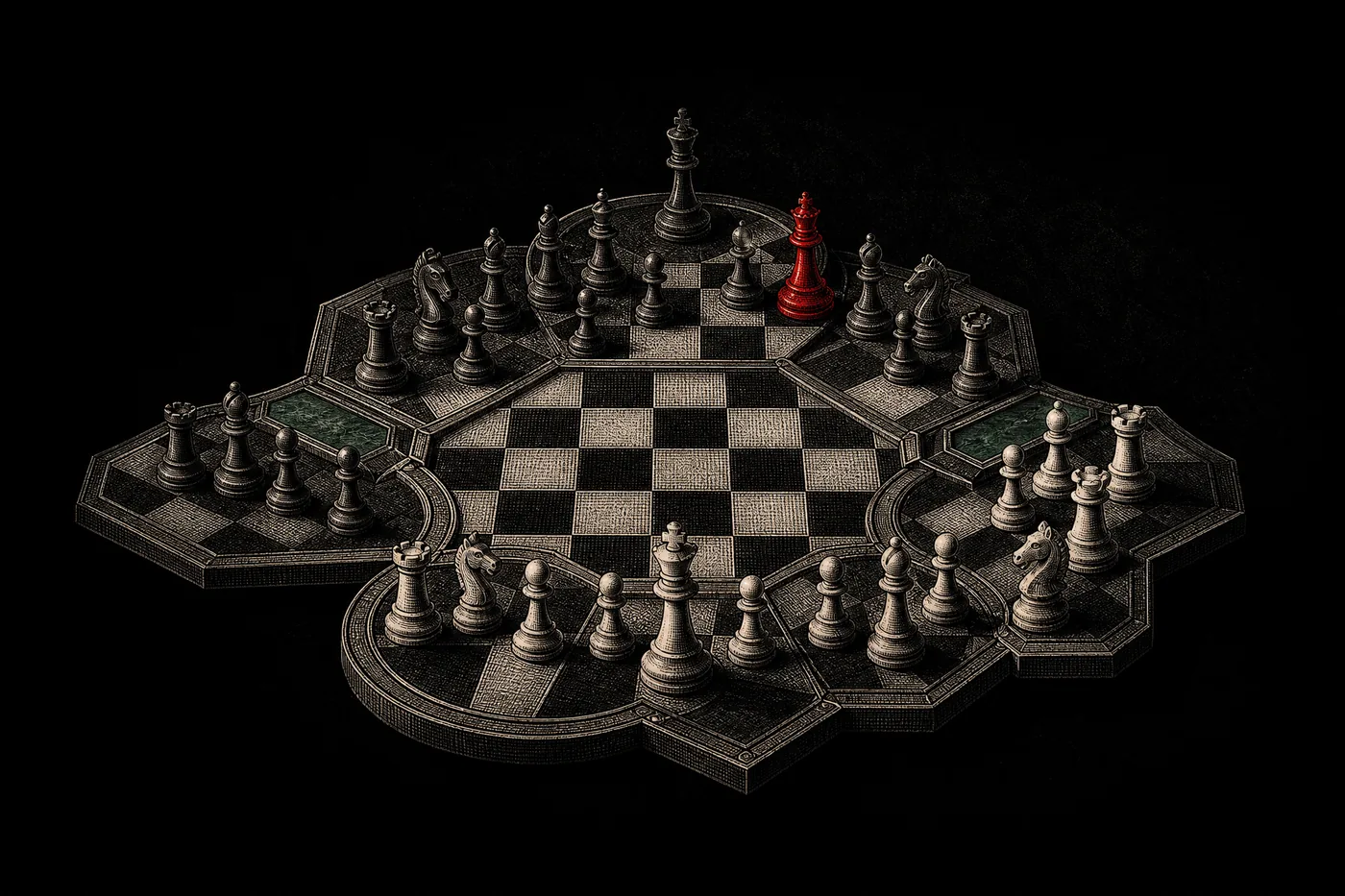
4-player chess takes the game you know and adds two more armies and two more brains to the table. Four players, four full sets of pieces, one giant cross-shaped board — and either a two-on-two team battle or a chaotic every-player-for-themselves scramble. It’s loud, it’s social, and it’s completely different from the quiet one-on-one duel of standard chess.
Because there are four kings in play, the rules add a scoring system and a turn order to keep things fair. Here’s how it all works.
4-Player Chess in 10 seconds
- Players: 4
- The twist: Four armies on a cross-shaped board; play as Teams or Free-for-All.
- How you win: Teams — checkmate an opponent (last team standing). Free-for-All — finish with the most points.
- Where to play: Chess.com (native, hugely popular).
The board and setup
Forget the tidy 8x8 square. The 4-player board is a standard 8x8 in the middle with three extra ranks jutting out from each of the four sides, forming a plus/cross shape. That works out to 160 playable squares — Chess.com notes the board “has 160 squares because three extra ranks are added to each side.”
Four armies — Red, Blue, Yellow, and Green — set up along the four edges, each with a normal 16-piece chess formation (eight pieces, eight pawns). Play goes clockwise, starting with Red. Each player’s pawns march toward the center and out the other side.
The two ways to play
Free-for-All (FFA): every player for themselves
In Free-for-All, all four players are enemies and you’re playing for points, not a single knockout. Whoever has the most points when the dust settles wins. Points come from:
- Capturing pieces: pawn or promoted queen +1, knight +3, bishop +5, rook +5, queen +9.
- Checkmating an opponent: +20.
- Being stalemated: the stalemated player actually gets +20 (a small consolation).
- Double/triple checks: checking two enemy kings at once with a non-queen earns +5, three kings +20.
The game ends when three players are eliminated — or when only two remain and one leads by 21+ points, at which point the leader can claim victory. There’s also a golden social rule: you can’t team up. Chess.com bans arranging alliances in FFA — “trying to influence another player to help you by communicating in the chat” can get you banned.
Teams: two-on-two
Teams pairs up players sitting across from each other: Red + Yellow versus Blue + Green. Your goal is straightforward — as Chess.com and Wikipedia both put it, “the goal of the game is to checkmate one member of the opposing team.” Checkmate either one of your two opponents and your team wins the game. You can’t capture your teammate’s pieces, and partners coordinate using arrows and chat.
What happens to eliminated players
When a player is checkmated or stalemated, their pieces don’t just vanish — they turn grey and go inactive. Chess.com: “all of their pieces become inactive and are grayed out. Capturing those pieces does not provide any points.” That stops survivors from farming easy points off a dead army. (If a player instead resigns or runs out of time, their king “remains alive and moves at random,” and their pieces can still be captured for points.)
A note on pawns and promotion
Pieces move the same way they do in standard chess. Pawns still promote when they reach the far side of the board — deep in enemy territory across the cross — so a runner can turn into a queen just like normal. The exact promotion rank depends on the mode, but the idea is the same: get a pawn all the way across and it powers up.

How to win at 4-player chess
Four-way chess rewards instincts you never use in a normal game:
- Watch the player on your left. In clockwise order, the player to your left moves right after you — they’re your most immediate threat. Keep an eye on what they can do the moment your turn ends.
- Don’t over-extend into a crossfire. With three enemies (in FFA), a piece poked into the center can be captured by anyone. Grab material, but don’t leave your king or queen hanging where two opponents can gang up.
- In FFA, let others fight. Points-based play rewards patience — let two rivals trade blows, then swoop in to capture the survivors. Being the quiet third party often wins.
- In Teams, coordinate relentlessly. Two armies aimed at one enemy king is overwhelming. Use arrows to set up combined attacks and defend your partner’s weak side.
- Bishops shine here. On the big cross-shaped board, long diagonals reach a long way — bishops (and queens) are especially powerful. Knights, with their short hop, feel a touch weaker than usual.
- Remember checkmate ends it fast in Teams. You don’t need to eliminate both opponents — a single checkmate on either enemy king wins for your team.
Where to play 4-player chess
Chess.com is the home of 4-player chess — it’s a built-in, hugely popular mode with matchmaking for both Teams and Free-for-All, plus faster and slower time controls. It’s the easiest way to get a game going 24/7. Lichess doesn’t offer a native four-player variant, so Chess.com is your main venue online. It’s also a blast over the board if you can get four friends and a physical four-player set.
4-player chess FAQ
Is 4-player chess harder than normal chess? It’s less about deep calculation and more about diplomacy, timing, and reading three opponents at once. Strong standard-chess players don’t automatically dominate — the multiplayer psychology is its own skill.
Can beginners play 4-player chess? Definitely. If you know how the pieces move, you can jump in. Many people find it more welcoming than 1v1 chess because a single blunder rarely ends your game instantly, and it’s a fun, social experience.
What’s the difference between Teams and Free-for-All? Teams is 2v2 and you win by checkmating an opponent. Free-for-All is solo, and you win by scoring the most points from captures and checkmates. Teamwork is encouraged in Teams and banned in Free-for-All.
How do you win Free-for-All? By finishing with the most points. You rack up points by capturing pieces and delivering checkmates, and the game resolves once three players are out (or a two-player lead of 21+ locks it up).
Try another variant
4-player chess is chess turned into a party. For more rule-benders, try the explosive Atomic chess, the lose-to-win Antichess, the lopsided Horde chess, or the sprint of Racing Kings — all in the variants hub.
Written and fact-checked by the Chess Lab Academy Editorial Team (AI-assisted, human-edited) · Rules verified against the Chess.com 4 Player Chess documentation and Wikipedia · Last verified 2026-07-13 · Sources · How we verify content.
