
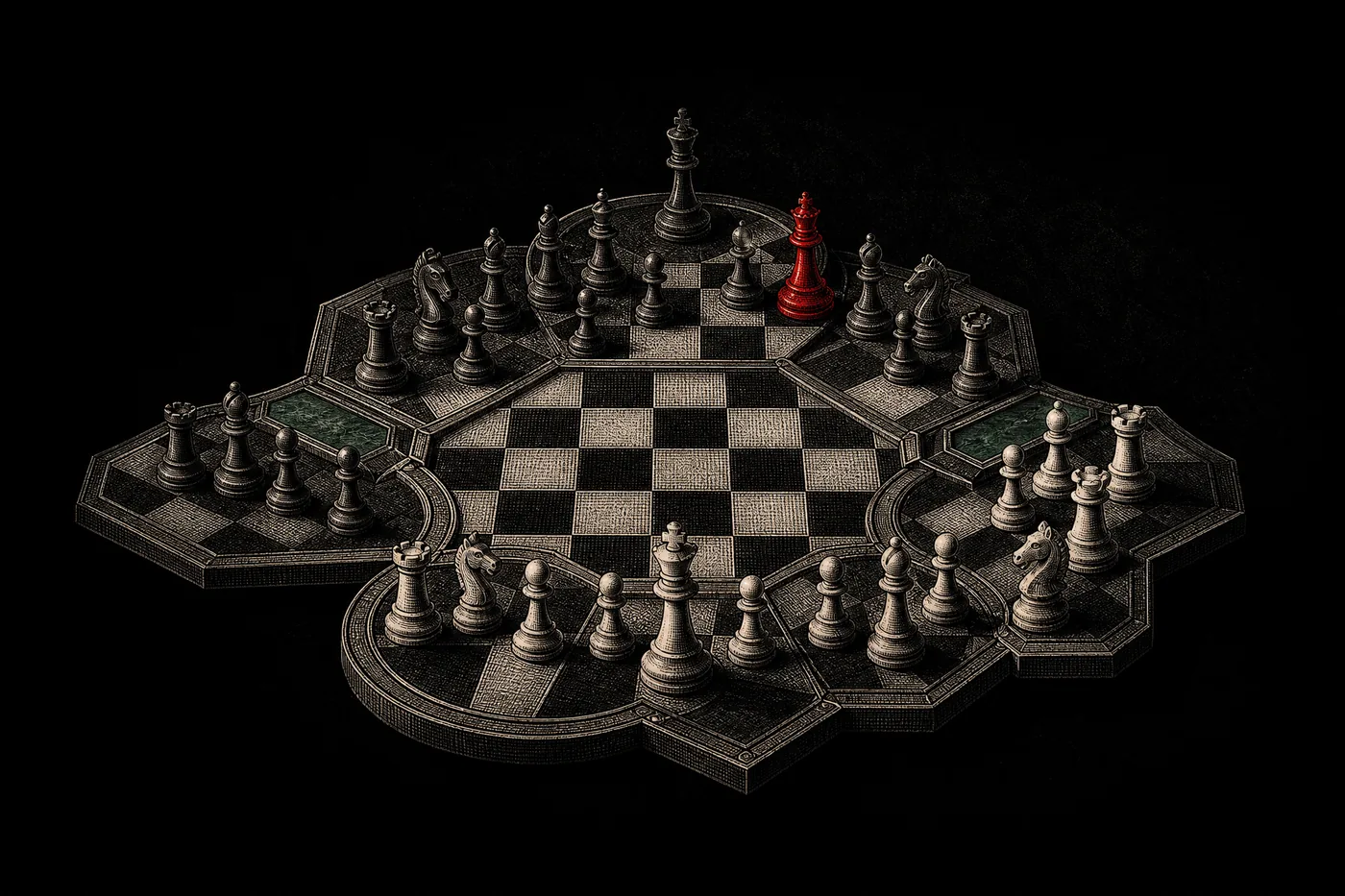
Fog of War chess is standard chess with the lights turned off. You can see your own pieces and the squares those pieces can legally move to — and that’s it. Everything else is hidden under a literal “fog.” Your opponent’s pieces mostly lurk out of sight, and their board looks just as murky from the other side. You each see a different, partial version of reality.
And just like Duck Chess, there’s no check and no checkmate here — you win by capturing the enemy king. Which means half the battle is finding it in the first place. Welcome to the most nerve-racking guessing game in chess.
Fog of War at a glance
- Players: 2
- Also known as: Dark Chess (it’s a close relative of Kriegspiel)
- How it differs (one line): you only see squares your own pieces can reach; enemy pieces are hidden in fog; capture the king to win — no check.
- Where it’s played: Chess.com (as “Fog of War”) and pychess.org (as “Fog of War” / Dark Chess).
- Invented by: Jens Bæk Nielsen and Torben Osted in 1989.
The rules: playing in the dark
Under the hood, the pieces move exactly as they do in normal chess. What changes is what you’re allowed to see — and how you win. Here’s the whole deal:
1. You only see what your pieces can reach
At any moment, your view of the board shows:
- All of your own pieces, always.
- Every square your pieces can legally move to this turn — including squares you could capture on.
- Any enemy piece sitting on one of those reachable squares (because if you can move there to capture it, you get to see it).
Everything else is fog. You typically can still tell a fogged square exists (so you know the board’s shape), but you can’t see whether an enemy piece is hiding there. As your pieces advance and spread out, more of the board lights up; as they get boxed in, your vision shrinks.
2. Your opponent sees a completely different board
There’s no shared view. Each player looks at their own personal, fogged-up version of the position. A piece that’s invisible to you might be in plain sight for your opponent, and vice versa. Nobody ever sees the whole truth at once.
3. There is no check — and no warning
This is the rule that catches everyone. You are never told when your king is in check, and you’re not required to move out of it. If an enemy piece is attacking your king and you don’t notice — because it’s hiding in the fog — nothing stops you from playing some other move and leaving your king hanging.
4. You win by capturing the king
Because there’s no check or checkmate, the game ends when someone actually captures the enemy king. Line up a piece on the king’s square, take it, game over. This means a Fog of War game can end shockingly fast: a knight you never saw coming can appear out of the mist and grab your king before you even realize you were in danger.
5. Castling and en passant get looser
Since attacked squares are invisible and “check” doesn’t exist, castling is allowed out of check, through check, and into check — the restrictions that normally protect the king simply don’t apply. En passant is still legal; on Chess.com, the pawn you can capture (and the square it passed over) stays visible to you only until the end of your turn. On some servers you also can’t see what’s directly in front of your own pawns, only whether the square ahead is blocked — a small but important extra sliver of fog.
How to win at Fog of War: 5 strategy tips
Fog of War is less about deep calculation and more about deduction, information, and nerve. Here’s how to stop stumbling and start hunting:
- Guard your king obsessively. You get no check warnings, so the most common way to lose is a sneak attack you never saw. Keep defenders near your king and be paranoid about the fogged squares around it — especially knight-distance squares, since knights are the ultimate ambush piece here.
- Spread out to see more. Your vision comes from your pieces’ reach. Developing pieces toward the center and pushing them into enemy territory doesn’t just create threats — it literally lights up more of the board so you can find your opponent.
- Use scouts. Sending a cheap piece (a knight or a pawn) deep into the fog can reveal a chunk of the enemy position. Even if you lose the scout, the information can be worth it.
- Hunt the king, not the pieces. Winning material feels nice, but the only thing that ends the game is capturing the king. Once you get a rough read on where the enemy king is hiding, funnel your attackers toward it.
- Play the odds, not certainties. You’ll rarely have complete information. Good Fog of War players make the move that’s safe against the most likely enemy setups, and they don’t freeze up waiting for certainty that never comes.
Where to play Fog of War chess
The two easiest spots are Chess.com (search for the “Fog of War” variant) and pychess.org, both of which handle all the fog logic for you automatically — you just see your view and play. Over the board it’s tricky, because keeping the information hidden requires a referee (this is essentially how classic Kriegspiel works, with an arbiter relaying only what each player is allowed to know), so online is by far the friendliest way in.
Fog of War FAQ
Is Fog of War harder than normal chess? It’s hard in a completely different way. Pure calculation matters less; instead you’re constantly making decisions with missing information, which can feel stressful (in a good way). Strong classical players don’t automatically dominate here — reading the fog is its own skill.
Can beginners play Fog of War? Yes, and honestly it’s a blast for newcomers because a lucky ambush can beat anyone. Just learn the standard rules and what check means first, so you understand exactly which threats you can no longer see coming.
What’s the difference between Fog of War and Dark Chess? They’re the same core idea — you only see squares your pieces control. “Dark Chess” is the older, formal name (from 1989); “Fog of War” is the branding Chess.com popularized. Tiny implementation details (like pawn-front visibility) can vary by platform.
Keep exploring
Love the “hunt the hidden king” tension? Try Duck Chess, which also ditches check and makes you capture the king — just with a rubber duck instead of a fog bank. Or push your visualization to the limit with Blindfold chess, where the whole board disappears and lives only in your head. For pure tactical chaos, there’s Crazyhouse.
Back to the full menu: all chess variants.
Written and fact-checked by the Chess Lab Academy Editorial Team (AI-assisted, human-edited) · Rules verified against Wikipedia (Dark chess), Chess.com’s Fog of War documentation, and pychess.org · Last verified 2026-07-13 · How we verify content.
