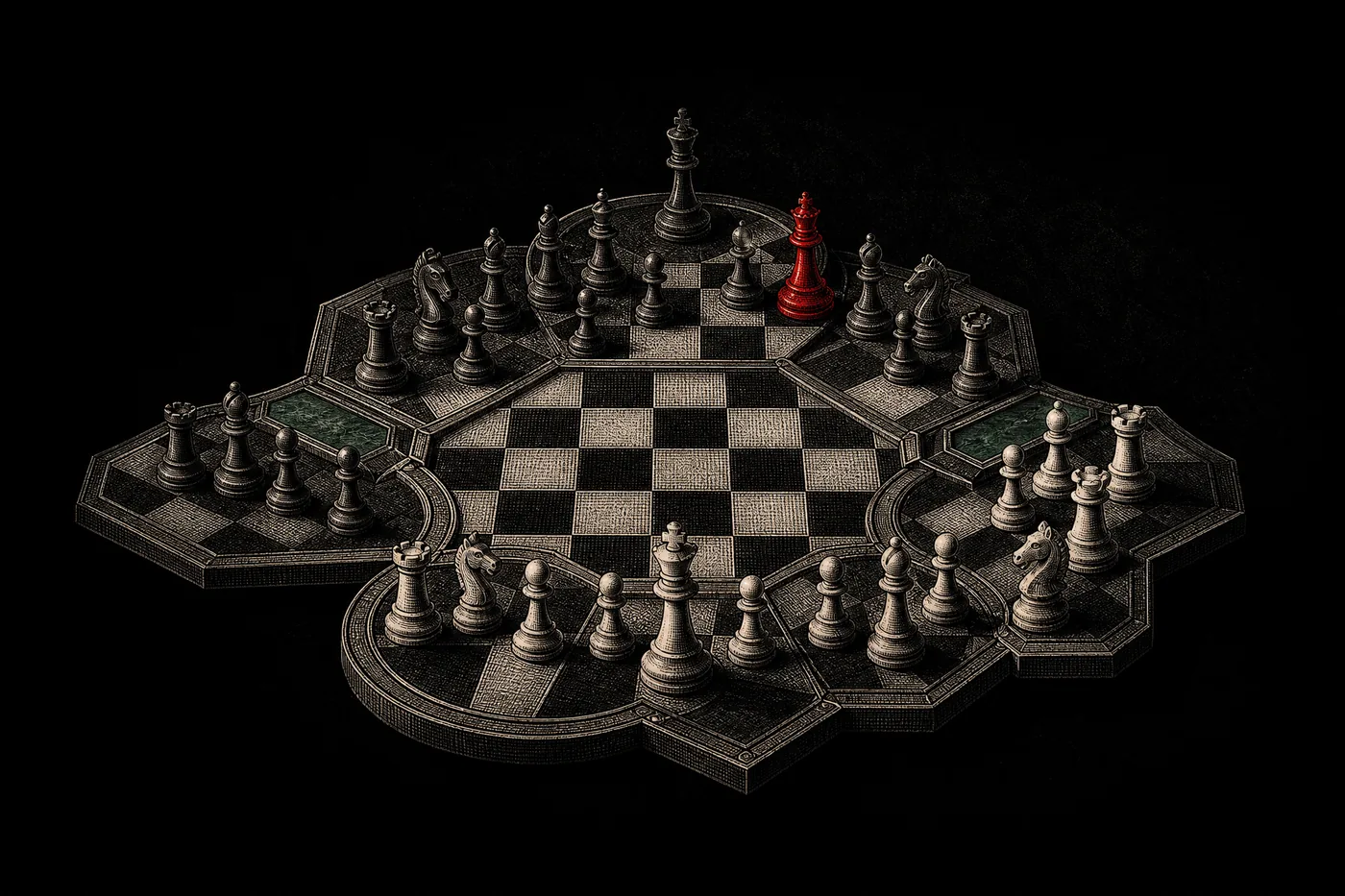
Here’s the honest truth up front: blindfold chess isn’t a rule variant at all. The rules are 100% ordinary chess — same pieces, same board, same checkmate. What changes is you. In blindfold chess you play without ever seeing the board or the pieces. Every move is announced out loud (or typed) in chess notation, and you have to hold the entire position in your head, updating your mental picture move by move.
It sounds superhuman. It isn’t. It’s a trainable skill — one of the best there is for making you a sharper player. We’ve filed it under variants because it’s a wildly different way to experience chess, but think of it as a mode and a skill, not a new rulebook.
Blindfold chess at a glance
- Players: 2 (or one blindfolded player against many, in famous exhibitions)
- What changes: nothing in the rules — you just can’t see the board; moves are called out in notation.
- Where it’s played: in your head, over the board with a caller, or in “blindfold” modes on chess apps and training sites.
- Why bother: it supercharges visualization, calculation, and memory.
So how does blindfold chess actually work?
Two players agree to play, but neither looks at a board (or only one player is “blind” and the opponent sees normally — common in teaching and exhibitions). Moves are spoken or written in algebraic notation: “e4,” “Nf6,” “Bxc5,” and so on. Each player mentally makes the move on their own imagined board, then replies. No pieces are physically touched by the blindfolded player. That’s the whole thing — the challenge is entirely in keeping the position straight in your mind while also trying to, you know, play good chess.
Because it leans so hard on notation, getting fluent in reading and writing chess moves is step one. If “Nbd7” or “exd5” makes you pause, that pause is a leak in your mental board.
Why play chess you can’t see? The benefits
Blindfold practice is one of the highest-value training tools in chess, and here’s why coaches love it:
- It forces real visualization. When you can see the board, it’s easy to be lazy and let your eyes do the work. Take the board away and you have to picture the position — which is exactly the muscle you use when calculating variations in a normal game.
- It sharpens calculation. Every serious combination you play is really you looking a few moves into a position you can’t see yet. Blindfold training is that skill, isolated and cranked to the max.
- It builds memory and pattern recognition. You start chunking the board into familiar structures instead of tracking 32 individual pieces. Studies of blindfold players going back to Alfred Binet in 1893 found it’s less about raw memory and more about experienced players seeing meaningful patterns.
- It boosts concentration. There’s nowhere to hide mentally — lose focus for one move and a piece “vanishes” from your mind. That relentless focus carries over to your regular games.
- It kills the “I didn’t see it” blunder. The more vividly you can hold a position, the fewer pieces you’ll leave hanging when you can see the board.
How to learn blindfold chess (step by step)
Nobody plays a full blindfold game on day one — and you shouldn’t try. It’s built from smaller skills, stacked up in order. Here’s the classic progression:
- Master the square colors. Can you instantly say whether h4 is light or dark? (It’s dark.) Drill this until it’s automatic. Knowing the board’s color pattern is the foundation everything else sits on.
- Learn the coordinates cold. Name any square’s neighbors, the diagonals it sits on, the knight-moves away from it. Our visualization guide has drills for exactly this.
- Trace single-piece journeys. Close your eyes and move a lone knight from a1 to h8 in your head, square by square, no board. Then a bishop, then a queen.
- Play out short, known sequences. Recite the moves of a simple opening — say, the first six moves of a game — and track the position mentally. Then answer questions: “What’s on e5? Which piece defends d4?”
- Solve simple puzzles blindfolded. Set up an easy mate-in-one in your mind from a described position and find the move without looking.
- Play a mini-game. Try a blindfold game on a small scale or against a gentle opponent. Losing track is normal at first — rebuild and keep going.
- Extend gradually. Longer games, tougher puzzles, more pieces. Fifteen focused minutes a day beats one exhausting marathon session.
A little history (and some jaw-dropping records)
Blindfold chess is ancient — one of the earliest recorded players was Sa’id bin Jubair (665–714), and Europe logged its first blindfold event in Florence in 1266. The great Philidor wowed crowds by playing three blindfold games at once in 1783. Then things got wild: George Koltanowski played 34 simultaneous blindfold games in 1937, Miguel Najdorf pushed the record to 45 opponents in 1947, and in 2016 Timur Gareyev took on 48 opponents at once — blindfolded, while pedaling an exercise bike. (The Soviet Union actually banned mass blindfold exhibitions in 1930, worried they were a health hazard. Chess: dangerous.)
Blindfold chess FAQ
Do I need a special talent for this? No. Grandmasters aren’t born with a “blindfold gene” — they built the skill through the same progression above. If you can play chess and read notation, you can learn to play blindfold; it just takes patient, regular practice.
Will blindfold training actually make me better at normal chess? Yes — that’s the main reason to do it. The visualization and calculation muscles you build transfer directly to seeing deeper and blundering less in your everyday games. Pair it with our full visualization training.
Is it bad for your brain? Despite that dramatic 1930 Soviet ban, there’s no good evidence that moderate blindfold practice harms you. Marathon 40-board exhibitions are exhausting, sure — but a daily 15-minute drill is just healthy mental exercise.
Keep exploring
If holding a hidden position in your head appeals to you, you’ll enjoy Fog of War chess, where the board is partly invisible for real. Want a different kind of “you can’t rely on memory” challenge? Chess960 scrambles the starting position so your memorized theory goes out the window.
Back to the full menu: all chess variants · or dive into visualization training to build the skill for real.
Written and fact-checked by the Chess Lab Academy Editorial Team (AI-assisted, human-edited) · History and records verified against Wikipedia’s Blindfold chess article · Last verified 2026-07-13 · How we verify content.