
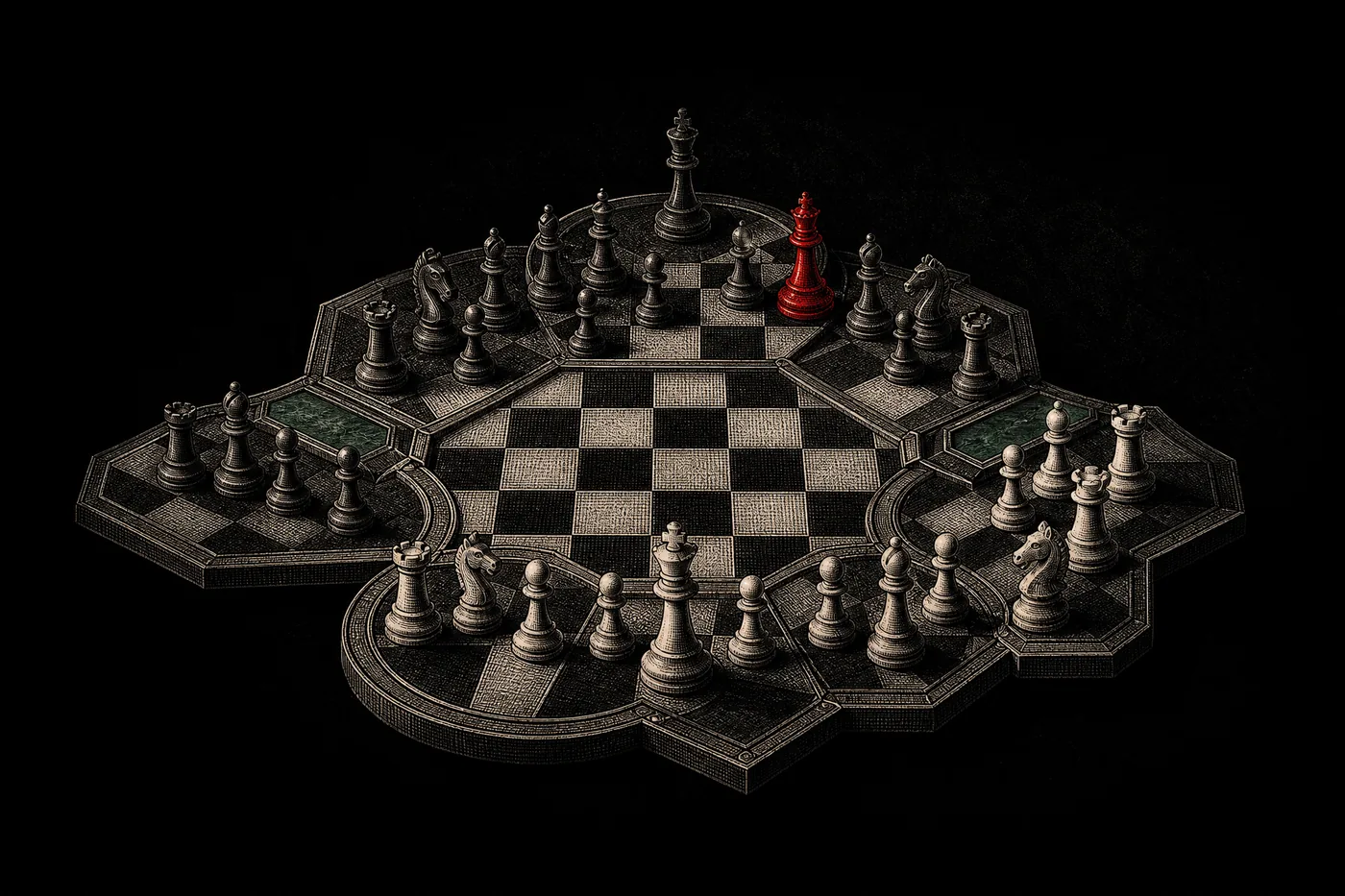
Duck Chess is exactly what it sounds like: regular chess, except there’s a rubber duck on the board, and every single turn you have to pick it up and drop it on an empty square. That duck blocks whatever square it’s sitting on — for both players — and it cannot be captured, ignored, or reasoned with. It’s the most gleefully silly variant around, and also one of the most brain-bending.
Oh, and here’s the twist that changes everything: there is no check and no checkmate in Duck Chess. You win by literally capturing the enemy king. Let that sink in — then let’s play.
Duck Chess at a glance
- Players: 2
- How it differs (one line): every turn = a normal chess move plus moving the duck to a new empty square; no check/checkmate — capture the king to win.
- Where it’s played: Chess.com (a hugely popular variant there), plus pychess.org and casual over-the-board games.
- Invented by: Dr. Tim Paulden in 2016.
The rules: how Duck Chess actually works
If you already know the standard rules of chess, you’re 90% of the way there. Pieces move exactly the same. Pawns promote, bishops slide, knights hop. Here’s everything that’s different:
1. Every turn has two parts
Your turn is always: (1) make a normal chess move, then (2) move the duck to any empty square. Both halves are mandatory. You can’t skip the duck, and you can’t leave it where it is — the duck must move every single turn. On the very first move of the game the duck isn’t on the board yet, so White makes a move and then places the duck for the first time; from then on, it’s the same duck getting relocated turn after turn.
2. The duck blocks its square — for everyone
Wherever the duck sits, that square is frozen. No piece from either side can land on it, and no sliding piece (rook, bishop, queen) can move through it. The duck is basically a tiny immovable roadblock that both players share.
One exception: knights jump over the duck just like they jump over everything else. So a knight doesn’t care about the duck unless the duck is sitting on the exact square the knight wants to land on.
3. The duck cannot be captured
You can’t take the duck. Ever. It’s not a piece — it’s a wall you keep rebuilding somewhere new. All you can do is move it on your own turn.
4. No check, no checkmate — you capture the king
This is the big one. In Duck Chess, check and checkmate don’t exist. Nobody warns you that your king is attacked. Your king can happily sit on a square an enemy queen is eyeing, and that’s completely legal — because to actually win, your opponent has to spend a real move capturing your king outright.
That flips your whole safety instinct. In normal chess, a threat to your king forces a response. In Duck Chess, a threat to your king is only real if your opponent can execute the capture before you slap the duck down to block it. Which leads to the single most important tactic in the game…
5. The duck is your emergency shield (and your murder weapon)
Because you place the duck after your move, you can use it to plug the exact square an attacker would use to grab your king. Someone lining up a queen to take your king next turn? Drop the duck in the queen’s path and the attack fizzles. Conversely, when you’re the one going for the kill, you have to make sure the defender can’t just duck-block your path first.
6. You can also win by stalemate
Here’s a fun reversal: in Duck Chess, getting stalemated is a WIN, not a draw. A stalemate happens when a player has no legal moves at all — every piece blocked by other pieces or the duck. Since kings can walk into “check” freely, the usual stalemate logic doesn’t apply, and the trapped player is considered to have won. (Castling, by the way, is also relaxed — the king may castle through squares that would normally be off-limits, because attacked squares simply don’t matter here.)
How to win at Duck Chess: 5 strategy tips
Duck Chess rewards a totally different kind of thinking. Players call the tactics “quacktics,” and here’s how to start finding them:
- Think one duck ahead. Before you play a move, ask: “After I place the duck, can my opponent capture my king next turn?” If yes, you either need a different move or you need to use the duck to block the killing square.
- Attack with two threats at once. A single threat to the king is easy to duck-block. But if you threaten to capture the king from two directions, your opponent can only block one — the duck can only be in one place. Double threats are how games are won.
- Use the duck to trap sliding pieces. Drop the duck in front of an enemy rook or bishop to shut it out of the action for a turn. A well-placed duck can freeze a whole file or diagonal.
- Knights are kings here. Because knights leap over the duck, they’re the only pieces that can’t be walled off. Knights near the enemy king are terrifying in Duck Chess.
- Don’t over-defend. Since there’s no check, you don’t have to react to “threats” the way you would in normal chess. Keep making your own threats — often the best defense is being one duck-block ahead on offense.
Where to play Duck Chess
The easiest place is Chess.com, where Duck Chess is one of the most popular variants and has a big, active player pool — you’ll get a game in seconds. pychess.org also supports it for free. And of course you can play over the board with any chess set and any small object standing in for the duck (a coin, an eraser, an actual rubber duck if you’ve got one handy).
Duck Chess FAQ
Is Duck Chess harder than normal chess? It’s different hard. The pieces are familiar, but the “no check, capture the king” rule and the extra duck decision every turn mean your normal instincts will trip you up at first. Most players lose a few kings to surprise captures before it clicks. That’s part of the fun.
Can beginners play Duck Chess? Absolutely — and it can be a great teacher. Because there’s no check to memorize, some newcomers find the “just don’t let your king get taken” goal wonderfully intuitive. If you’re brand new, skim the basic rules of chess and what check means first, then enjoy watching those rules get gloriously bent.
Why is there no checkmate? Because the duck can block almost any attack, “forced mate” would be nearly impossible to pin down. Switching the goal to actually capturing the king keeps the game decisive and adds a layer of tension — every attack is a race between your capture and their duck.
Keep exploring
If you love the “capture the king, no check” idea, you’ll feel right at home in Fog of War chess, where you win the same way — except you can barely see the board. Or try the explosive chaos of Atomic chess and the piece-recycling madness of Crazyhouse.
Back to the full menu: all chess variants.
Written and fact-checked by the Chess Lab Academy Editorial Team (AI-assisted, human-edited) · Rules verified against Chess.com’s Duck Chess documentation, pychess.org, and The Chess Variant Pages · Last verified 2026-07-13 · How we verify content.
