
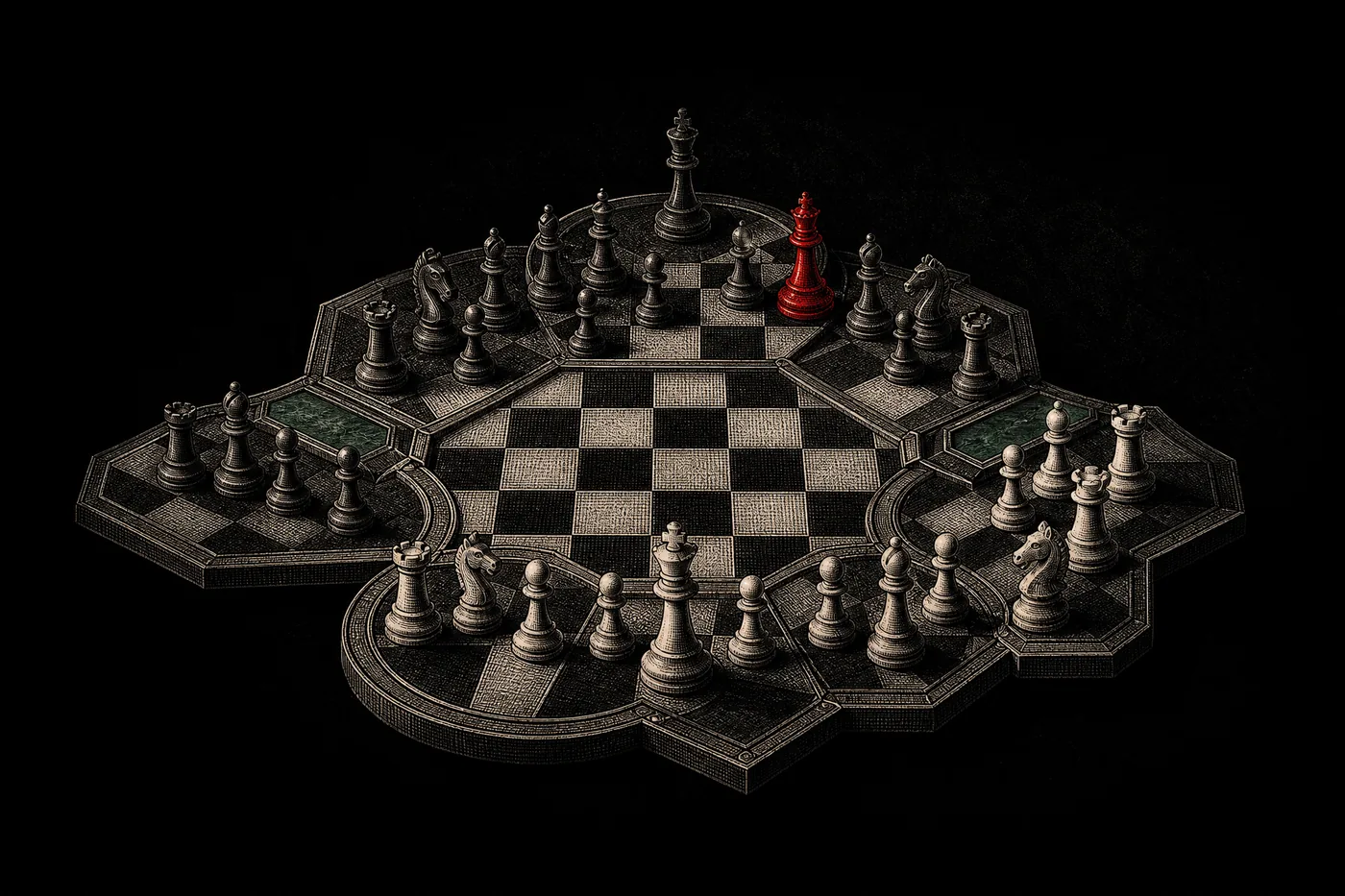
Bughouse is chess turned into a noisy, chaotic team sport: four players, two boards, two teams of two — and the twist that makes it magic is that every piece you capture gets handed to your partner, who can parachute it straight onto their own board. It’s fast, it’s loud, and it’s probably the most fun you can have with two chess sets.
If normal chess is a quiet duel, Bughouse is a doubles match where you’re constantly yelling “I need a knight!” across the table. Nothing else in chess feels quite like it.
Bughouse at a glance
- Players: 4, in two teams of 2, on two boards side by side
- How it differs: you play one board; pieces your partner captures get passed to you to drop onto your board
- Where it’s played: hugely popular over the board at clubs and tournaments; playable online (Chess.com has it; many casual servers support it)
- Origin: a mid-20th-century variant, closely related to the single-board version, Crazyhouse
The rules: how Bughouse works
Bughouse is played on two separate boards at the same time. Here’s the setup: you and your partner sit next to each other, but you play opposite colors. So if you’re White on your board, your partner is Black on theirs. That detail matters, because the pieces flow between you.
The core mechanic: capture, pass, drop
This is the whole heart of the game:
- When you capture an enemy piece, you don’t keep it — you hand it to your partner. A captured black knight, passed to your partner, becomes a white knight in their reserve (it takes on your partner’s color).
- On their turn, instead of moving a piece already on the board, your partner can drop one of those reserve pieces onto any empty square on their board. That’s a full move.
- Pieces flow constantly. You’re not just fighting your own opponent — you’re supplying your partner and getting supplied in return.
Drop rules (the fine print)
Dropping has a few important limits — these mostly match Crazyhouse:
- A dropped piece can go on any empty square, with one exception below.
- Pawns may not be dropped on the 1st or 8th rank. (No sneaking a pawn onto the back rank to instantly promote.)
- A drop can deliver check — and even checkmate. Parachuting a queen next to an unguarded king can end the game on the spot. (Some casual house rules ban check-by-drop, so agree beforehand.)
- Promoted pawns revert to pawns when captured. If your partner promotes a pawn to a queen and that queen later gets captured, it goes into the reserve as a pawn, not a queen.
How a team wins
Here’s the kicker: the whole match ends the instant either board finishes. A game ends when a player is checkmated, resigns, runs out of time, or makes an illegal move. So if your partner gets checkmated on their board, your team loses — even if you were completely winning on yours. You win and lose as a unit.
Everything else is normal chess: pieces move the way they always do, check works the same, castling and en passant are legal. If you know the standard rules, you already know 90% of Bughouse.
Two things that make it frantic
- Clocks. Bughouse is almost always played with chess clocks, usually fast time controls. Managing time is half the game — a player who’s flagging (about to run out of time) is a disaster for the whole team.
- Talking is allowed. Partners can — and constantly do — talk during the game. “Don’t trade queens!” “I need a bishop!” “Sit on your clock!” The chatter is part of the sport.
How to win at Bughouse
Bughouse strategy is genuinely different from regular chess. A few keys:
- Communicate nonstop. Tell your partner what you need and warn them what you’re about to give the enemy. If you’re forced to trade a piece, your opponent’s partner is about to get it — call it out.
- Think about what you’re feeding the other board. Capturing an enemy queen is great for you, but it hands a queen to the opponent across the table. Sometimes the right move is not to capture.
- Watch your partner’s clock, not just your own. If your partner is about to flag, the match is lost regardless of your position. Sometimes you speed up and simplify just to buy them time.
- Sit on pieces you don’t need yet. You don’t have to drop immediately. Holding a knight in reserve until the perfect square opens can be devastating.
- King safety is everything. Because opponents can drop attackers out of nowhere, an exposed king dies fast. Castle early and keep the squares around your king covered.
Where to play Bughouse
Bughouse is a social, in-person favorite:
- Over the board is where it truly shines — chess clubs, scholastic tournaments, and after-hours skittles rooms live for it. All you need is two sets, two clocks, and three friends.
- Online, Chess.com supports Bughouse, and various casual chess servers have offered it over the years. Availability comes and goes, so check what’s live before you plan a session.
- If you want the same drop-based thrill but can only find one opponent, play its solo cousin, Crazyhouse — same recycling-pieces idea, one board, two players.
Frequently asked questions
Is Bughouse harder than normal chess? Different, not necessarily harder. The moves are the same, but you’re juggling two boards’ worth of information, a partner, and a ticking clock. It’s less about deep calculation and more about speed, communication, and instinct.
Can beginners play Bughouse? Yes — it’s actually a fantastic way to get newer players hooked, because it’s fast, forgiving, and social. Just learn the basic rules of chess first, then jump in with a patient partner.
Why is it called “Bughouse”? “Bughouse” is old slang for a madhouse — which is exactly what the table sounds like once four people are shouting piece requests at each other. It’s also called Siamese, Tandem, or Exchange chess.
Do I really lose if my partner loses? Yes. The match ends the moment either board finishes, so your team’s result is tied to both players. That’s what makes teamwork the entire point.
The bottom line
Bughouse takes everything you know about chess and drops it into a two-board, four-player, piece-recycling free-for-all where you win and lose as a team. Master the flow of pieces, keep talking, and watch both clocks — that’s the whole game. It’s chaotic, it’s social, and it might just be the most fun variant ever invented.
Hungry for more? The one-board version is Crazyhouse; for a totally different flavor, try memory-proof Chess960 or the aggressive sprint of Three-Check. Browse them all in the variants library.
Written and fact-checked by the Chess Lab Academy Editorial Team (AI-assisted, human-edited) · Rules verified against Wikipedia and Chess.com’s Bughouse page · Last verified 2026-07-13 · How we verify content.
