
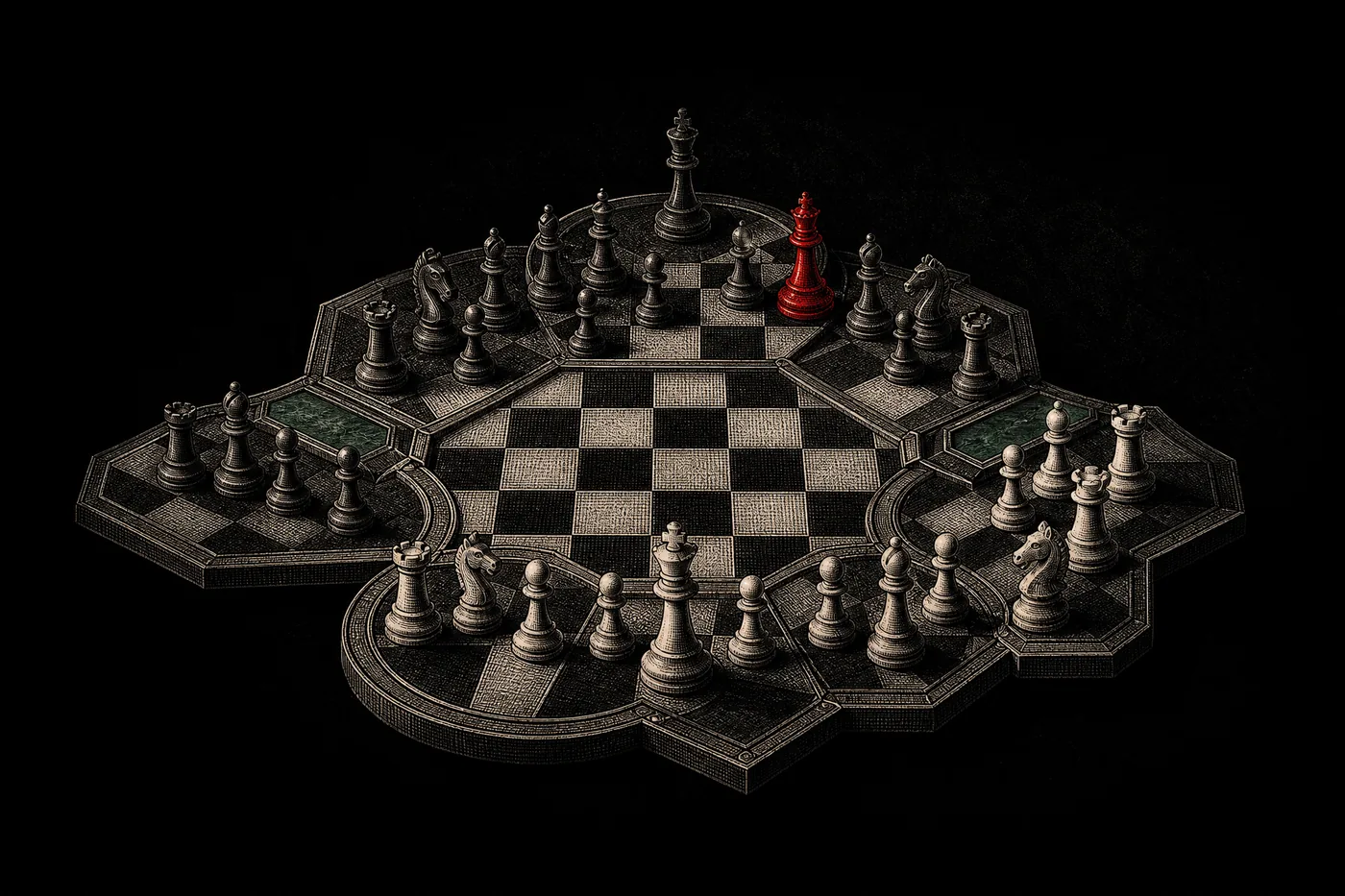
Chess960 is standard chess with one wild twist: before the game starts, the pieces on your back rank get shuffled into one of 960 legal arrangements — and both sides get the same one. Everything else plays exactly like normal chess, which means your carefully memorized openings are worth nothing from move one. It’s the same game you love, just with the cheat sheet set on fire.
It was dreamed up by world champion Bobby Fischer, who unveiled it in Buenos Aires in June 1996. His whole point: force players to think from the first move instead of regurgitating theory. If you’ve ever felt like chess was becoming a memory contest, this is the antidote.
Chess960 at a glance
- Players: 2 (same as normal chess)
- How it differs: the back-rank pieces start scrambled — one of 960 possible setups, identical for both players
- Where it’s played: Lichess, Chess.com, and over the board (it’s a serious, respected variant with its own world championship)
- Invented by: Bobby Fischer, 1996 — hence the nickname “Fischer Random”
The rules: what actually changes
Here’s the good news — almost nothing changes. Pawns still move like pawns, the queen is still the queen, checkmate still ends the game. The only difference is where the pieces start and one twist on castling.
The starting position
Before the game, White’s eight back-rank pieces (the a1–h1 row) are placed randomly, following three rules that keep the game fair and playable:
- The two bishops must land on opposite-colored squares — one light, one dark. (No stacking both bishops on the same color, which would be a nightmare.)
- The king must sit somewhere between the two rooks. This is what guarantees castling is always possible.
- Black mirrors White exactly. Whatever White’s setup is, Black gets the identical layout on the 8th rank, straight across the board.
The pawns don’t move — they always start on the 2nd and 7th ranks like normal. Run the math on all the legal ways to place those pieces (4 squares for the light bishop × 4 for the dark bishop × 6 for the queen × 10 for the knights) and you get exactly 4 × 4 × 6 × 10 = 960 positions. That’s where the name comes from. One of those 960 is the regular chess setup you already know.
The castling twist
This is the one rule that trips people up. In Chess960 you can still castle, and here’s the key thing to remember: your king and rook always end up on the same squares as in normal chess.
- Kingside castling: king finishes on g1, rook on f1 (g8/f8 for Black).
- Queenside castling: king finishes on c1, rook on d1 (c8/d8 for Black).
That’s true no matter where your king and rook started. The pieces basically teleport to their standard destinations. The usual conditions still apply: neither the king nor that rook may have moved, the king can’t be in check, and it can’t pass through or land on a square an enemy controls. All the squares between the starting and ending positions of both pieces have to be clear (ignoring the castling king and rook themselves).
Because pieces can start on unusual squares, castling sometimes looks strange — occasionally the king barely moves, or the rook jumps right over the king. On Lichess the trick is that you castle by moving your king onto your own rook. It feels weird the first time, then it clicks.
How to play Chess960 well
Your opening theory is gone, but chess principles are more valuable than ever. A few things to lean on:
- Fall back on fundamentals. Develop your pieces toward the center, get your king safe, don’t move the same piece twice for no reason. The players who win at Chess960 are the ones with real understanding, not just memorized lines. This is exactly why opening theory matters less here — you’re on your own.
- Spot the awkward pieces. In many setups a bishop or knight starts blocked in or aimed at nothing. Find your worst-placed piece early and make a plan to bring it to life.
- Watch for instant tactics. Some random positions have a queen or bishop already eyeing a weak enemy pawn (f2/f7 are classic soft spots). Scan for cheap threats — yours and your opponent’s — before you settle into a plan.
- Think before you castle. Since the king and rook can start almost anywhere, the path to castling varies wildly. Sometimes you can tuck your king away in one move; other times it takes real maneuvering. Plan the route early.
- Slow down on move one. You can’t autopilot. Spend a moment actually looking at the position and asking “what does this setup want?” That habit alone will win you games.
Where to play Chess960
Chess960 is one of the best-supported variants out there:
- Lichess offers it as a standard variant — casual games, rated games, and tournaments, all free.
- Chess.com supports it too (they’ve hosted big-money Fischer Random events with top grandmasters).
- Over the board: it has a genuine competitive following, including a FIDE World Fischer Random Championship. You can also just set it up at home — grab a random legal position from an online generator and play with a physical set.
It’s easily the most “mainstream” variant on this list, so you’ll never struggle to find a game.
Frequently asked questions
Is Chess960 harder than normal chess? In some ways it’s easier to get into, because nobody can crush you with 20 moves of memorized theory — you both start thinking on move one. But it demands stronger general understanding, so it can feel harder if you’re used to leaning on opening prep.
Can beginners play Chess960? Absolutely, and there’s a decent argument that beginners should. It rewards understanding principles over memorizing lines, which is exactly what new players need to build. Just make sure you know the normal rules of chess first — everything except the setup is identical.
Do I need to memorize all 960 positions? No — please don’t. The whole point is that you can’t prepare. You react to whatever position appears. Learn good habits, not specific setups.
Why is it called “Fischer Random”? Because Bobby Fischer invented it and the starting position is randomized. “Chess960” is just the more precise name, referring to the exact number of legal starting positions.
The bottom line
Chess960 keeps every rule you already know and changes exactly one thing — the starting lineup — plus a small castling tweak that lands your king and rook on their usual squares. That single change turns off “memory mode” and turns on “actually thinking,” which is why so many strong players love it. If regular chess ever starts feeling like a spelling bee, this is your reset button.
Want more variety? Try the pure-aggression rush of Three-Check, the race-to-the-middle chaos of King of the Hill, or the piece-recycling madness of Crazyhouse — and browse the full variants library for the rest.
Written and fact-checked by the Chess Lab Academy Editorial Team (AI-assisted, human-edited) · Rules verified against the Lichess Chess960 page and Wikipedia; the starting position above was confirmed legal with python-chess · Last verified 2026-07-13 · How we verify content.
