
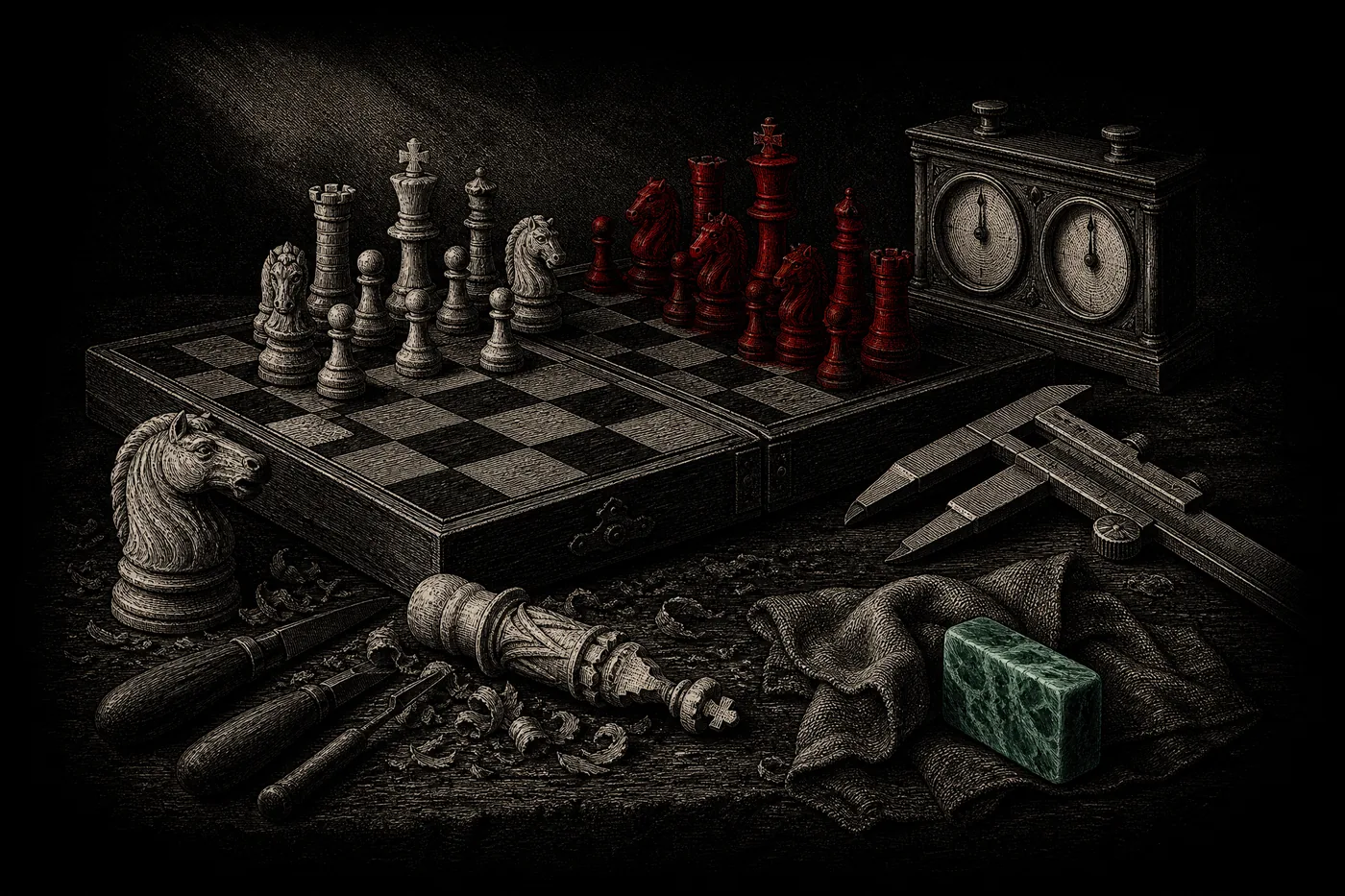
Here’s the short answer, before you spend a cent: if you want a set to actually play chess with — at home, at a club, in a tournament — a good weighted plastic Staunton set is hard to beat, and cheap. If you want something you’ll be proud to leave out on a shelf and hand down one day, that’s when wood earns its price tag. Neither is “better.” They’re built for different jobs, and once you see what each material really gives you, the choice basically makes itself.
Let’s break it down honestly — no fake product roundup, just what the materials actually do.
The 10-second version
- Plastic: tough, light-to-weighted, cheap, standard tournament choice. Buy this to play.
- Wood: beautiful, heavier, ages nicely, costs more. Buy this to own and enjoy.
- Both come in the same Staunton shape, so pieces are equally easy to recognize either way.
What actually matters when you’re choosing
Ignore the marketing photos for a second. The things that genuinely change your experience are:
- Feel in the hand — how heavy and stable the pieces are when you move them.
- Durability — will it survive a dropped bag, a kid, a decade of use?
- Portability — are you hauling this to a club, or does it live on a table?
- Look — does it matter to you that it’s pretty?
- Budget — described honestly as tiers, not fake prices.
Here’s how the two materials stack up on each:
| Plastic (ABS) | Wood (boxwood, sheesham, rosewood, ebony) | |
|---|---|---|
| Feel | Great when weighted; can feel hollow/light when cheap | Naturally solid, warm, tactile |
| Durability | Excellent — shrugs off drops and travel | Good, but can chip, dent, or crack if abused |
| Portability | Light and rugged — ideal for club/travel | Heavier; nicer wood you’ll baby a bit |
| Look | Clean and functional, rarely stunning | Genuinely beautiful, real grain |
| Budget | Entry-level to mid-range | Mid-range to premium |
| Best for | Playing, clubs, tournaments, kids | Display, gifts, “forever” home set |
The facts (the honest, checkable bits)
Plastic pieces are usually ABS, a hard, impact-resistant plastic. That’s why they survive being dumped in a bag and rattled around — the trait that makes them the default for scholastic and club play. A cheap plastic set feels tinny because the pieces are hollow and light; a good plastic set fixes this by adding weight (more on that in a moment), so it moves with a satisfying, stable thunk.
Wooden pieces are traditionally turned from boxwood for the light side. Boxwood is a light-colored, unusually fine-grained, relatively dense wood that’s been prized for carving and turning for centuries — exactly the qualities you want for detailed chess pieces. For the dark side, makers either use a naturally dark wood (sheesham, rosewood, ebony) or stain boxwood black — a finish literally called “ebonized” because it mimics ebony. That’s a genuine, traditional technique, not a shortcut. (Buxus — Wikipedia)
Both materials are almost always cut to the same Staunton pattern — the standardized shape FIDE recommends for competition — so a knight looks like a knight whether it’s ABS or ebony. Wanting to know more about the specific woods? We go deep in our chess set materials guide.

Which one should you actually buy?
- **First real set / kids / clubs / tournaments ** weighted plastic. It’s the workhorse. A double-weighted plastic Staunton set with a roll-up vinyl board is the single most sensible chess purchase most people can make, and it costs very little.
- **A home set you’ll love and use for years ** wood, mid-range. A boxwood-and-sheesham set hits a lovely sweet spot of looks, weight, and price.
- **A gift, a display piece, an heirloom ** wood, premium. This is where rosewood and ebony live, and where you’re paying for beauty. See our luxury chess sets guide for what that money actually buys.
- **Travel ** honestly, neither in its full-size form — look at a dedicated travel or magnetic set instead.
Common mistakes to dodge
- Buying a pretty wooden set you’re then scared to use. If it’s going to live in a cupboard because you don’t want to scratch it, it isn’t really a chess set — it’s décor. Match the set to how you’ll treat it.
- Judging plastic by the worst plastic. The flimsy hollow sets from a bargain bin give plastic a bad name. A properly weighted plastic set feels fantastic and is what serious clubs actually use.
- Assuming “wood = tournament grade.” Plenty of gorgeous wooden sets are the wrong size or too fragile for competition. It’s the size and weighting that make a set tournament-ready, not the material.
- Forgetting the board. Great pieces on a too-small board (or vice versa) look and play badly. Match your piece size to your square size — our set-up guide covers the proportions.
FAQ
Are wooden chess sets worth it? If you value how a set looks and feels and you’ll actually use it, yes — a mid-range wooden set is a genuine pleasure. If you mainly want to play a lot, travel, or teach kids, a good weighted plastic set gives you 90% of the playing experience for a fraction of the cost.
Do wooden pieces play “better” than plastic? Not in any way that affects your moves — a bishop is a bishop. What wood can offer is a heftier, warmer feel. But a well-weighted plastic set closes most of that gap, which is why top tournaments happily use plastic.
Which material do tournaments use? Overwhelmingly weighted plastic Staunton sets, because they’re durable, consistent, affordable in bulk, and easy to replace. Wood shows up more at home and in exhibitions.
Is plastic a downgrade? No. It’s a different tool. Plastic optimizes for durability and value; wood optimizes for beauty and feel. Pick based on the job.
The bottom line
Buy plastic to play, buy wood to own. If you can only get one and you’re new, start with a weighted plastic Staunton set — it’ll never let you down — and treat yourself to wood later once you know you love the game.
Next: how weighting actually works in weighted chess pieces, the full chess set materials rundown, or start from the gear guide hub.
Written and fact-checked by the Chess Lab Academy Editorial Team (AI-assisted, human-edited) · Material facts verified against Wikipedia and the FIDE Standards of Chess Equipment · Last verified 2026-07-13 · How we verify content.
