
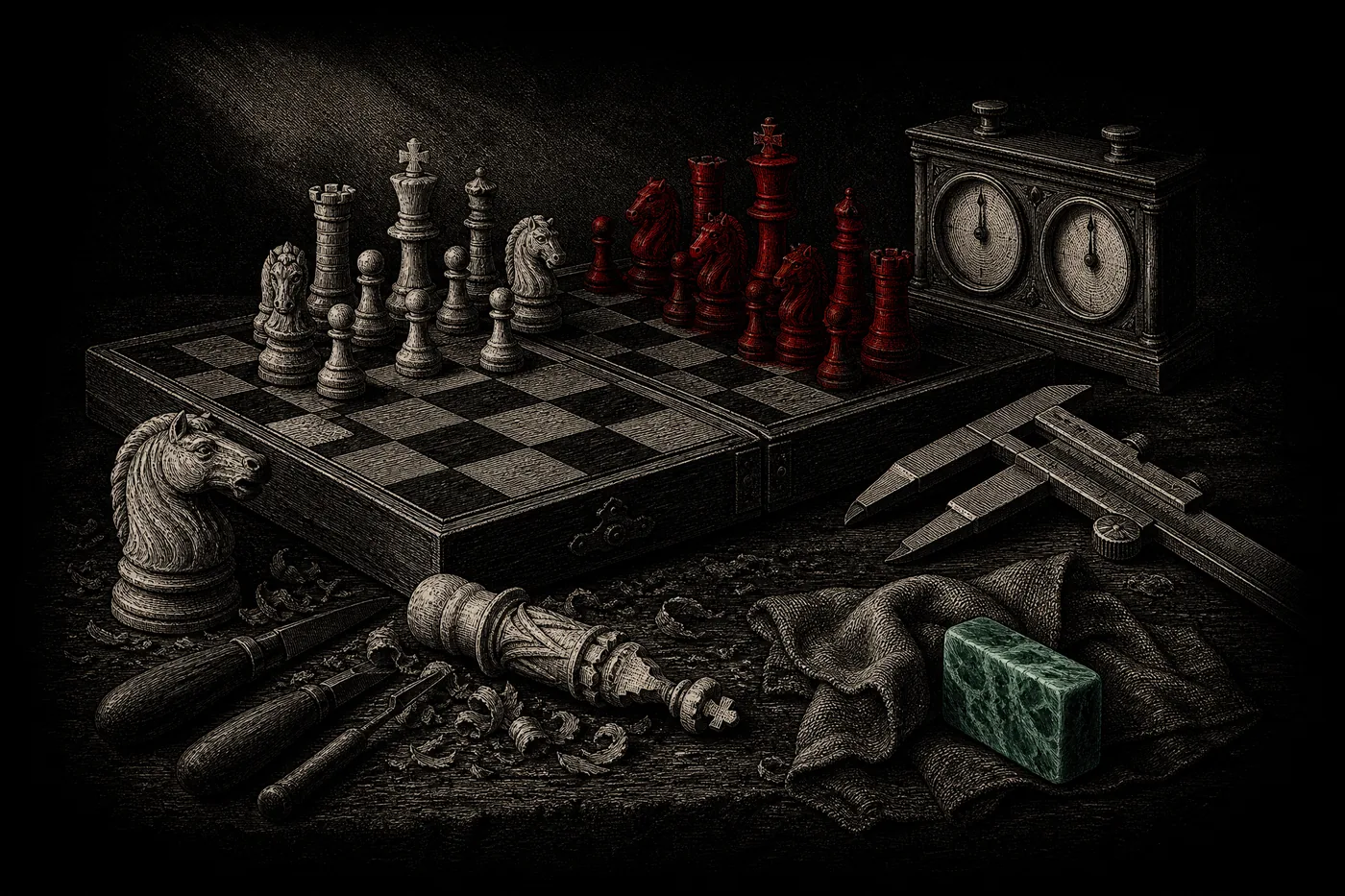
Pick up a cheap chess set and a good one, and the difference you feel first isn’t the wood or the carving — it’s the weight. Quality pieces have a small chunk of metal hidden in the base, so they sit low and steady and land with a satisfying, planted thunk. That’s all “weighted” means. And it matters more than beginners expect: a well-weighted set is calmer to play with, harder to knock over, and just plain nicer in the hand.
Here’s exactly what the weighting terms mean, why makers do it, and how much weight you actually need.
The 10-second version
- Weighting = a metal slug set into the base of each piece.
- Tiers go unweighted single double triple-weighted (each roughly heavier than the last).
- Most players are happiest with double-weighted. It’s the practical sweet spot.
What “weighted” actually means
Turn a good piece over and you’ll usually find a recess in the base, filled with a metal weight and then sealed under a felt (baize) pad. That metal is what gives the piece its heft and low center of gravity. Historically the weight was lead; many modern makers use steel or iron slugs instead. The felt base does two jobs: it hides and holds the weight, and it lets the piece glide across the board without scratching it. (Staunton chess set — Wikipedia)
So “weighted” isn’t a coating or a heavier plastic — it’s literally metal inside the base. The more metal, the heavier the tier.
The weighting tiers, explained
There’s no single industry ruler for these labels, but the ladder is consistent and the relative order always holds:
| Tier | What it feels like | Best for |
|---|---|---|
| Unweighted | Light, can feel hollow; tips easily | Kids’ first sets, ultra-budget, giant garden sets |
| Single-weighted | Noticeably steadier than unweighted | Casual home play on a budget |
| Double-weighted | Solid, planted, “premium” feel | Most players, clubs, serious home use |
| Triple-weighted | Very heavy, deliberate, luxurious | Enthusiasts and collectors who love the heft |
A rough rule of thumb you’ll see repeated: each step up roughly increases the metal in the base, so a double-weighted set can feel around twice the mass of an unweighted one, and triple heavier again. Exact grams vary by maker and piece size, so treat the tiers as relative, not as precise numbers.
Why weighting matters (it’s not just showing off)
- Stability. A weighted piece has a low center of gravity, so a bumped board or a shaky hand won’t send your position tumbling. This is genuinely useful in fast games and blitz.
- Feel and control. Heft makes pieces feel deliberate to place, which a lot of players find more satisfying and even a touch calming.
- Board protection. The felt base that caps the weight also protects your board’s finish and lets pieces slide cleanly.
- The touch-move reality. In serious play you commit to the piece you touch, so a stable, easy-to-place piece that won’t topple its neighbors is a real practical plus.
Note what weighting does not do: it doesn’t make you play better moves. A knight moves the same whether it weighs 5 grams or 50. You’re buying feel and stability, not strength.
Which tier should you buy?
- **Kids or a knockabout family set ** unweighted or single-weighted is fine, and cheaper to replace when a piece goes missing.
- **Your main home set / club play ** double-weighted. This is the honest default for almost everyone — solid feel, stable, not so heavy it’s a chore to pack up.
- **You love a hefty, luxurious feel (and don’t move the set much) ** triple-weighted. Gorgeous on a heavy board, but it adds real bulk and cost.
- **Travel ** weight is your enemy here; a light or magnetic set beats a heavy weighted one on the road.
Weighting applies to both plastic and wood — plenty of the best club sets are double-weighted plastic. If you’re still deciding on material, see wood vs plastic; for the woods themselves, see chess set materials.
Common mistakes to dodge
- Chasing the heaviest tier by default. Triple-weighted sounds impressive but is heavy to store and travel with, and many players actually prefer the balance of double-weighted. Heavier isn’t automatically better.
- Assuming weighted = wood. Weighting is about the metal in the base, not the material. A weighted plastic set is a real, excellent thing.
- Ignoring the felt. A quality felt base is part of the weighting job — it caps the weight and protects your board. Peeling or missing felt is a sign of a cheap build.
- Mismatching board and weight. A heavy triple-weighted set on a flimsy roll-up board looks and feels off. Pair heft with a solid board.
FAQ
What does “double-weighted” mean? It means each piece has more metal in its base than a single-weighted piece — roughly the next step up the heft ladder. It’s the most popular tier because it feels solid without being unwieldy.
Are weighted chess pieces better? Better feeling and more stable, yes. Better for your actual chess, no — weighting changes the experience, not the moves. For most people, some weighting (ideally double) is well worth it.
Can you weight pieces yourself? People do modify cheap sets, but it’s fiddly and rarely worth it. It’s far easier to buy a set that’s weighted the way you want from the start.
Is lead in old weighted pieces a concern? Some older sets used lead weights sealed inside the base. It’s inert under the felt, but if you have young kids or want to be cautious, look for sets that specify steel or iron weighting.
The bottom line
Weighted just means metal in the base, and it’s one of the clearest lines between a toy-feeling set and a proper one. For nearly everyone, double-weighted is the sweet spot — solid, stable, satisfying, and still sane to store.
Next: wood vs plastic, the full chess set materials guide, or head back to the gear hub.
Written and fact-checked by the Chess Lab Academy Editorial Team (AI-assisted, human-edited) · Construction facts verified against Wikipedia and the FIDE Standards of Chess Equipment · Last verified 2026-07-13 · How we verify content.
