

To set up a chessboard, place it so each player has a light-colored square in their bottom-right corner (“white on the right”). Line up your pawns across the second row, then put your back row in this order from left to right: rook, knight, bishop, queen, king, bishop, knight, rook. Remember “queen on her own color” and you’re set.
That’s the whole job. Let’s make sure you never get it wrong again — including the two little tricks that catch almost every beginner.
Quick setup checklist
- Board: light square in your bottom-right corner.
- Pawns: fill your entire 2nd row.
- Corners: rooks. Next to them: knights. Then: bishops.
- Center: queen and king. Queen on her own color, king beside her.
- White and Black mirror each other across the board.
Which way does the chessboard go?
Step one, and the one people botch most. The board has to be oriented correctly, or every other piece ends up mirrored.
The rule is dead simple: “white on the right.” When the board is facing you, the square in your bottom-right corner must be light-colored. Both players see a light square on their own right-hand side.
If your bottom-right corner is dark, the board’s rotated 90°. Just turn it a quarter-turn and you’re good. Get this wrong and your king and queen will end up swapped — a classic rookie giveaway.
Where do the chess pieces go?
Each player sets up on the two rows closest to them. The row right in front of you gets all eight pawns — a tidy wall of foot soldiers.
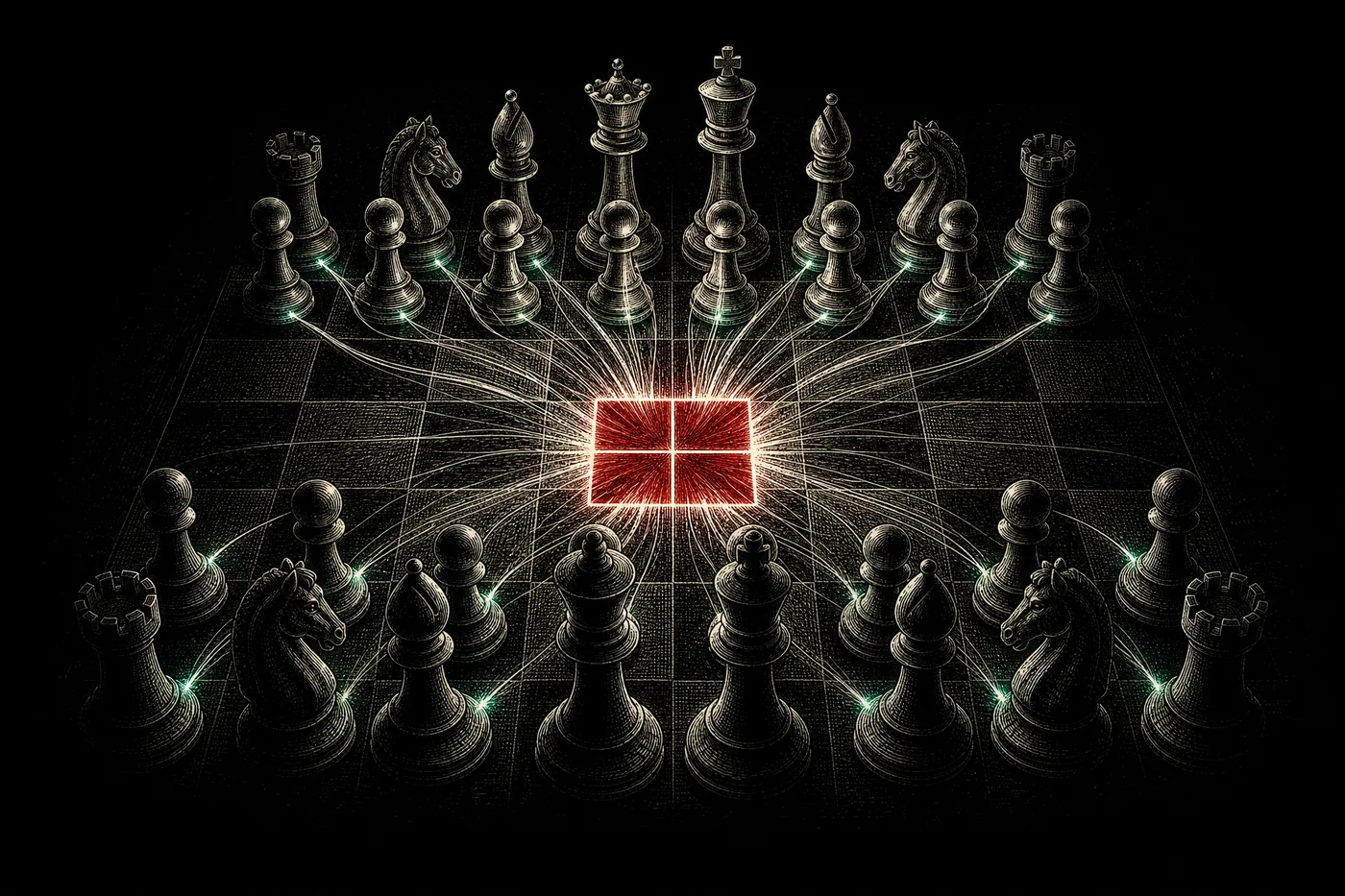
The back row (the one at the very edge) holds your eight bigger pieces, in this exact order from your left to your right:
Rook Knight Bishop Queen King Bishop Knight Rook
Here’s a clean way to think about it, working inward from the corners:
- Corners: the two rooks (they look like little castle towers — easy to remember they guard the corners).
- Next to the rooks: the two knights (the horses).
- Next to the knights: the two bishops (the tall pointy ones).
- The two middle squares: the queen and king.
The setup is perfectly symmetrical — Black mirrors White exactly across the board, so your rook faces their rook, your knight faces their knight, and so on.
A quick way to double-check you’ve placed everything: each side has exactly eight pawns and eight back-row pieces — two rooks, two knights, two bishops, one queen, and one king. Sixteen pieces per army, 32 total, filling the two rows nearest each player and leaving the four middle rows empty at the start. If your count is off, a piece has gone missing or sneaked into the wrong row.
Notice too that your bishops begin on opposite colors — one on a light square, one on a dark square. That’s by design: each bishop is locked to its own color for the entire game, so starting them on different colors means your two bishops cover the whole board between them.
Where do the king and queen go?
The two center squares are the only spot people second-guess. Which one is the queen, which is the king?
Use the famous memory trick: “the queen goes on her own color.”
- The white queen sits on a light square (d1).
- The black queen sits on a dark square (d8).
The king takes the remaining center square right next to her.
A neat little consequence: because each queen sits on her matching color, the two queens always end up facing each other down the same column (the d-file), and the two kings face each other down the next column (the e-file). If your queens aren’t lined up across from each other, you’ve put the king and queen in the wrong squares — swap them.
One more sanity check you can do in a single glance: the king and queen should sit on different colors from each other. They’re side by side on neighboring squares, and neighboring squares are always opposite colors, so a light-squared queen guarantees a dark-squared king (and vice versa). If you ever find both royals on the same color, something’s wrong.
Why does correct setup matter?
You might think “it’s just the starting position, who cares?” But a wrong setup quietly breaks the game’s logic.
If you swap the king and queen, castling will land your king on the wrong side and feel completely off, your opening moves won’t match any of the guides you read, and you’ll build bad habits from move one. The standard position exists so that openings, tactics, and every lesson in the world all line up. Set it up right and everything else you learn — like opening principles — actually clicks into place.
It also matters for reading and writing moves. The whole chess notation system depends on a correctly oriented board with files labeled a–h and ranks 1–8.
A fun bit of history
Why do the rooks look like little castle towers when “rook” doesn’t even mean castle? The piece comes from the Persian word rukh, meaning “chariot” — in the oldest versions of chess it was a war chariot, not a building. As the game traveled into Europe, the design morphed into a fortified tower, and English speakers started informally calling it a “castle.” That’s also why castling — the move that whisks your king toward a rook — got its name. So when you set those towers in the corners, you’re placing 1,500-year-old chariots in disguise.
Common setup mistakes to dodge
- Dark square in the bottom-right. The board’s turned the wrong way. Rotate it a quarter-turn. Remember: white on the right.
- King and queen swapped. The #1 error. Fix it with “queen on her own color.”
- Knights and bishops switched. Order from the corner is rook, knight, bishop. The knights (horses) sit outside the bishops.
- Mirroring Black instead of matching it. Black isn’t a flipped copy in placement order — it’s the same left-to-right order, just on the opposite side, so the pieces naturally face their counterparts.
- Setting up before checking orientation. Always fix the board’s direction first, then place pieces.
Key takeaways
- “White on the right”: light square in each player’s bottom-right corner.
- Pawns fill the row in front; the back row goes rook, knight, bishop, queen, king, bishop, knight, rook.
- Rooks in the corners, then knights, then bishops, with king and queen in the center.
- “Queen on her own color” — white queen on light (d1), black queen on dark (d8).
- Done right, the queens face off on the d-file and kings on the e-file.
Keep climbing
Board’s set — time to learn what everything does.
Next up: How the pieces move · then dig into the full rules of chess and your first opening principles.
Written and fact-checked by the Chess Lab Academy Editorial Team (AI-assisted, human-edited) · Rules verified against the FIDE Laws of Chess and every position checked with Stockfish 17 · Last verified 2026-06-25 · Sources · How we verify content.
