
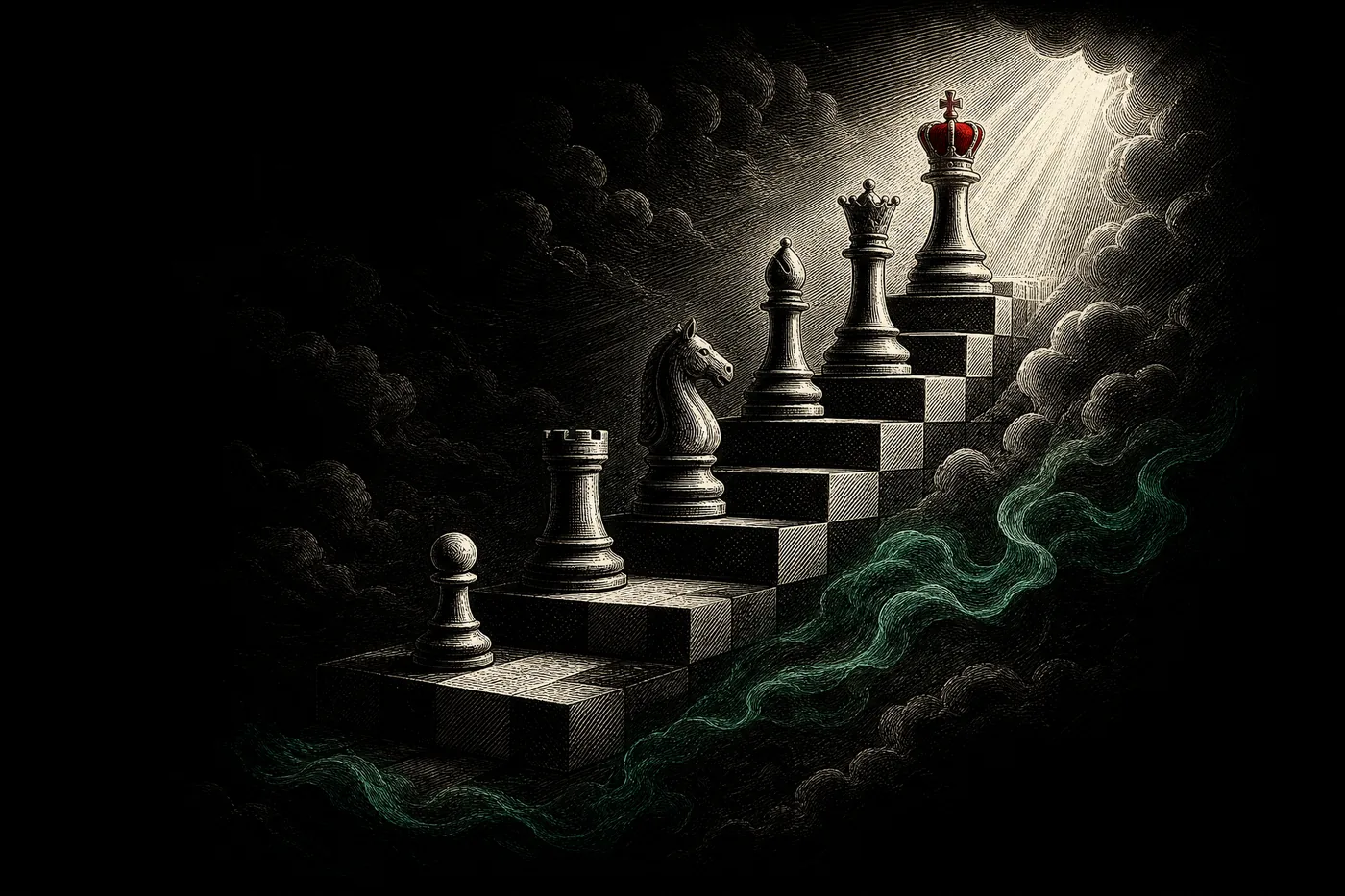
Chess visualization is your ability to see the board in your head — to picture where pieces sit after a sequence of moves without touching anything. You train it the same way you’d train any mental skill: small, frequent drills that gradually stretch how far ahead you can “see” while keeping the picture sharp. Start with two or three pieces, calculate a short line in your mind, then check yourself. That’s the whole engine of improvement.
If your calculation goes blurry after a couple of moves — pieces drifting, squares forgotten — that’s not a talent ceiling. It’s an untrained mind’s eye, and the mind’s eye gets stronger with reps. Let’s build it.
The visualization starter kit
- Know your coordinates cold. Every square by name, every diagonal, instantly.
- Drill small first. 2–3 pieces, short lines. Sharp beats deep.
- Calculate before you move. See the whole line in your head, then check.
- Name the color of squares. Is h1 light or dark? Train your board map.
- Stretch slowly. Add a piece or a move only when the picture stays clear.
Why does visualization matter so much?
Because calculation is only as good as the board you’re picturing. You can pick perfect candidate moves and follow forcing lines flawlessly — but if, three moves in, you’ve “lost” where your rook is, the whole calculation collapses. Visualization is the screen your calculation runs on.
It’s also the difference between players who trust their reading of a position and players who second-guess every line. A clear mental board means you commit to good moves with confidence instead of hoping. This is exactly why visualization and calculation are trained together — they’re two halves of the same skill.
How do you start training chess visualization?
Begin embarrassingly small. The goal isn’t to impress anyone; it’s to keep the picture perfectly clear and grow from there.
- Master the coordinates. You can’t visualize a board you can’t name. Drill until “f6,” “the a1–h8 diagonal,” and “is c4 light or dark?” come instantly. (Brush up on files, ranks, and diagonals.)
- Start with 2–3 pieces. A king and pawn vs a king. Picture a few moves, then look at a real board to check.
- Calculate before touching anything. Pick a position, decide the next 2–3 moves in your head, then play them out to verify.
- Add complexity slowly. One more piece, or one more move of depth — only once the smaller version is crisp.
Three pieces feels too easy — which is exactly the point. You’re building a clean, reliable picture before you ask your brain to juggle sixteen pieces.

What are the best visualization exercises?
A few drills carry most of the weight:
- The square-color drill. Name a random square, instantly say its color. Light or dark, no peeking. This wires the board map into your head.
- The knight-path drill. Pick a start and target square, then visualize the shortest knight route between them. Brutal at first, magic for board vision.
- Blindfold mini-games. Play a 2–4 piece position entirely in your head, calling out moves. Not the legendary full-board blindfold stuff — just tiny scenes. (More on that below.)
- Read-the-line puzzles. Take a tactics puzzle and solve the entire solution in your head before moving. If you lose the thread, restart from the diagram.
- Notation-only replays. Read a short game’s moves and try to picture each position. Stop the moment it blurs.
Is blindfold chess a good training tool?
Yes — in small doses, and you do not need to play a full blindfold game to benefit. Full blindfold chess (an entire game with no board) looks superhuman, but it’s just an extreme version of the same skill, built up piece by piece over years.
For improvement, mini blindfold drills are the sweet spot: hold a 2–4 piece endgame in your head and play it out, or visualize the first few moves of a familiar opening. The aim isn’t showing off — it’s stretching how many pieces and moves you can hold clearly. Push only as far as the picture stays sharp; the second it gets fuzzy, reset. Clarity is the rep that counts.
The legend of blindfold simuls
Here’s a fun motivator: the all-time blindfold records are genuinely jaw-dropping — masters have played dozens of games at once, entirely in their heads, calling moves to each board from memory. It sounds like a party trick, but it’s the same muscle you’re training when you picture a three-piece endgame — just stretched to an extreme over a lifetime of practice. Nobody is born able to do that. They built it one clear position at a time, exactly like you’re about to. Your goal isn’t 40 boards. It’s seeing your next three moves crisply. Same skill, friendlier scale.
Common visualization mistakes
- Jumping to complex positions too soon. If you start with a crowded board, the picture blurs and you learn nothing. Earn complexity by mastering simplicity.
- Moving pieces to “help” yourself calculate. It feels productive but skips the actual training. The whole point is to not move them. See it first.
- Pushing past the blur. Once the mental board goes fuzzy, you’re just guessing. Reset to the diagram instead of bluffing forward.
- Skipping the coordinate work. Shaky square-naming caps everything above it. Five minutes a day of square-color and knight-path drills pays off hugely.
- Practicing rarely but intensely. Visualization rewards little-and-often. Five minutes daily beats an hour once a week.
Key takeaways
- Visualization = seeing the board in your head; it’s the screen your calculation runs on.
- Start with 2–3 pieces and short lines; keep the picture perfectly clear before adding complexity.
- Drill coordinates, square colors, and knight paths — board vision is the foundation.
- Use mini blindfold drills, not full blindfold games, to stretch your mind’s eye.
- Practice little and often, and always reset to the diagram when the picture blurs.
FAQ
How do I improve my chess visualization? Start tiny — two or three pieces — and calculate short lines in your head before checking against a real board. Drill coordinates, square colors, and knight paths daily, and only add pieces or depth once the mental picture stays sharp.
How do you see the chess board in your head? By building a strong square map first (instant coordinates and square colors), then practicing holding small positions in mind. The board “appears” through repetition: the more clean reps you do, the more vivid and reliable the picture becomes.
Do I need to play blindfold chess to get good? No. Full blindfold games are impressive but unnecessary. Short mini-drills — picturing a few moves of a 2–4 piece position — train the same skill far more safely and are plenty for real improvement.
Why does my calculation get fuzzy after a few moves? That’s a visualization limit, not a calculation failure. Your mind’s eye loses track of the moved pieces. Train it with small positions and stop the instant the picture blurs, rather than guessing onward.
How long does it take to improve visualization? You’ll feel a difference within a few weeks of short daily drills. It’s a slow-but-steady skill: little-and-often practice compounds, while rare marathon sessions mostly just tire you out.
Is visualization the same as calculation? No — they’re partners. Calculation is choosing and sequencing moves; visualization is clearly seeing the resulting positions. Weak visualization caps your calculation, which is why they’re best trained together.
What’s a good first visualization drill? The square-color drill: name a random square and instantly say whether it’s light or dark. It takes minutes a day and builds the board map that every other visualization skill stands on.
Keep climbing
A sharp mental board is only worth it if you point it at the right moves. The next step is turning clear vision into accurate, decisive calculation.
Next up: How to calculate in chess · Also handy: files, ranks & diagonals, how many puzzles per day, and the improvement hub.
Written and fact-checked by the Chess Lab Academy Editorial Team (AI-assisted, human-edited) · Positions checked with Stockfish 17, rules per the FIDE Laws of Chess · Last verified 2026-06-25 · Sources · How we verify content.
