
The two bishops checkmate forces a lone king into a corner using your king plus both bishops. Because the bishops cover squares of both colors, you can mate in any corner (unlike the bishop-and-knight mate). The bishops build a moving diagonal wall, your king helps herd, and the king gets cornered. It’s moderate difficulty — harder than the rook mate, far easier than bishop + knight.
Here’s how the bishop pair works together and the exact mating picture to aim for.
Two bishops in 3 ideas
- Yes, two bishops can force mate (any corner).
- Place the bishops on adjacent diagonals — they form a wall the king can’t cross.
- Walk the wall forward, bring your king up, and corner the lone king for mate.
Can you checkmate with two bishops?
Yes — and it’s a forced win against any defense. This matters because not every “two extra pieces” combo can mate: a lone bishop can’t, a lone knight can’t, and famously two knights can’t be forced to mate at all. But two bishops, working as a pair with your king, always can. So if you ever reach king + two bishops vs a lone king, the full point is there for the taking.
The reason the bishop pair is so strong: a single bishop only ever touches half the board (one color). Two bishops cover both colors, so together they can wall off the king completely and shepherd it anywhere — including into any corner you like.
How do two bishops work together to mate?
The key picture is the wall. Put your two bishops on adjacent, parallel diagonals and they control a long unbroken barrier of squares. The lone king can’t step across that barrier — both colors are covered — so it’s stuck on one side.
From there the method is:
- Build the wall — bishops on neighboring diagonals, fencing the king onto one part of the board.
- March the wall forward, one bishop at a time, pushing the king toward an edge. Keep the barrier intact as you advance.
- Bring your king up to support — like every basic mate, the bishops can’t finish alone. Your king blocks escape squares the bishops can’t reach.
- Herd the king into a corner. Two bishops can’t mate against the edge alone (only the corner), so keep pushing all the way.
- Deliver mate with one bishop checking and the other (plus your king) sealing the escape squares.
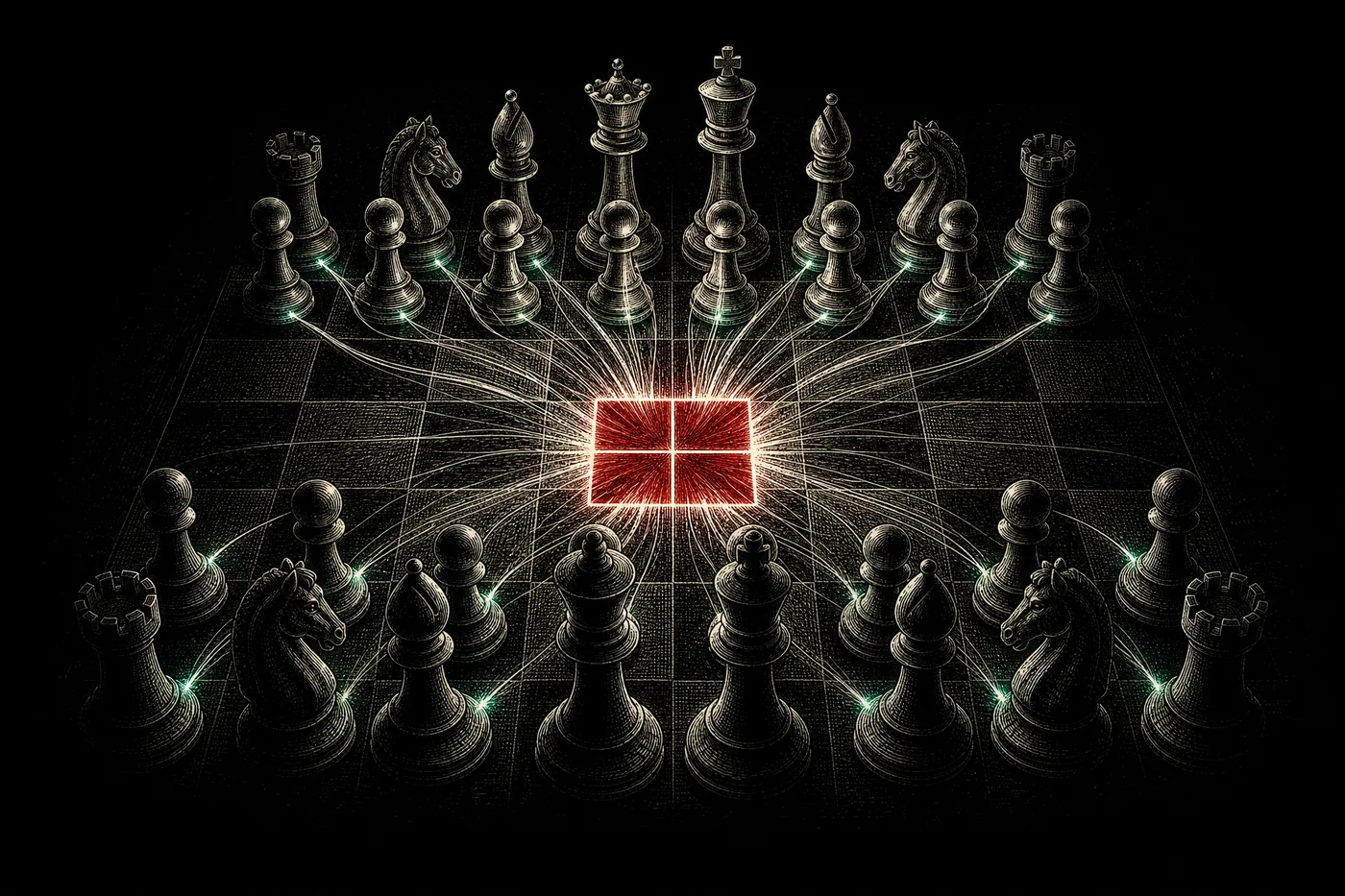
What does the two bishops mate look like?
The finish lives in the corner. Here’s a clean mating picture:
Walk through why the king on a8 is mated: the light-squared bishop on g2 checks along the long a8–h1 diagonal. The escape squares b8 (covered by the dark-squared bishop on h2), a7 and b7 (both guarded by White’s king on b6) are all off-limits. The king can’t capture either bishop — they’re miles away — and can’t approach White’s king. No legal move while in check: checkmate.
Notice the teamwork: each bishop handles one color, the king mops up the rest. That division of labor is the soul of the two-bishop mate.
How do you drive the king from the center?
Beginners often build a nice wall and then freeze, unsure how to actually make progress. The trick is to advance patiently with all three pieces, never letting the king slip back toward the center:
- Use one bishop to take away squares on one side, then bring the other bishop up alongside it to extend the barrier. The king loses ground each time.
- Bring your king up to “kiss” distance — one square away from the enemy king, in opposition. Your king is the piece that actually corners the lone king; the bishops just fence off the escape routes.
- When the king is on the edge, walk it toward a corner. Two bishops can’t mate against the side of the board alone — only in the corner — so keep nudging it along the rim until it has nowhere left to slide.
A useful mental check: after every move, ask “did the enemy king lose a square?” If yes, you’re making progress. If it just shuffled side to side, tighten the net before pushing again. Slow and steady wins this one comfortably inside the move limit.
How long does the two bishops mate take?
With perfect play, two bishops vs a lone king is mate in at most 19 moves from any legal start (endgame tablebases confirm it). That’s comfortably inside the 50-move draw rule, but you’ll want decent technique so you don’t waste moves wandering. Practice the wall-and-march routine a few times and it becomes automatic.
A fun bit of history
For centuries, players debated which “two minor pieces” combos could actually force mate, and the answers are delightfully uneven. Two bishops? Yes. Bishop and knight? Yes (but brutally hard). Two knights? No — against best defense it’s a draw, which still surprises people who assume more material always wins. The two-bishop mate, by contrast, is reliable enough that it shows up in real tournament games, sometimes after a long endgame grind where one side hangs onto the bishop pair specifically because it knows the mate is there.
Common mistakes to dodge
- Trying to mate on the edge instead of the corner. Two bishops can only mate a king in the corner. Don’t stop pushing early.
- Letting the wall break. If your bishops drift onto non-adjacent diagonals, a gap opens and the king slips through. Keep them coordinated.
- Forgetting your king. The bishops cannot mate alone — your king must come block the escape squares.
- Stalemating in the corner. As always, check the king has a legal square unless it’s truly mate. See what is stalemate.
Key takeaways
- Two bishops can force checkmate in any corner (because the pair covers both colors).
- Put the bishops on adjacent diagonals to build a wall, then march it forward.
- Bring your king up to help — the bishops can’t mate alone.
- The mate happens in the corner: one bishop checks, the other plus your king seal every escape. Mate in 19 or fewer with perfect play.
Keep climbing
You’ve handled the friendliest two-piece mate. Ready for the legendary hard one? The bishop-and-knight mate is the final boss of basic endgames.
Next up: Bishop & knight checkmate (the hardest basic mate) · Or revisit the basic checkmates overview and the king & queen mate.
Written and fact-checked by the Chess Lab Academy Editorial Team (AI-assisted, human-edited) · Positions verified with Stockfish 17 and rules checked against the FIDE Laws of Chess · Last verified 2026-06-25 · Sources · How we verify content.
