
The bishop and knight checkmate is the hardest basic mate because you can’t corner the king just anywhere — you must drive it to a corner that matches your bishop’s color. A light-squared bishop mates only in a light corner; a dark-squared bishop, only in a dark corner. With the 50-move clock ticking, it takes precise technique. Most players never need it, but landing it is a true badge of honor.
Here’s why it’s so tricky, the “W maneuver” that tames it, and the exact mating picture.
The hard mate, decoded
- You must drive the king to a same-color corner as your bishop.
- The bishop and knight cover different colors — they have to be perfectly coordinated.
- The W maneuver is the knight’s path that herds the king along the edge to the right corner.
- You have 50 moves before a draw can be claimed — and it can take up to ~33. Tight.
Why is the bishop and knight mate so hard?
Three things stack up against you.
First, the corner is fixed. Two bishops can mate in any corner; king and rook drive to any edge. But a bishop only ever touches one color of square. So the only corner where the bishop can control the mating squares is a corner of its own color. If your bishop is light, you can only mate on a light corner (a8 or h1) — and the lone king will run for the wrong-colored corner to save itself. You have to outmaneuver it.
Second, coordination is fussy. The bishop covers one color, the knight the other, and the knight is short-ranged and clumsy. Keeping the two pieces working as a team while also advancing your king is genuinely demanding.
Third, the clock. With no pawns on the board, the 50-move rule applies: if 50 moves pass with no capture or pawn move, the defender can claim a draw. Perfect play mates in up to 33 moves, so you have a buffer — but waste a few moves and you can actually run out of time. No other basic mate has this pressure.
How do you checkmate with a bishop and knight?
The plan has three phases:
- Push the king to the edge. Just like the other mates — use king, bishop, and knight together to shrink the king’s space until it’s stuck on a rim.
- Drive it to the right corner. This is the unique part. The king will head for the wrong-colored corner (where it’s safe). You must herd it along the edge toward the corner that matches your bishop. This is where the famous knight maneuver comes in.
- Deliver mate with the bishop checking, the knight and your king sealing every escape.
The bishop builds a diagonal barrier the king can’t cross; the king and knight do the close-in herding. Your own king must stay active the entire time — it’s the most important of the three pieces.
What is the W maneuver?
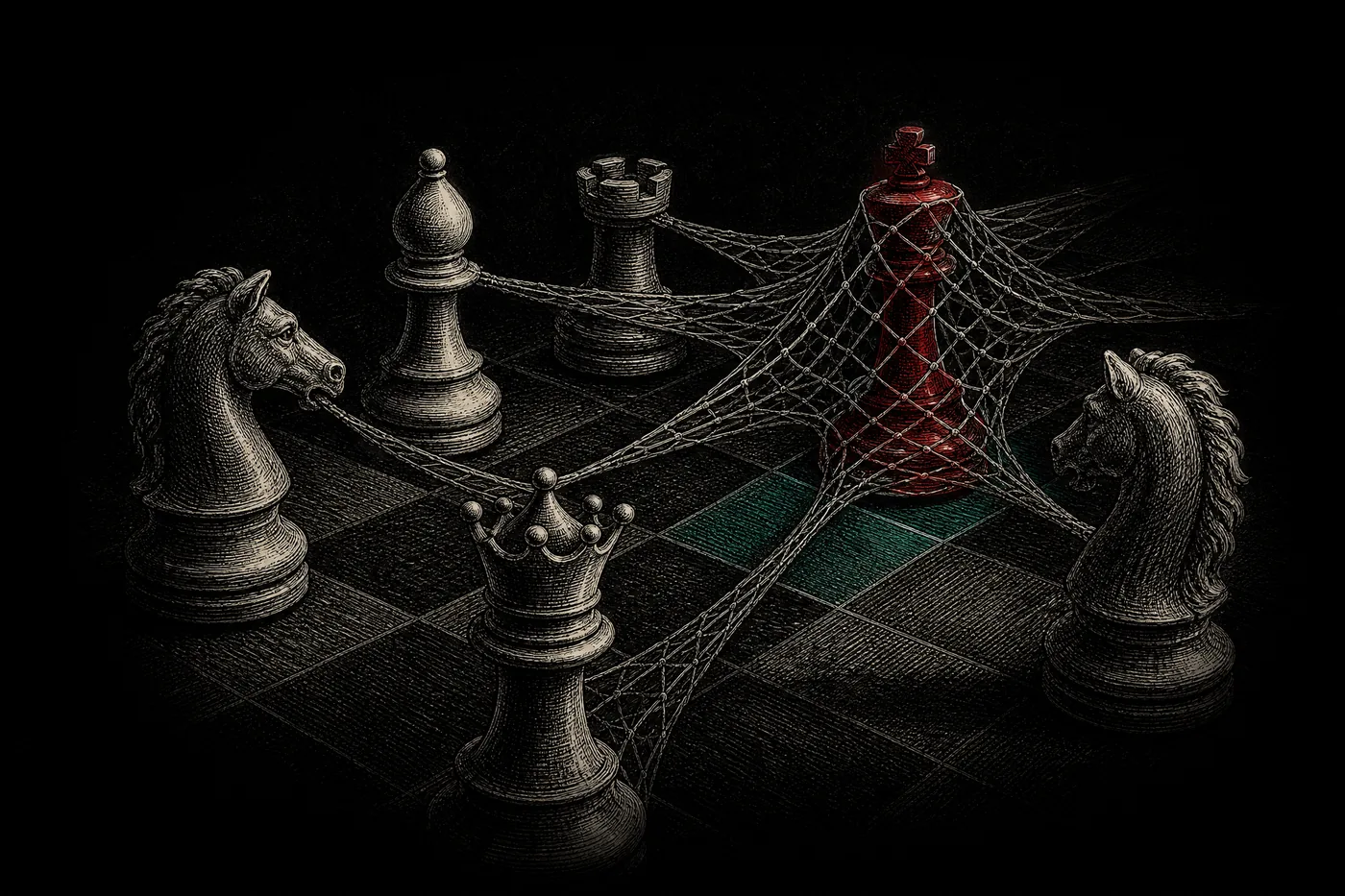
The W maneuver is the knight’s signature path that escorts the king along the edge to the correct corner. The knight bounces between a sequence of squares that trace a W shape on the board, controlling each escape square in turn as the king is walked toward the right corner.
The idea: the king tries to slide along the edge away from the bad corner. The knight, hopping its W-pattern, keeps removing the square the king wants to flee to, while your king shadows it and the bishop holds the long diagonal. Square by square, the king is squeezed into the mating corner with no way out. It feels like herding a stubborn sheep with three sheepdogs — but once you’ve drilled the pattern, it clicks.
What does the bishop and knight mate look like?
The finish happens in the bishop-colored corner. Here’s a clean mate with a light-squared bishop in the light corner (a8):
Trace the cage on the king at a8: the light bishop on c6 checks along the a8–h1 diagonal. The escape squares are all sealed — b8 by the knight on d7, and a7 plus b7 by White’s king on b6. The king can’t capture any attacker (all out of reach) and can’t approach White’s king. In check with no legal move: checkmate. Notice the perfect division of labor — bishop on the light diagonal, knight on a dark square, king mopping up the rest.
A fun bit of history
This mate has humbled grandmasters. In a famous 2001 game (Kempinski–Epishin, played in the German Bundesliga), GM Vladimir Epishin failed to convert bishop and knight against a lone king and only drew — at the top level! Because it’s so rare and so hard, many strong players deliberately learn it just so they’re never caught out. There’s even an old chess proverb that you should keep a bishop and knight together precisely because the mate exists, even if the odds of needing it are slim. It’s the endgame equivalent of knowing how to land a backflip: you’ll almost never use it, but pulling it off earns instant respect.
Common mistakes to dodge
- Driving the king to the wrong corner. The single biggest error. You cannot mate in a corner that’s the opposite color of your bishop — herd it to the matching one.
- Losing piece coordination. If the bishop and knight drift apart, the king slips through the gap. Keep them working as a unit.
- Letting your king fall behind. Your king must lead the chase. A passive king means no mate.
- Burning the clock. Wandering aimlessly can flirt with the 50-move draw. Know the method before you trust it in a real game. And as always, mind stalemate.
Key takeaways
- Bishop and knight checkmate is the hardest basic mate — you must reach a same-color corner as your bishop.
- The W maneuver (the knight’s path) herds the king along the edge to the right corner.
- All three pieces — king, bishop, knight — must coordinate; the king leads the chase.
- Perfect play mates in up to 33 moves, so beat the 50-move rule by knowing the technique cold.
Keep climbing
You’ve reached the summit of basic mates. If you want a refresher on the easier ones, or to see how the bishop pair compares, those pages are right here.
Revisit: Two bishops checkmate (the easier cousin) · Basic checkmates overview · or head back to the endgame hub.
Written and fact-checked by the Chess Lab Academy Editorial Team (AI-assisted, human-edited) · Positions verified with Stockfish 17 and rules checked against the FIDE Laws of Chess · Last verified 2026-06-25 · Sources · How we verify content.
