
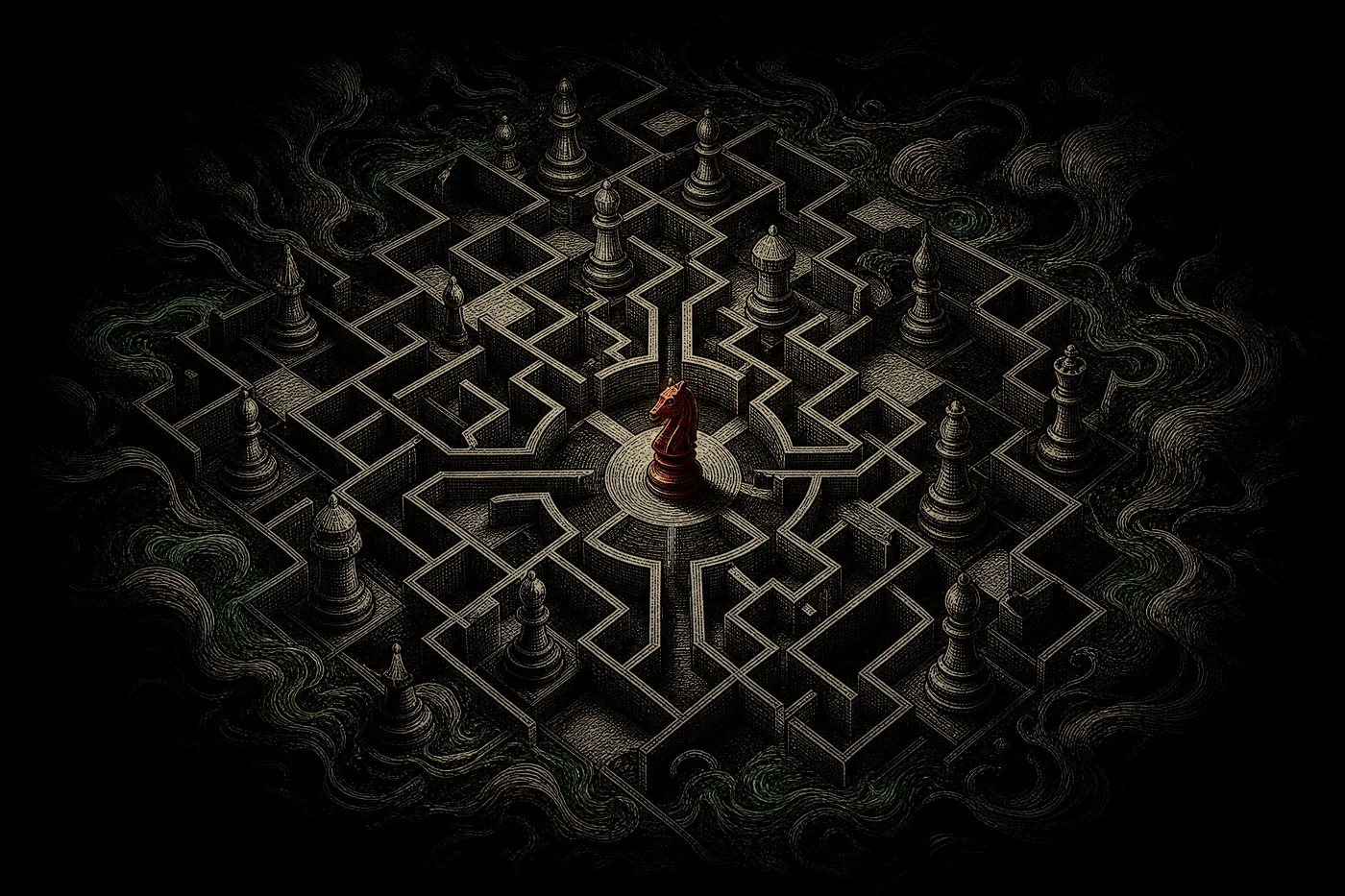
A mate in four puzzle is a four-move forced sequence that ends with the enemy king in a box, no matter how they defend. This is the deep end of mate training — the puzzles that feel impossible until the corridor of checks suddenly snaps into focus and the whole thing becomes obvious. Solve a few and your calculation gets noticeably sharper. Take a breath and open the trainer.
Your move — solve the position
Real positions from real games. Solve one, and the next appears.
Take that instinct to a live board — 3D chess with character skins & rewards.
What “mate in four” means
Four of your moves, three forced replies from your opponent, ending in checkmate against every defense. Four moves sounds like a lot to hold in your head, and it would be — except the moves are forcing. Because each is a check or an unstoppable threat, your opponent almost never has a real choice, so the position stays on rails. You’re not searching a jungle of possibilities; you’re tracing one narrow, twisting path to a mate you can already picture at the end.
Long forced mates are pure calculation and visualization training. That’s the real prize here: the checkmate is the reward, but the skill you build seeing four moves ahead is what wins your actual games.
A method for solving mate in four
- Visualize the mating net first. Before you calculate a single move, ask how this king gets mated — which piece delivers the final check, and on which square. Long mates are far easier when you solve backward from that picture than when you shove pieces forward hoping.
- Chain your most forcing moves. In a mate-in-four the line is almost always checks. Play the most forcing check, see the forced reply, then the next check — the opponent’s answers are so limited that the corridor reveals itself.
- Answer every defense, every move. Deeper puzzles have more branch points. At each of your opponent’s turns, confirm all their legal replies still lose. A single surviving defense kills the whole line.
- Watch for the quiet killer. Not every move can be a check. Sometimes move three is a silent, non-checking move that removes the king’s last escape square or threatens unstoppable mate. When your checks run dry but the king is caged, hunt for that quiet finishing touch.
Only commit to a line when it mates against every reply at every branch. Deep puzzles punish “close enough.”
Common mistakes to dodge
- Calculating forward instead of backward. Pushing pieces forward and hoping is exhausting and error-prone. Picture the finish and reason back — it’s dramatically faster.
- Dropping a branch. With three enemy replies to cover, it’s easy to solve the main line and miss a sideline that escapes. Verify every defense.
- Losing the board in your head. Four moves deep, pieces blur. Slow down, rebuild the position mentally move by move, and don’t rush the commit.
- Only looking at checks. Some four-move mates hinge on a quiet move in the middle. If checks alone don’t finish, look for the move that quietly takes away the king’s last breath.
Keep climbing
You’re at the deep end of forced-mate training. Consolidate, or drop back to rebuild speed on shorter nets.
Next up: rebuild sharpness with mate in three and mate in two · Train the underlying skill: calculation and visualization · Study the shapes: checkmate patterns · Back to the hub: all chess puzzles.
Frequently asked questions
Are mate in four puzzles too hard for most players? They’re advanced, but they’re solvable by anyone willing to slow down — because the moves are forcing, the line stays narrow. If they feel overwhelming, spend time on mate in three first, then come back.
What’s the best way to calculate a long forced mate? Work backward from the mating picture and chain your most forcing moves. Forcing moves limit the opponent’s replies, which keeps the calculation manageable even four moves deep.
Do longer mate puzzles actually help my game? Yes — arguably more than any other puzzle type for pure calculation. Seeing four accurate moves ahead in a puzzle directly trains the visualization you use over the board.
Are the positions genuine? Every one is a real, engine-verified forced mate from the Lichess open database (CC0). No fabricated setups.
Written and fact-checked by the Chess Lab Academy Editorial Team (AI-assisted, human-edited) · Puzzles from the Lichess open database (CC0), engine-verified · Last verified 2026-07-13 · Sources · How we verify content.
