
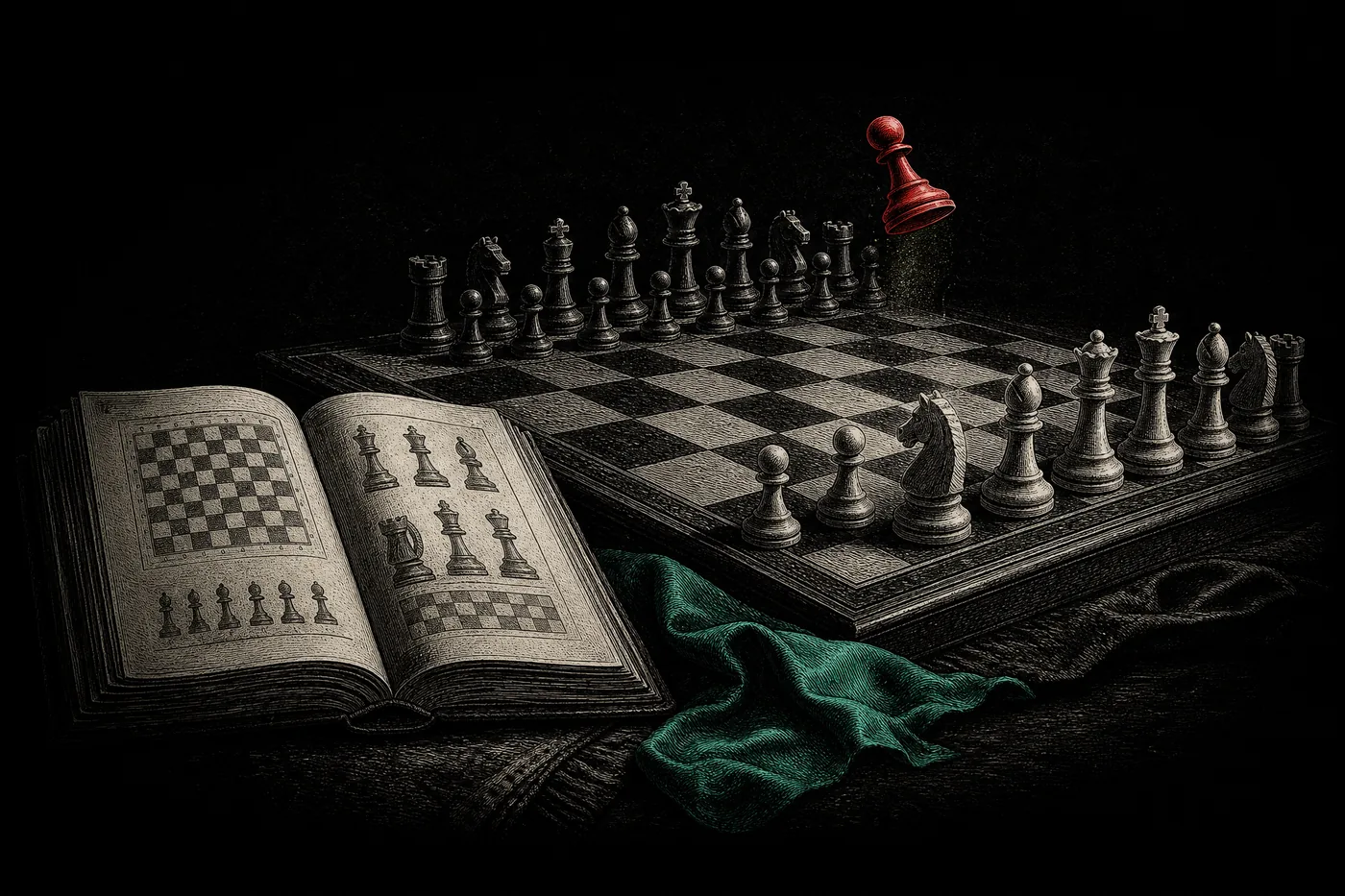
A knight moves in an L-shape: two squares in a straight line (up, down, left, or right) and then one square at a 90-degree angle — or one square then two, it’s the same move. And here’s its claim to fame: the knight is the only piece that can jump over other pieces, friend or foe. Nothing blocks its path.
That hopping L is what makes the knight feel so alien at first — and so deadly once it clicks. Let’s break the move down until it’s second nature.
Knight cheat sheet
- Move: an “L” — 2 squares one way + 1 square at a right angle.
- Always lands on the opposite color square from where it started.
- Jumps over any pieces in the way (the only piece that can).
- Captures by landing on an enemy piece’s square.
- Best in the center, terrible in the corner.
What exactly is the L-shaped knight move?
Picture the letter L. The knight goes two squares in one direction, then turns and goes one square. That’s one L. The knight can make that L in eight different orientations, so from a central square it has up to eight possible destination squares.
A handy mental trick: from any square, a knight always lands on the nearest squares it can’t already reach in a straight or diagonal line. Another handy fact — the knight always changes square color. Start on a light square and you’ll land on a dark one, every single time, without fail. (Players use this to double-check a knight move is legal.)
The number of squares a knight can reach depends heavily on where it stands:
In the center: up to 8 squares. On the edge: 3 or 4. In the corner: a miserable 2. This is the origin of the famous chess saying, “a knight on the rim is dim” — knights crave the center, where their reach is maximized.
Can a knight jump over other pieces?
Yes — and it’s the only piece that can. Rooks, bishops, and queens all get blocked by anything sitting in their path. The knight just leaps clean over, like a horse jumping a fence. It doesn’t matter if the squares in between are packed with pieces; the knight only cares about its landing square.
This is exactly why knights are often the first pieces to come out in the opening: they don’t need pawns to move out of the way first. While your bishops and rooks are stuck behind the pawn wall on move one, your knights can already hop into the game. That’s a core idea in opening principles — get your knights out early.
How does a knight capture?
The same way it moves. A knight captures by landing on a square occupied by an enemy piece — completing its L-shaped jump onto that piece, which then comes off the board. There’s no separate capturing rule like the pawn has.
Important: the knight only affects its destination square. Any pieces it jumped over on the way are completely safe — it can’t capture something mid-jump. It only ever takes the piece it lands on.
This makes the knight sneaky. Because it attacks in that bent L-pattern, its threats are easy to overlook. The knight’s signature weapon is the fork: jumping to a square where it attacks two (or more) enemy pieces at once. A knight forking a king and a queen is one of the most satisfying — and most common — beginner-trap moments in all of chess.
Why is a knight written as “N” in notation?
Quick fun one. In chess notation, each piece gets a letter: King = K, Queen = Q, Rook = R, Bishop = B… and the knight gets N. Why not K? Because K is already taken by the King, and you can’t have two pieces share a letter. So the knight borrowed the N from “knight.” A move like Nf3 means “knight to f3.” We cover the whole system in chess notation explained.
Why the knight matters
The knight is worth about 3 points — the same as a bishop — but it shines in different situations. Knights are kings of closed, cluttered positions where pawns clog the board and long-range pieces get blocked. While a bishop sulks behind a wall of pawns, the knight just hops over everything and keeps making trouble.
Knights are also the best forking piece in the game thanks to their weird attack pattern. Learn to spot knight forks early and you’ll win material against beginners constantly — and learn to fear them so you don’t walk into one.
Common knight mistakes
- Parking knights on the rim. A knight on the edge or corner loses half its power. Aim for strong central squares instead.
- Forgetting they jump. Beginners assume a piece “blocks” a knight — it doesn’t. Always check what a knight can leap to, even through a crowd.
- Missing enemy forks. Because the L-shape is unintuitive, beginners constantly leave their king and queen on squares a single knight hop can fork. Scan for it before every move.
- Trapping your own knight. A knight deep in enemy territory with no safe squares can get rounded up. Make sure it has an escape route.
Key takeaways
- A knight moves in an L-shape: 2 + 1 at a right angle, in any of 8 directions.
- It’s the only piece that jumps over others — nothing blocks it.
- It always lands on the opposite color square from where it started.
- It’s strongest in the center (up to 8 squares), weakest in the corner (just 2).
- The knight’s specialty is the fork — attacking two pieces at once.
FAQ
Can a knight move in a straight line? No. The knight only ever moves in its L-shape. It can’t slide straight or diagonally like other pieces.
Does a knight really jump over pieces? Yes — it’s the only piece that can. Pieces in between don’t block or get captured; only the landing square matters.
How many squares can a knight move to? Up to 8 from a central square, but as few as 2 from a corner. Position is everything for a knight.
Why is the knight an “N” and not a “K”? Because “K” is reserved for the King. The knight uses “N” (the second letter of its name) to avoid the clash.
What is a knight fork? A move where a knight lands on a square attacking two or more enemy pieces at once. If it forks the king and queen, you usually win the queen.
Is a knight or bishop better? They’re worth the same (about 3 points). Knights prefer closed, blocked positions; bishops prefer open ones. It depends on the board.
Keep climbing
You’ve tamed the trickiest mover. Now meet its long-range rival.
Next up: How does a bishop move? · Back to the overview of all pieces · Or learn how to write moves in chess notation.
Written and fact-checked by the Chess Lab Academy Editorial Team (AI-assisted, human-edited) · Rules verified against the FIDE Laws of Chess (Article 3.6) and every position checked with Stockfish 17 · Last verified 2026-06-25 · Sources · How we verify content.
