
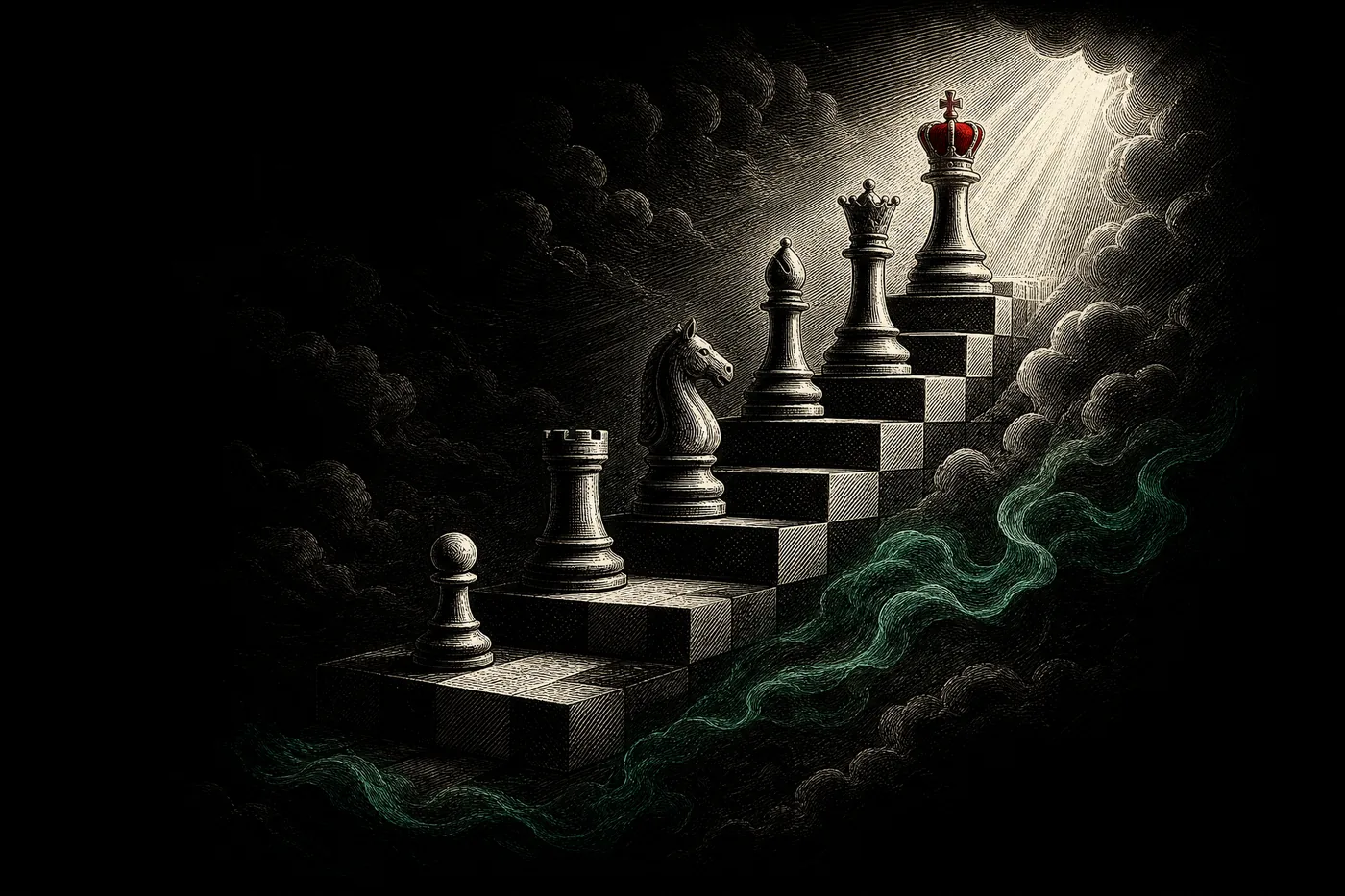
Here’s the whole secret to a good chess thought process: before you move, you check what your opponent is threatening, you look at your best candidate moves, and then you make sure the move you want doesn’t hang anything — every single turn. That’s it. Most blunders below master level aren’t from failing to find a brilliant move; they’re from skipping that simple safety check and giving away a free piece.
The good news? A thought process is a habit, not a talent. You can install it deliberately, and once it’s automatic, your blunder rate drops off a cliff. Let’s build yours.
The routine, every move
- What changed? What did my opponent’s last move threaten or attack?
- Candidates. What are my 2-3 best-looking moves?
- Calculate. For each, what’s their reply? Then mine?
- Blunder check. Does my move hang a piece or allow a tactic? Say it out loud.
- Move. Only after the blunder check passes.
How should you think during a chess game?
The trick is to think in the same order every time, so nothing gets skipped when the position gets scary. Random thinking is where blunders live. Here’s the order that works:
Step 1 — Ask “what is my opponent threatening?” This is the most important and most-skipped step. Before you get excited about your own plan, figure out theirs. Their last move had a reason. What was it? A capture next move? A fork? A mate threat? If you only learn one thing from this page, learn to ask this question every single turn.
Step 2 — Find your candidate moves. Don’t fixate on the first move you see. Look for 2-3 reasonable options — “candidate moves,” as they’re called. The best move is often your second idea, the one you’d have missed if you’d moved on instinct.
Step 3 — Calculate a little. For your top candidate, picture your opponent’s most annoying reply, then your response. You don’t need to see 10 moves deep — even two or three moves of “if I go here, they go there, then I go here” prevents most disasters.
Step 4 — Run the blunder check. Before your hand touches a piece, ask: does this move hang anything? Does it walk into a tactic? This one check, done religiously, is worth more rating points than any opening you’ll ever memorize.
What should you think about each move?
You don’t need to run the full deep routine on every move — that’d be exhausting and you’d flag on the clock. Match the depth to the moment:
- Quiet, obvious positions: just do the quick blunder check and move. Don’t agonize.
- After any capture or check: slow down. The board just changed; old assumptions might be dead.
- When you see a tempting move: that’s exactly when to double-check, because excitement is where blunders breed.
- Critical moments (sacrifices, king safety, pawn breaks): this is where you spend real time and really calculate. Budgeting that time well is its own skill — see time management.
The single habit that separates 1200s from 1600s isn’t brilliance. It’s that the 1600 quietly runs the blunder check before moving, every time, while the 1200 sometimes forgets when excited.
How do you stop blundering in chess?
Blundering — hanging a piece or missing an obvious threat — is the number-one rating killer below the intermediate level. Here’s how to slash it:
- Always do the “is it safe?” check before moving. Look at every piece your move leaves undefended. This alone fixes most of it.
- Sit on your hands (literally, or figuratively online). Touching the piece commits you mentally before you’ve checked. Decide, then move.
- Check all the opponent’s checks, captures, and threats — the “CCT” scan. Most tactics come through a check or capture you didn’t look at.
- Be extra careful when you’re winning. Players blunder most when ahead, because they relax. Stay sharp until the handshake.
- Slow down at the right moments. Many blunders are time-trouble blunders or tilt blunders — emotional and clock failures wearing a tactical disguise.
What are candidate moves and how do you calculate?
“Candidate moves” is just a fancy phrase for the moves worth considering in a position — usually two or three. The legendary trainer Kotov made the idea famous: instead of jumping at your first instinct, you list candidates, then examine each in turn. It stops you from tunnel-visioning on one plan and missing a better one.
“Calculation” is just looking ahead: if I go here, they’ll probably go there, then I’d go here. You picture the moves without playing them. Beginners think calculation means seeing 15 moves deep like a computer — it doesn’t. Seeing two or three moves accurately beats seeing eight moves fuzzily. Accuracy over depth, always.
A simple drill: in any position, force yourself to name three candidate moves before choosing. You’ll be amazed how often candidate #2 or #3 is clearly better than the move you almost rushed out.
How is this different from strategy and tactics?
Good question — your thought process is the container that holds both. Tactics are the short, forcing sequences (the forks and pins your calculation finds). Strategy is the long-term plan (where your pieces belong, which pawn break to aim for). Your thought process is the routine that makes sure you check for both every move: “any tactics here?” and “what’s my plan?” If that distinction’s fuzzy, we untangle it in strategy vs tactics.
Pro tip: strong players run their blunder check on autopilot — they’ve done it so many times it’s instant and invisible. That’s the goal. At first it’ll feel slow and clunky; after a few hundred games it becomes a reflex you don’t even notice. Stick with it through the awkward phase.
A fun bit of history
The idea of a structured thinking method got famous from Soviet grandmaster Alexander Kotov’s 1971 book Think Like a Grandmaster, where he introduced the “tree of analysis” and the candidate-move method. His advice — pick your candidates, examine each branch once, and don’t keep jumping back and forth like a “wandering” mind — became gospel for generations of improving players. Modern coaches have softened some of his rules (real thinking is messier than a tidy tree), but the core idea stuck: think in an order, not in a panic.
Common mistakes to dodge
- Skipping the threat check. Diving into your own plan without asking what the opponent wants. The #1 source of blunders.
- Moving on the first idea. Your first move is often fine — but sometimes candidate #2 is winning and you never looked.
- Calculating too deep, too fuzzy. Trying to see ten moves ahead and getting it wrong. Two accurate moves beat eight guesses.
- Relaxing when winning. The “I’ve basically won” feeling is where games get thrown away.
- No blunder check before moving. The cheapest, highest-value habit, and the most-skipped.
Key takeaways
- A good chess thought process runs the same order every move: threats candidates calculate blunder check move.
- “What is my opponent threatening?” is the most important and most-skipped question.
- Pick 2-3 candidate moves instead of rushing the first one you see.
- Accuracy beats depth in calculation — two solid moves beat eight fuzzy ones.
- The blunder check before moving is worth more rating than any opening.
Keep climbing
The best way to cement a thought process is to catch yourself skipping it — which you do by reviewing your own games and spotting the exact moves where you blundered without checking.
Next up: How to analyze your own games · Also useful: time management and the beginner mistakes that blunders come from. Explore the full improvement hub.
Written and fact-checked by the Chess Lab Academy Editorial Team (AI-assisted, human-edited) · Engine-verified with Stockfish 17, rules per the FIDE Laws of Chess · Last verified 2026-06-25 · Sources · How we verify content.
