

Chess has its own language — en passant, zugzwang, fianchetto, fork, zwischenzug — and it can feel like everyone’s in on a secret. This chess glossary is the decoder ring. Every entry is a short, definition-first explanation that answers “what does this term mean?” in the first sentence, then links you to a deeper guide if you want to go further.
Bookmark it. Skim it once, then come back whenever a word stumps you mid-game, mid-lesson, or mid-commentary.
Most looked-up terms right now Elo rating · Chess titles · Grandmaster · Blunder · Brilliant move · Hypermodernism
How this glossary is organized
We’ve sorted every term two ways so you can find things fast. Below is the by-category directory — pick the area you’re curious about. Each category also links to the full deep-dive guide if you want the long version. (Want a single-page A–Z of beginner vocabulary instead? Try our beginner’s chess terms glossary.)
Rules
The moves and laws that make chess chess.
Terms: en passant · castling · check · checkmate · stalemate · promotion Full guide: the rules of chess
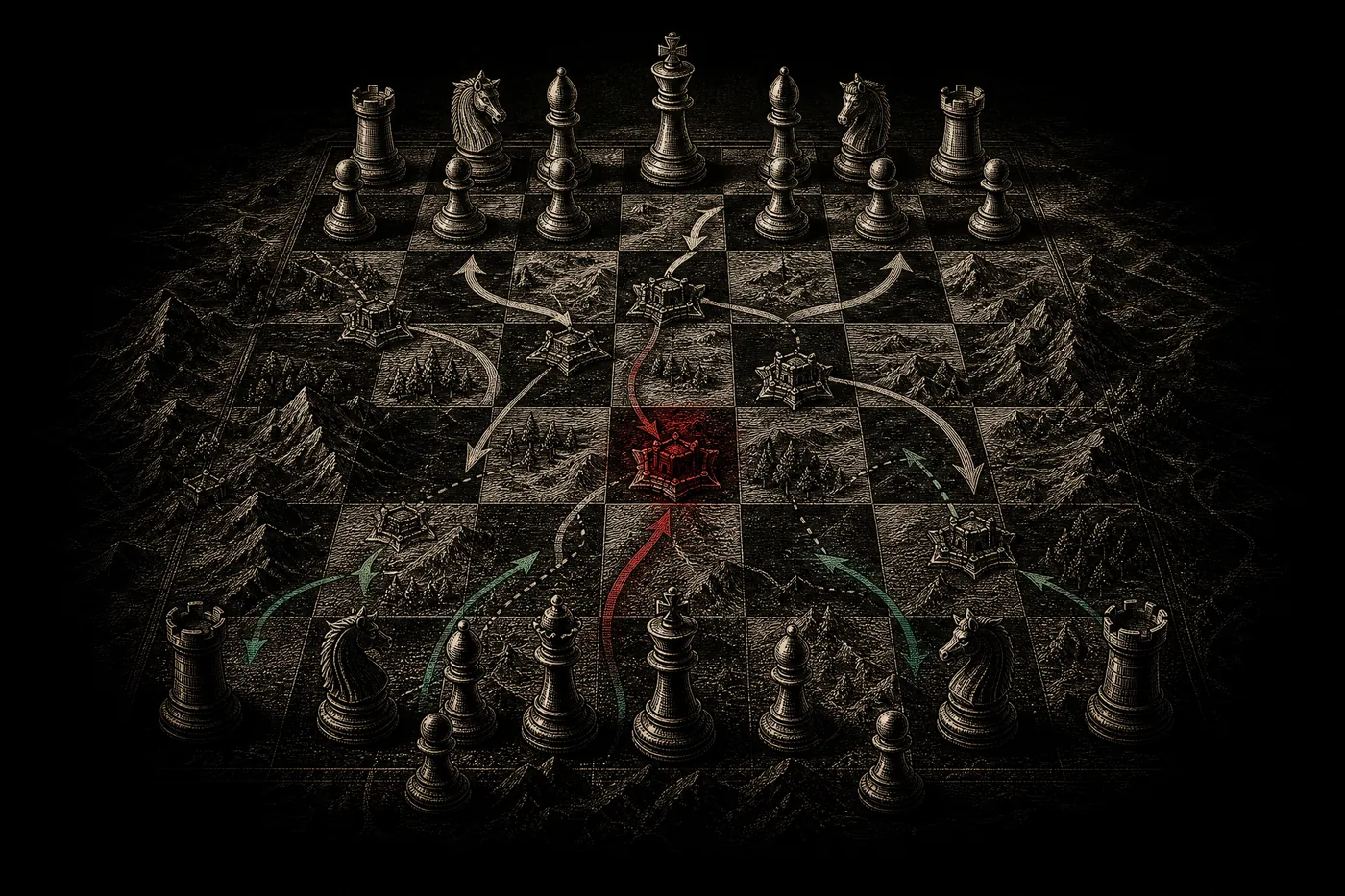
Strategy
The long-term ideas behind good moves.
Terms: outpost · initiative · tempo · prophylaxis · zugzwang · the center Full guide: basic chess strategy
Pawn structure
The skeleton of every position — where the pawns live.
Terms: isolated pawn · passed pawn · doubled pawns · backward pawn · pawn chain Full guide: open vs closed positions
Tactics
The short, forcing tricks that win material and games.
Terms: fork · pin · skewer · discovered attack · zwischenzug · sacrifice Full guide: the tactics hub
Openings
How games begin, and the vocabulary that comes with it.
Terms: gambit · fianchetto · development · transposition Full guide: the openings hub
Notation
How chess moves get written down and shared.
Terms: algebraic notation · FEN · PGN Full guide: chess notation explained
Formats
The time controls and ways to play.
Terms: blitz · bullet · rapid · classical chess Full guide: chess time controls
Ratings & titles
The numbers and ranks that measure strength.
Terms: Elo rating · chess titles · Grandmaster · International Master · FIDE Master Full guide: rating systems explained
Culture
The lore, slang, and colorful side of the game.
Terms: blunder · brilliant move · hypermodernism Meet the players: famous chess players
How to use this glossary
Every page here is built to do one job well: answer “what does this mean?” fast. Read the bold first sentence for the quick definition, skim the example, and stop there if that’s all you needed. Each entry also links to the matching deep guide — so a glossary page on the fork is your two-minute answer, while the tactics hub is where you actually learn to spot forks in your own games. The glossary is the dictionary; the guides are the textbook.
Why learn the lingo?
Because chess instruction is written in this language. The moment you know a “fork” is a double attack and an “outpost” is a safe square deep in enemy turf, lessons stop sounding like gibberish and start clicking. Vocabulary isn’t gatekeeping — it’s the key that unlocks everything else: lessons, commentary, puzzle hints, and finally being able to explain your own ideas. You don’t need to memorize all of it at once. Learn the handful of terms you keep bumping into, and the rest will stick naturally as you play.
Frequently asked questions
What is a chess glossary? A reference that defines chess terms in plain English — the vocabulary of rules, tactics, strategy, openings, notation, formats, and ratings. Use it to look up any word you don’t recognize.
What chess terms should a beginner learn first? Start with the essentials: check, checkmate, castling, fork, pin, develop, and “the center.” Those six or seven unlock most beginner lessons. Our beginner’s chess terms glossary collects them on one page.
What’s the difference between a glossary entry and a full guide? The glossary gives you a short, definition-first answer. The full guides (in Learn, Tactics, Openings, and Endgames) go deep with examples, diagrams, and practice.
Keep climbing
A glossary tells you what the words mean. The next step is putting them to work.
Start with the rules of chess, sharpen up in the tactics hub, pick an opening, and follow an improvement plan to climb the ranks.
Researched and fact-checked by the Chess Lab Academy Editorial Team (AI-assisted, human-edited) · Definitions checked against Wikipedia’s Glossary of chess, FIDE regulations, and the FIDE Laws of Chess · Last verified 2026-07-13 · How we verify content.
