

Alexander Alekhine’s games are some of the most thrilling in all of chess literature. His masterpieces aren’t quiet, technical wins — they’re deep, imaginative attacks that seem to come out of nowhere, until you look closer and realize he’d been building toward them for twenty moves. Here are the games that matter most, and why they’ve stayed famous for a century.
A quick note on how we present these: we describe each game in prose from verified sources rather than reprinting a full move list, so you’re never getting a garbled transcript. Where you want to play through the moves yourself, the major online databases and the sources at the foot of this page have reliable, annotated versions.
The triple queen sacrifice — Bogoljubov vs. Alekhine, Hastings 1922
This is the one every attacking player should see at least once. Playing Black against Efim Bogoljubov at Hastings 1922, Alekhine steered a Dutch Defense into a wild, double-edged position, then produced a finish so audacious it barely looks legal.
The game’s nickname says it all: the “triple queen sacrifice.” Alekhine gives up his queen, lets Bogoljubov promote a pawn to a new queen, gives that one up too, watches another pawn promote — and sacrifices that one as well — all while his own passed pawns come charging down the board. When the dust settles, Alekhine is simply winning. Chess author Andrew Soltis rated it one of the four best games of the entire twentieth century. It’s the perfect showcase of Alekhine’s imagination and iron calculation.
The “most beautiful combination” — Réti vs. Alekhine, Baden-Baden 1925
Three years later, Alekhine produced what many call the most beautiful combination ever played. Again with the black pieces, he faced the great hypermodern theorist Richard Réti at Baden-Baden 1925. Réti got an interesting position out of the opening — and then Alekhine ensnared him in a whirlwind of tactics described as the longest combination of his career, with pieces hanging all over the board and every capture leading to a deeper point.
Garry Kasparov has praised it as one of the most beautiful games in chess history. What makes it so admired isn’t just the fireworks — it’s that every stunning move is exactly calculated. There are no bluffs; the whole storm resolves precisely in Alekhine’s favor.
”Alekhine’s Gun” — Alekhine vs. Nimzowitsch, San Remo 1930
If the first two games are pure tactics, this one is a lesson in slow, suffocating pressure — and it gave chess a permanent piece of vocabulary. At San Remo 1930, a tournament Alekhine won by a ridiculous 3½ points, he faced Aron Nimzowitsch, then one of the five strongest players alive.
Alekhine lined up two rooks behind his queen on a single file — a battery of maximum firepower now known everywhere as “Alekhine’s Gun.” The pressure became so total that Nimzowitsch was squeezed into near-zugzwang: almost every legal move made his position worse. It’s the clearest possible proof that Alekhine wasn’t only a tactician — he could win by strategy so complete his opponent simply ran out of moves.
The title win — Alekhine vs. Capablanca, Buenos Aires 1927
No collection of Alekhine’s games is complete without the match that made him champion. In 1927 he challenged José Raúl Capablanca, whose positional technique was so flawless that many thought him unbeatable — and against whom Alekhine had never once won before the match. Over a gruelling 34 games, Alekhine’s deeper preparation and greater fighting stamina told, and he took the crown +6 −3 =25.
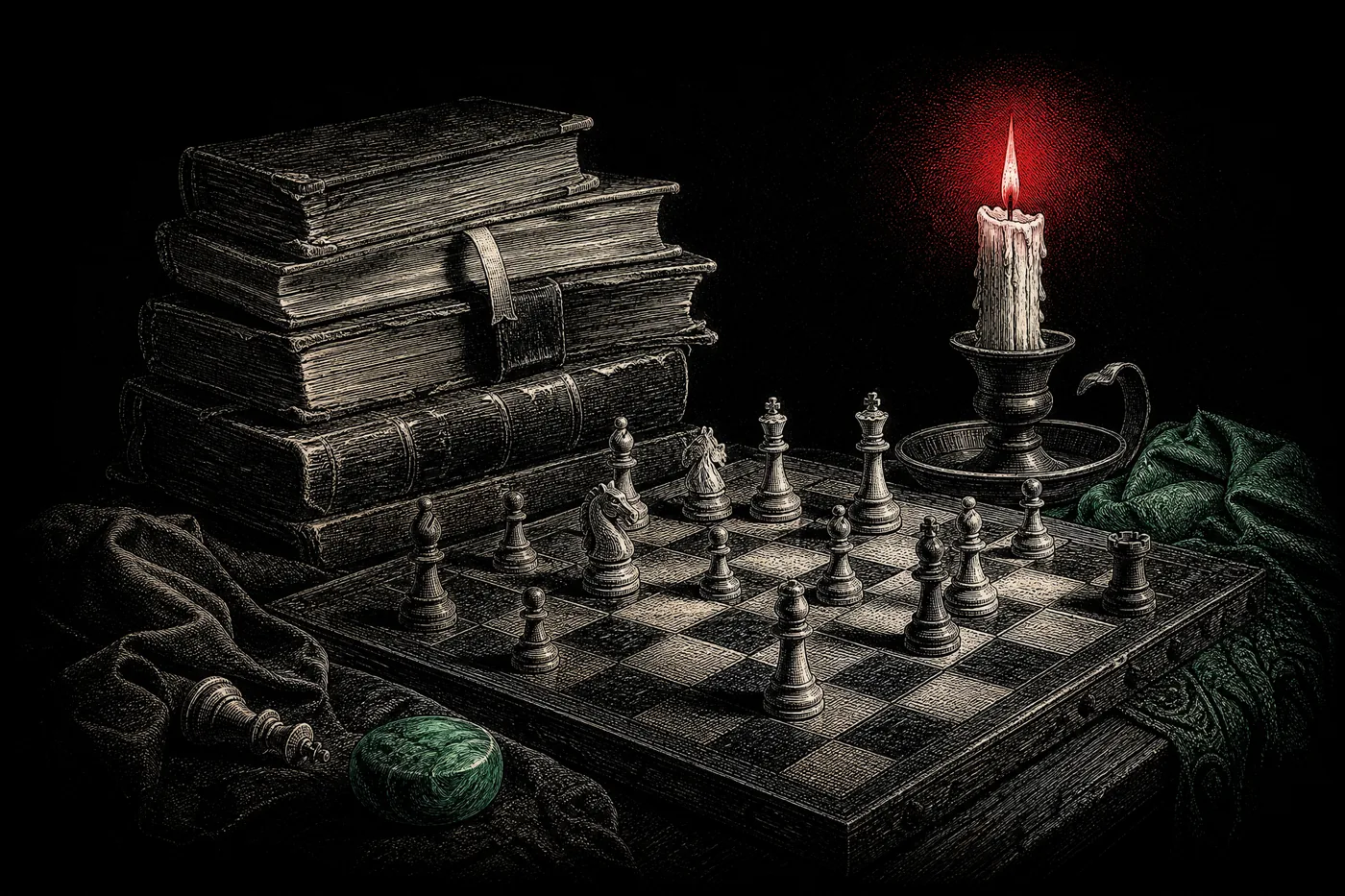
Much of the match was fought in the Queen’s Gambit Declined — quiet, classical positions rather than fireworks — which is exactly why the win surprised people. It showed Alekhine could out-grind the greatest grinder of the age, not just out-attack him. The board below is the kind of Orthodox QGD structure the two contested for weeks.
Why these games still matter
Alekhine’s best games teach a lesson every improving player needs: combinations don’t fall from the sky. The queen sacrifices and mating nets that make his games famous were only possible because he first built up space, activity, and pressure. Study him and you learn to earn your tactics — to set the board on fire only after you’ve quietly poured out the fuel. That’s why coaches still point students toward his games a hundred years later.
FAQ
What is Alekhine’s most famous game? Two are usually named: the triple-queen-sacrifice win over Bogoljubov (Hastings 1922) and the “most beautiful combination” against Réti (Baden-Baden 1925). His “Alekhine’s Gun” win over Nimzowitsch at San Remo 1930 is a close third.
What is “Alekhine’s Gun”? A heavy-piece battery — two rooks stacked behind the queen on one file — named after his 1930 win against Nimzowitsch, where the pressure forced his opponent into near-zugzwang.
How did Alekhine beat Capablanca in 1927? Through deeper opening preparation and greater fighting endurance over a 34-game match in Buenos Aires, winning +6 −3 =25 — despite never having beaten Capablanca before it.
Where can I play through Alekhine’s games move by move? Reliable, annotated versions live in the major online databases, on Chess.com, and on Wikipedia’s tournament and match pages, which we’ve cited below.
Keep exploring
Back to Alexander Alekhine’s profile · his playing style · his openings · his career & strength · fun facts · or browse all chess players.
Written and fact-checked by the Chess Lab Academy Editorial Team · Facts verified against Wikipedia, the 1927 World Championship record, the San Remo 1930 record, and Chess.com, as of July 2026 · Last verified 2026-07-10 · How we verify content.
