The Caro-Kann Exchange doesn’t branch into a dozen theoretical thickets the way the Classical does — it’s a quiet, systems-based line. But there is real variety in the plans, and there’s the crucial matter of telling the Exchange proper (4.Bd3) apart from its sharp lookalike, the Panov Attack (4.c4). Here’s the map.
The Exchange at a glance
Line Key moves Personality Who it favors Main line (Bf4 / Qb3) 4.Bd3 Nc6 5.c3 Nf6 6.Bf4 Bg4 7.Qb3 Classic, symmetrical Roughly equal Black’s minority attack …Rb8, …a5, …b5-b4 vs c3 Positional counterplay Black’s plan White’s classical squeeze Nf3, 0-0, Nbd2, kingside/center Slow small-edge play Slight pull, White The …Bf5 question 4…Bf5?? loses the bishop Cautionary tale White (if Black errs) Panov cousin (4.c4) Isolated-queen’s-pawn attack Sharp, ambitious Initiative, White
The main line: 4.Bd3, 6.Bf4, 7.Qb3
This is the heart of the Exchange. After 4.Bd3 Nc6 5.c3 Nf6 6.Bf4, White has the ideal setup — both bishops out, the d4-pawn braced by c3 — and Black mirrors it. The one bit of “theory” you need is the 7.Qb3 poke and its antidote.
Step through the line
Move by move — press Next to advance, Back to rewind.
The main line — 7.Qb3 pressures b7 and d5, but 7...Na5 8.Qa4+ Bd7 9.Qc2 defuses it completely.
7.Qb3 double-attacks the b7-pawn (undefended once …Bg4 has left c8) and the d5-pawn. Black’s move-order-perfect reply is 7…Na5, hitting the queen; after 8.Qa4+ Bd7 9.Qc2 everything is defended and the game is dead level. Skip the …Na5 defense and you can drop a pawn — the engine confirms a careless move here just hands White a clear plus. (See the traps page for the exact punishment.)
Black’s minority attack (the star plan)
Here’s the beautiful part. The Exchange’s Carlsbad pawn structure is the mirror image of the Queen’s Gambit Declined, Exchange Variation — so the famous minority attack that White wields in the Queen’s Gambit belongs to Black here.
The plan: park a rook on b8, play …a5, and roll …b5-b4 into White’s c3-pawn. When the pawns trade, White is left with a weak, backward c-pawn on a half-open file — a long-term target Black can gnaw on for the rest of the game.
It’s not a knockout — the engine still calls these positions roughly equal — but it gives Black a concrete, purposeful game instead of passive shuffling. That’s exactly what you want against a “quiet” system.
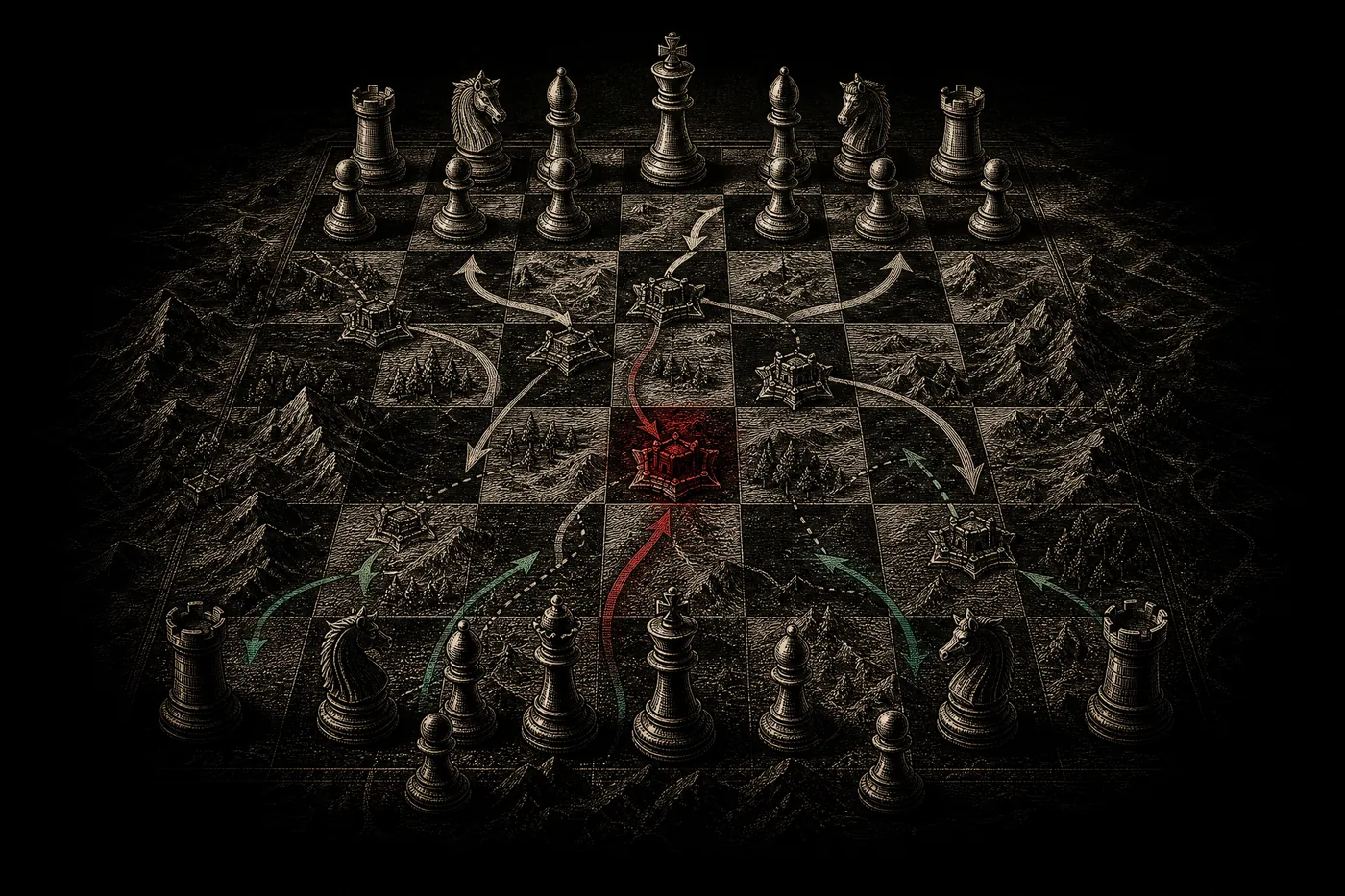
White’s classical squeeze
White’s side of the same structure is just as understandable: Nf3, 0-0, Nbd2, Re1, and then push in the center or on the kingside using the small space edge. White can also expand on the queenside (a2-a4, b2-b4) to gain space and take the sting out of Black’s minority attack before it starts. None of this is forcing — it’s a patient, technical squeeze that rewards the better middlegame player. If you like grinding small edges, this is a lovely structure to own from the White side (more on that in how to beat the Exchange).
The …Bf5 question (a variation that loses on the spot)
Not really a “variation” so much as a warning worth flagging in any tour of the line: because White’s bishop sits on d3 guarding f5, Black must not develop the light-squared bishop to f5. The Caro-Kann instinct screams ”…Bf5!” — and here that instinct loses a whole piece to Bxf5, since nothing recaptures.
The fix is trivial once you know it: bishop to g4. But it catches enough club players that it earns a spot on the traps page.
The Panov-Botvinnik Attack (4.c4) — the sharp cousin
Now the big distinction. From the very same position after 3.exd5 cxd5, White can play 4.c4 instead of 4.Bd3 — and that is not the Exchange proper. It’s the Panov-Botvinnik Attack, a completely different, much sharper opening.
Where the Exchange is about calm symmetry, the Panov hits Black’s d5-pawn immediately and steers the game toward a Queen’s Gambit with an isolated queen’s pawn — dynamic, attacking, theory-heavy. Same first three moves, opposite temperament. If you’re preparing against the Exchange, prepare a Panov answer too, because you won’t know which one you’re facing until move four. (Full Panov coverage lives on the parent Caro-Kann variations page.)
Quiet move-order cousins (4.Nf3, 4.c3)
You may also meet 4.Nf3 or 4.c3 — lazy move orders that usually just transpose back into the main 4.Bd3 setup. Don’t overthink them: develop your pieces to their normal squares (knights to c6 and f6, bishop to g4, …e6, …Bd6), watch the f5-square, and you’ll reach the same comfortable Carlsbad middlegame.
So which line should you study?
- Playing Black? Learn the 7.Qb3 …Na5 antidote cold, remember bishop to g4, and know the minority attack plan. That’s a complete, comfortable repertoire against the Exchange.
- Playing White? Set up Bd3, c3, Bf4, Nf3, Nbd2, 0-0 and play for the slow squeeze.
- Not sure if it’s the Panov? Watch move four: 4.Bd3 = Exchange (relax), 4.c4 = Panov (buckle up).
FAQ
Is the Caro-Kann Exchange the same as the Panov? No. Both start 3.exd5 cxd5, but the Exchange proper is 4.Bd3 (quiet), while 4.c4 is the Panov-Botvinnik Attack (sharp, isolated-queen’s-pawn play). Different openings from the same crossroads.
What is the minority attack in the Exchange? It’s Black’s main plan: …Rb8, …a5 and …b5-b4 to attack White’s c3-pawn and leave White with a long-term weakness. It’s the mirror of the minority attack White gets in the Queen’s Gambit Exchange.
Why is 7.Qb3 not dangerous? Because 7…Na5 hits the queen, and after 8.Qa4+ Bd7 9.Qc2 the b7-pawn is safe and Black is fully equal.
Is the Exchange drawish? It’s solid and symmetrical, so draws happen — but it’s not a forced draw. Both sides have real plans (minority attack for Black, a slow squeeze for White) and there are winning chances for the better player.
Keep climbing
Anchor the names with the Caro-Kann Exchange overview and the move-by-move guide. Then compare it with the space-grabbing Advance Variation and see the whole family on the Caro-Kann guide. New to structures like this? The opening principles explain why the minority attack works.
Written and fact-checked by the Chess Lab Academy Editorial Team (AI-assisted, human-edited) · Lines checked against mainstream opening theory and verified with Stockfish 17 · ECO B13 · Last verified 2026-07-11 · Sources · How we verify content.