

The Caro-Kann Exchange Variation is what happens when White meets the Caro-Kann by just… trading in the middle: 1.e4 c6 2.d4 d5 3.exd5 cxd5 4.Bd3. No sharp gambits, no space grabs — White releases the central tension, drops a bishop on d3, and settles in for a quiet, logical game. It’s the “I don’t want to memorize twenty moves of theory, I just want to play chess” answer to the Caro-Kann, and it’s more respectable than its sleepy reputation suggests.
The 30-second version
- Moves: 1.e4 c6 2.d4 d5 3.exd5 cxd5 4.Bd3 · ECO: B13 · You meet it as: Black.
- The idea: White trades the center for a clean, symmetrical-ish structure and a tiny space edge, then develops naturally (Bd3, c3, Bf4, Nf3).
- The structure: a Carlsbad pawn skeleton — the mirror image of the Queen’s Gambit Declined Exchange.
- Don’t confuse it with the Panov! The Exchange proper is 4.Bd3. The sharp Panov-Botvinnik Attack is 4.c4 — a totally different, much wilder animal.
- The verdict: roughly equal. White keeps a small, safe pull at most; Black equalizes with easy, natural moves.
Step through the line
Move by move — press Next to advance, Back to rewind.
The Caro-Kann Exchange main line — White develops calmly with Bd3 and c3, Black mirrors and equalizes.
What is the Caro-Kann Exchange, exactly?
After the standard Caro-Kann start 1.e4 c6 2.d4 d5, White has a big decision about the central tension. The Classical (3.Nc3) defends e4, the Advance (3.e5) locks it, and the Exchange just resolves it with 3.exd5 cxd5. Both sides now have a pawn on the d-file (White on d4, Black on d5) and an open, uncluttered board.
Then comes the defining move. In the Exchange proper, White plays 4.Bd3 — a modest developing move that quietly does one useful job: it stops Black’s signature …Bf5 (we’ll come back to why that matters, because it’s the source of the nastiest trap in the whole line).
From here White has a stock plan you could teach a beginner in a minute: c3 to build a little pawn triangle and shore up d4, Bf4 to develop the dark-squared bishop actively, Nf3, castle, and bring the queen’s knight to d2. Black does almost exactly the same thing from the other side. That symmetry is the whole personality of the line.
The Exchange vs. the Panov — don’t mix them up
This is the single most important thing to get straight, because the two share the first three moves and then split into opposite universes:
- Exchange Variation (4.Bd3): quiet, symmetrical, low-theory. White wants a slow, safe game and a nagging edge. This page.
- Panov-Botvinnik Attack (4.c4): sharp and ambitious. White hits the d5-pawn, the game turns into a Queen’s Gambit with an isolated queen’s pawn, and pieces start flying.
If you see 4.Bd3, relax and develop. If you see 4.c4, buckle up — that’s the Panov, and it demands active, precise play. Same signpost, two different roads. (Both technically fall under ECO B13, which is part of why they get muddled.)
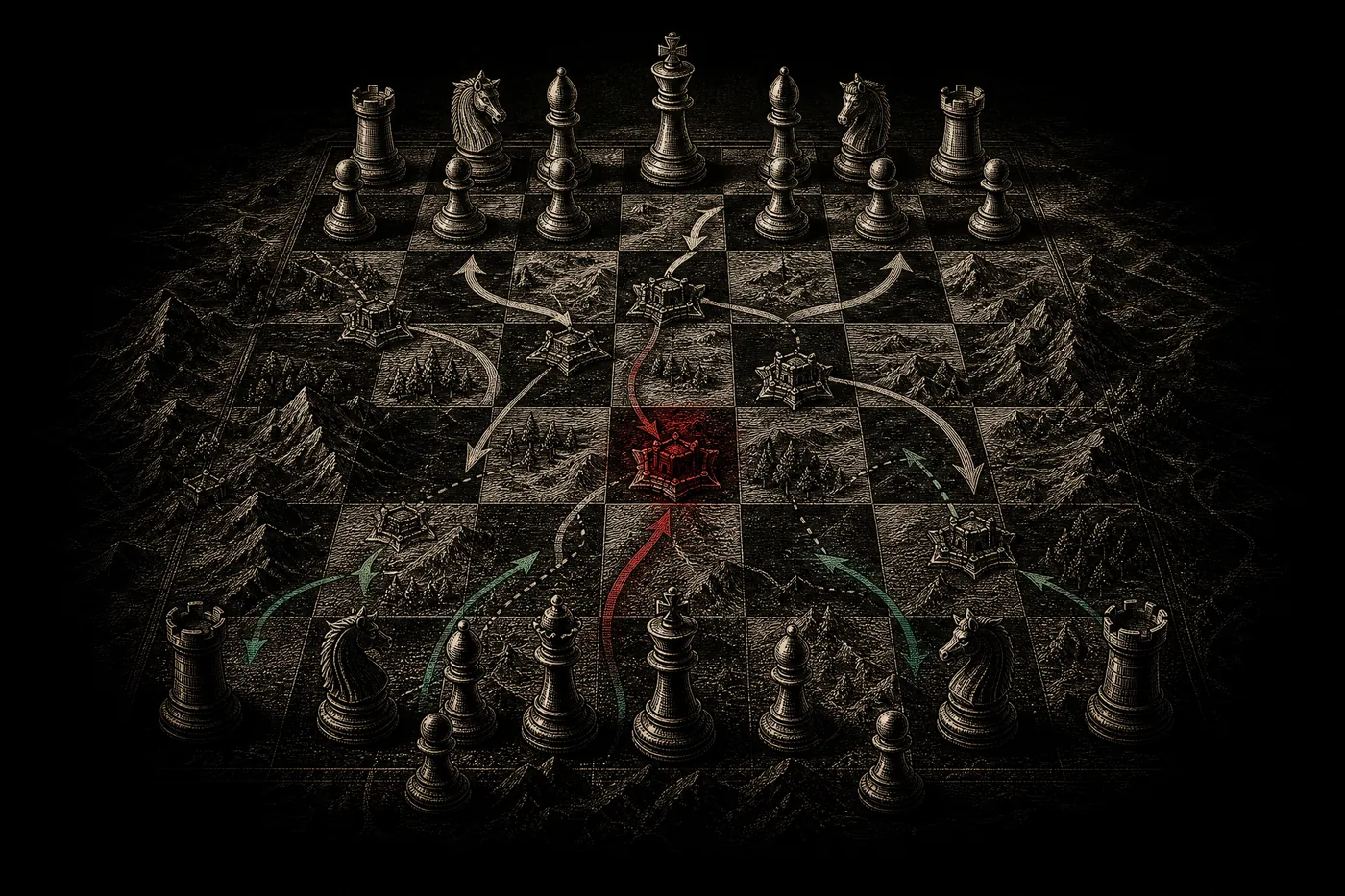
The big idea: the Carlsbad structure
The pawn skeleton in the Exchange is a famous one: the Carlsbad structure. White ends up with pawns on a2, b2, c3, d4; Black with pawns on a7, b7, d5, e6. If that looks familiar, it should — it’s the exact mirror image of the Queen’s Gambit Declined, Exchange Variation, just with the colors flipped.
That mirror has a neat consequence. In the Queen’s Gambit Exchange, White is the one who gets the famous minority attack. Flip the board, and in the Caro-Kann Exchange it’s Black who inherits that plan: pushing …b5-b4 to chew at White’s c3-pawn and leave White with a long-term weakness. White, for his part, develops classically, leans on his slight space edge, and plays in the center or on the kingside. Same structure the great teachers used to explain the minority attack — you just happen to be on the other side of it.
What are the plans for both sides?
For Black (that’s you):
- Develop the light-squared bishop to g4 — not f5 (that square is guarded by White’s Bd3, and dropping the bishop there loses it outright — see the traps page).
- Mirror White’s setup: …Nc6, …Nf6, …e6, …Bd6/Be7, castle.
- Aim for the queenside minority attack (…Rb8, …a5, …b5-b4) or the central …e5 break to free everything.
For White:
- Just develop: Bd3, c3, Bf4, Nf3, Nbd2, 0-0. Nothing fancy.
- Use the tiny space edge and try to make Black’s game a hair passive.
- Consider the Qb3 poke at b7/d5, or a kingside pawn advance, to create small problems.
Strengths and weaknesses (from Black’s chair)
Why you’ll be happy to see it:
- It’s harmless if you know the basics. The engine calls the tabiya roughly equal — a small edge for White at most.
- Low theory. You don’t need deep prep; good principles carry you.
- Clear plans. The minority attack and the …e5 break give you something concrete to do.
The catch:
- It can be a little dry. Symmetrical positions reward patience and technique, not fireworks.
- White gets the small pull, and if you drift, that pull can slowly grow. You have to actually play for something.
- One sneaky trap — the …Bf5 blunder — is easy to walk into on autopilot.
Who plays the Exchange?
The Exchange got its big moment in 1970, when Bobby Fischer wheeled it out against Tigran Petrosian in the “Match of the Century” and won a model positional game — instantly making a sleepy sideline fashionable. Decades earlier, José Raúl Capablanca had shown the Black side’s smooth equality against Géza Maróczy. Today it’s a favorite of players who want a calm, understandable game as White and don’t fancy a theory race. See both games on our master games page.
Is the Exchange something you should worry about?
Honestly? Not much — but respect it. As a Caro-Kann player you’ll meet the Exchange constantly, especially from opponents who don’t want a fight in the opening. The good news is that a few simple ideas (bishop to g4, mirror the development, know the minority attack) give you a completely comfortable game. For the full honest breakdown, see is the Caro-Kann Exchange good?
Explore the Caro-Kann Exchange
- The Exchange move by move
- Exchange variations (4.Bd3 lines, and the Panov cousin)
- Caro-Kann Exchange traps (the …Bf5 blunder and more)
- The Caro-Kann Exchange for beginners
- Famous Exchange games (Fischer, Capablanca)
- How to beat the Caro-Kann Exchange (as White)
- Is the Caro-Kann Exchange good?
Up a level: the full Caro-Kann guide and its sibling the Advance Variation. Back to the openings hub.
FAQ
What is the Caro-Kann Exchange Variation? It’s the quiet line where White trades in the center: 1.e4 c6 2.d4 d5 3.exd5 cxd5, and then the Exchange proper continues 4.Bd3. It leads to a symmetrical Carlsbad pawn structure and a roughly equal game with a small edge for White.
What’s the difference between the Exchange and the Panov Attack? Both start 3.exd5 cxd5. The Exchange is 4.Bd3 — calm and positional. The Panov-Botvinnik Attack is 4.c4 — sharp, with isolated-queen’s-pawn play. Totally different games from the same crossroads.
Is the Caro-Kann Exchange good for White? It’s sound and gives a tiny, safe pull with almost no theory — a great practical choice. But it’s not a way to refute the Caro-Kann; Black equalizes with natural moves.
Why can’t Black play …Bf5 in the Exchange? Because White’s bishop on d3 guards f5. Playing …Bf5 while that bishop is home simply hangs the piece to Bxf5. Develop to g4 instead. (Full story on the traps page.)
What’s the main plan for Black in the Exchange? Develop naturally and aim for the queenside minority attack (…b5-b4 against c3) or the central …e5 break. Black is comfortable in this structure.
Keep climbing
New to this whole family? Start with the Caro-Kann overview, then ground yourself in the opening principles — the Exchange is those principles in their purest, most symmetrical form. Compare it with the space-grabbing Advance Variation and the classic French cousin, the French Defense.
Written and fact-checked by the Chess Lab Academy Editorial Team (AI-assisted, human-edited) · Lines checked against mainstream opening theory and verified with Stockfish 17 · ECO B13 · Last verified 2026-07-11 · Sources · How we verify content.
