
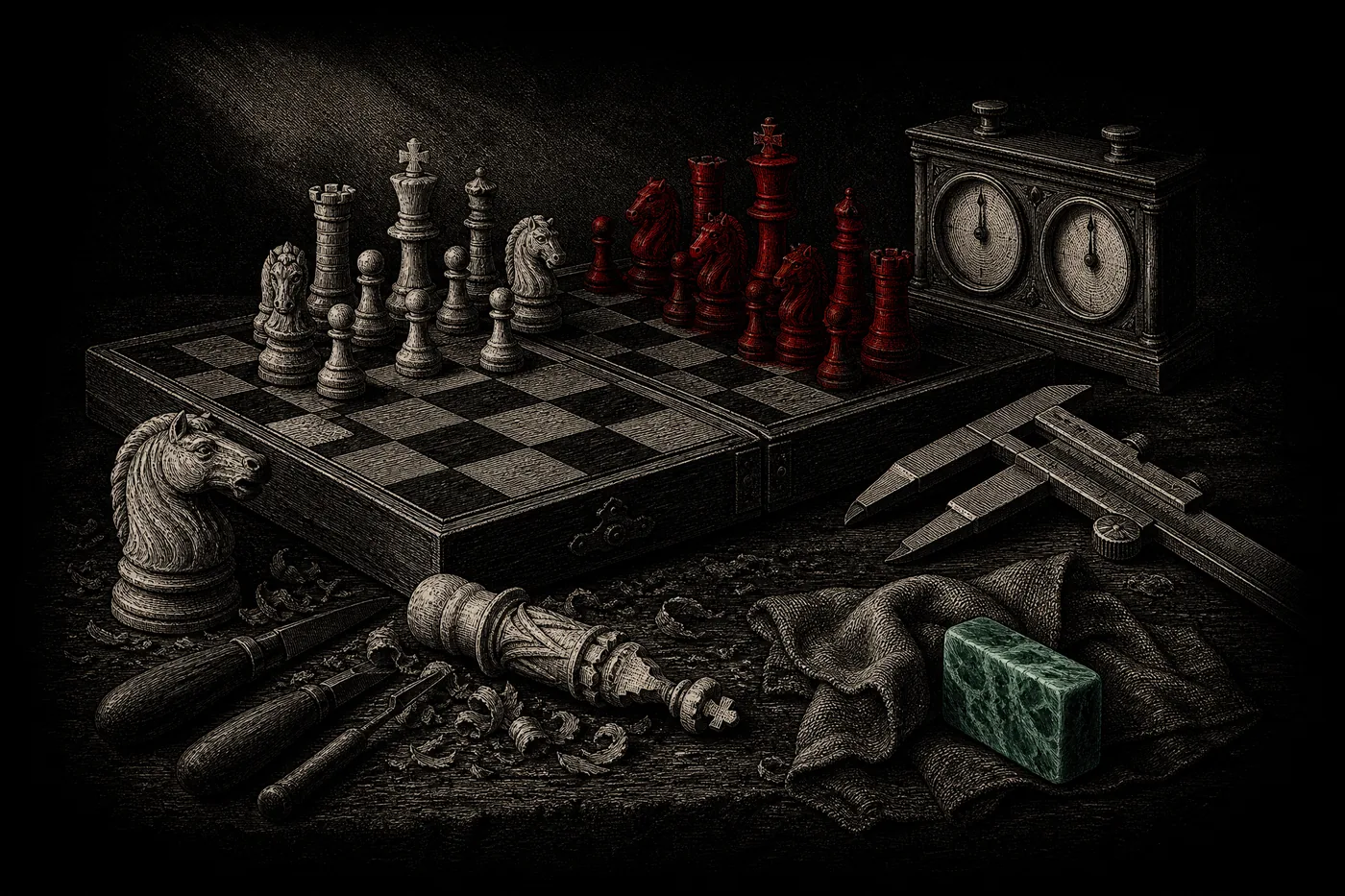
A “tournament chess set” isn’t a brand — it’s a set of proportions and practical features that organizers expect you to show up with. In plain terms: a plain Staunton set with a king around 3.75″, a roll-up board with roughly 2.25″ squares and coordinates printed on the edge, plus a chess clock. Get those right and you’re event-ready. The good news is that the “correct” tournament set is usually the cheap plastic one — regulation is about proportion and legibility, not luxury.
Here’s exactly what makes a set tournament-legal and what to pack for your first over-the-board game.
Event-day checklist
- Weighted plastic Staunton pieces, 3.75″ king
- Roll-up vinyl board, ~2.25″ squares, coordinates on the edge
- A chess clock (digital, delay/increment capable)
- A pen and, if required, a scoresheet to record moves
- A tube or bag to carry it all
The regulation numbers
Two bodies define the standards, and they agree in spirit.
FIDE (international standard). For its recommended equipment, FIDE specifies:
- King height 9.5 cm, then queen 8.5 cm, bishop 7 cm, knight 6 cm, rook 5.5 cm, pawn 5 cm — dimensions may differ by up to 10% but must stay in descending order.
- A piece’s base diameter of 40–50% of its height.
- A board square of 5–6 cm, with the rule of thumb that four pawns fit on one square.
- Pieces in the Staunton style, made of wood, plastic, or an imitation, with the king’s top clearly different from the queen’s. (FIDE Handbook)
US Chess (inches). American events quote the same thing in inches: a 3.75″ king on 2.25″ squares is the classic combination, with the king base around 1.75″ — roughly 77% of the square, inside the widely-cited “75–80% rule” for comfortable spacing. US Chess allows squares from about 2.0″ to 2.5″ and kings from roughly 3.375″ to 4.5″. (US Chess Sales · House of Staunton)
The single proportion to remember: the king’s base should be about three-quarters of the square’s width. That spacing is what makes a board readable at a glance under time pressure. We unpack it fully in the chess board sizes guide.
What makes a set “tournament-legal” beyond size
| Requirement | Why it exists |
|---|---|
| Staunton pattern | Everyone must instantly recognize every piece — no ambiguity |
| Plain, non-distracting design | Ornate or themed pieces are barred; they slow recognition |
| Clear king-vs-queen tops | You must never confuse the two royals |
| Matte, low-glare board | Reduces eye strain over a long game |
| Printed coordinates | Helps recording and dispute resolution |
| Neutral colors | Traditionally cream/black or natural wood tones — high contrast |
This is exactly why a weighted plastic set is the tournament workhorse: it’s plain, legible, high-contrast, and hard to damage. Fancy wood is welcome too, as long as it meets the same proportions and isn’t distracting.

The rest of the kit
A tournament set is more than pieces and a board.
- The clock. Nearly all events are timed, and most now require a digital clock that supports delay or increment (a few seconds added or protected each move). Learn how they work in our chess clock guide. Well-known makers like DGT dominate the category, but any clock that handles your event’s time control and can be set for delay/increment will do.
- The scoresheet. In longer time controls you’re expected to record your moves in algebraic notation. Bring a pen; venues usually supply the paper, and clubs may use electronic scoresheets.
- Carrying it. A tube for the roll-up board and a zip bag for pieces keeps everything together and survives a backpack.
A note on whose gear gets used: at most events each player is expected to be able to provide a standard set and board, and the higher-rated or lower-board player’s equipment is often preferred if there’s a disagreement — so owning regulation gear is part of showing up prepared. Brush up on the unwritten rules in our chess etiquette guide.
Buying for your situation
- Your very first tournament. A single roll-up vinyl board (2.25″ squares, coordinates), a weighted plastic Staunton set (3.75″ king, spare queens included), a basic delay-capable digital clock, and a pen. That’s the whole list.
- A club buying in bulk. Multiple identical roll-up sets plus a stack of clocks. Uniform gear speeds pairing and avoids arguments over whose board to use.
- A serious competitor. Same proportions, nicer materials if you like — a weighted set you enjoy handling and a clock you know how to set quickly under pressure.
- Online-to-over-the-board switchers. The physical adjustment is real: get a regulation set early and play a few slow games at home so the clock and scoresheet feel routine before event day.
Common mistakes
- Bringing a non-regulation “nice” set. An ornate or themed set can be refused. Keep a plain Staunton set for events.
- A too-small board for the pieces. If the king base fills most of the square, the board looks cramped and pieces knock into each other. Respect the 75–80% spacing.
- An analog clock at a delay/increment event. Many time controls now assume a digital clock. Check the event’s requirements first.
- Never having recorded moves before. Practice notation at home — scrambling to write moves and manage the clock in your first rated game is stressful.
- Forgetting spare queens or a pen. Small omissions, real headaches. Pack them.
FAQ
What size is a tournament chess set? The standard is a 3.75″ king on 2.25″ squares (about a 9.5 cm king on 5–6 cm squares in FIDE terms). US Chess permits squares from roughly 2.0″ to 2.5″ and kings from about 3.375″ to 4.5″, keeping the king base near three-quarters of the square.
Do tournament pieces have to be wood? No. FIDE explicitly allows wood, plastic, or imitation materials. Weighted plastic Staunton sets are extremely common at all levels precisely because they’re durable and legible.
Do I need my own clock? Usually yes for rated play, or at least you should be prepared to provide one. Most events expect a digital clock that supports delay or increment — see our chess clock guide.
Can I use my fancy themed set at a tournament? No. Themed or ornate pieces slow recognition and are typically disallowed. Keep a plain Staunton set for competition and enjoy the decorative one at home.
Written and fact-checked by the Chess Lab Academy Editorial Team (AI-assisted, human-edited) · Equipment specifications verified against the FIDE Handbook and US Chess guidelines · Last verified 2026-07-13 · Sources · How we verify content.
