
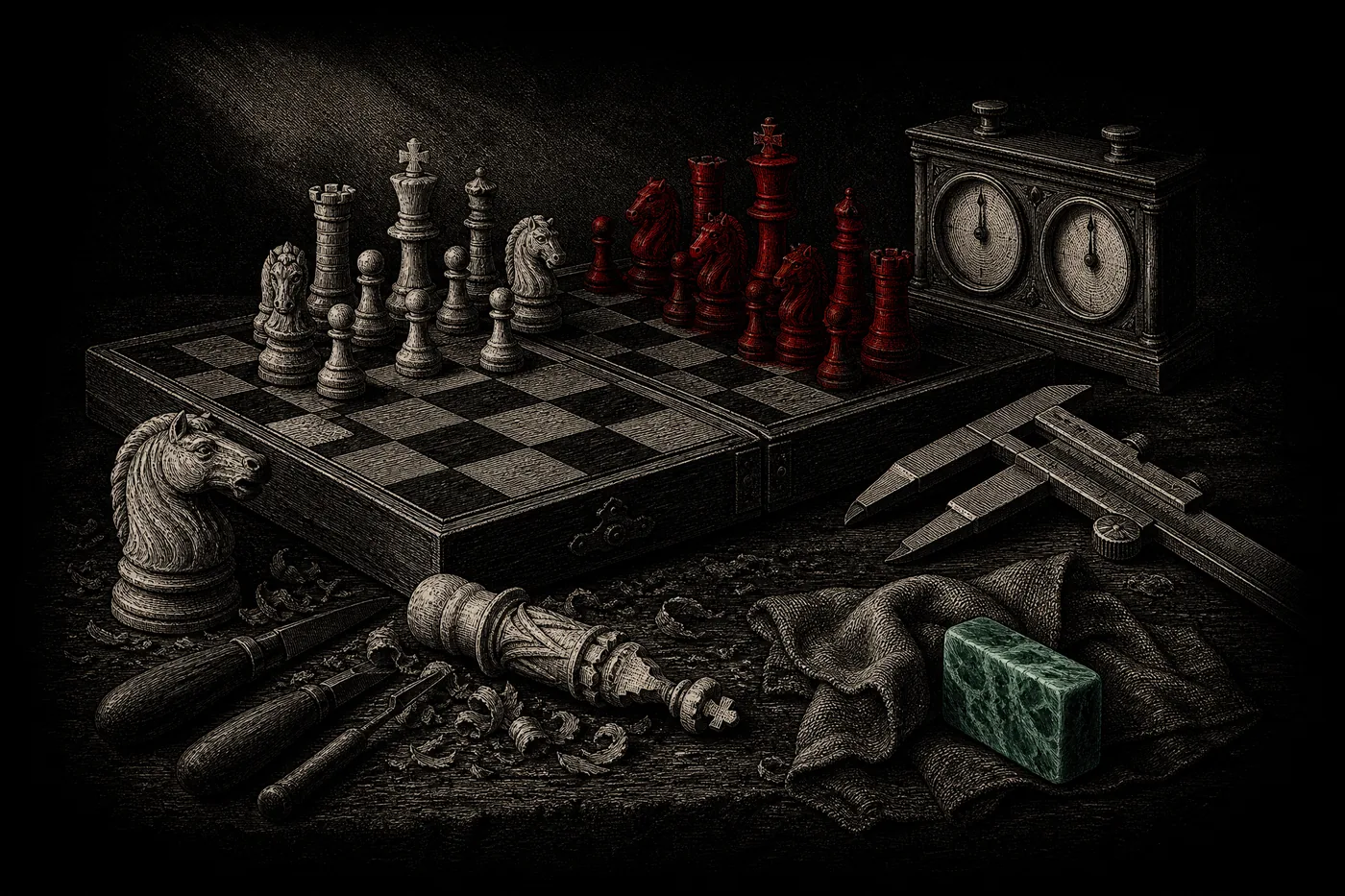
If you’ve ever wondered why nearly every serious chess set on Earth looks basically identical — the same rounded king with a cross on top, the same horse-head knight — the answer is a single design from 1849 called the Staunton pattern. It’s the shape FIDE recognizes for official play, the one clubs and tournaments require, and the one you should buy if you actually want to play chess rather than display it. Here’s where it came from, why it won, and how to tell a good Staunton set from a mediocre one.
In one line The Staunton pattern is the standardized, instantly-recognizable chess-piece design — king, queen, bishop, knight, rook, pawn — that became the world standard after 1849 and is the shape used in all official play today.
What “Staunton” actually means
“Staunton” describes the silhouette of the pieces, not a brand. Each piece has a distinctive, unambiguous shape:
- King — the tallest piece, topped with a cross.
- Queen — slightly shorter, topped with a coronet of points.
- Bishop — a rounded top with a single slit (said to echo a bishop’s mitre).
- Knight — a carved horse’s head, the most artistic and telltale piece.
- Rook — a squat, castle-turret tower.
- Pawn — a small, simple ball-topped piece.
The whole point of the design is legibility: you can tell every piece apart at a glance, from across a table, under time pressure. That’s why FIDE’s equipment standard calls for Staunton-style pieces and even specifies that the king’s top must clearly differ from the queen’s. (FIDE Handbook)
The 1849 origin story
Before Staunton, chess sets were a chaotic mess of regional styles — ornate, fragile, and often hard to identify mid-game. Then, in 1849:
- The design was registered in London on 1 March 1849 (as an “Ornamental Design for a set of Chess-Men,” registration no. 58607) in the name of Nathaniel Cooke.
- It was named after Howard Staunton, the leading English chess master of the day, who endorsed and promoted it — a celebrity endorsement, essentially. The first sets were numbered, and early ones carried Staunton’s signature.
- It was manufactured and sold by John Jaques of London, the games maker, and went on public sale in 1849.
- A lovely detail: the knight was modeled on a horse’s head from the Elgin Marbles — the Parthenon sculpture of a horse pulling the moon-goddess Selene’s chariot. (Wikipedia · Jaques of London)
The combination of a clean, sturdy, legible design plus a famous name behind it made the pattern spread fast. Within a generation it was the default, and it’s been the standard for official play ever since.
How to spot a quality Staunton set
Since “Staunton” isn’t a brand, quality varies enormously. Here’s what separates a good set from a flimsy one:
| Marker of quality | What to look for |
|---|---|
| The knight | Crisp, expressive carving with real detail — the knight is where makers show off, so a lifeless knight signals a cheap set |
| Weighting | Weighted bases (single, double, or triple) so pieces stand firm and feel substantial |
| Felted base | A smooth felt or baize pad that glides and protects the board |
| Proportion | A king base around 40–50% of its height — stable, not top-heavy (per FIDE) |
| Finish | Even turning, smooth joins, no wobble; a clear king-vs-queen top |
| Material | Durable plastic for play, or fine woods (below) for beauty |
The knight really is the tell. It’s the one piece that’s sculpted rather than turned on a lathe, so a maker’s care — or lack of it — shows there first.
Materials, honestly
- Plastic. The practical champion. A weighted plastic Staunton set is durable, legible, tournament-legal, and inexpensive. This is what most serious players actually use day to day.
- Boxwood. The classic pale wood for the “white” pieces — fine-grained and smooth.
- Ebony / ebonized. True ebony is a dense black hardwood used for the “black” pieces in premium sets; ebonized means a cheaper wood stained black to imitate it — a perfectly good, more affordable option.
- Rosewood, sheesham, padauk. Warm-toned hardwoods often used for the dark pieces in mid-range and display sets.
None of these plays “better” than plastic. Wood is about beauty and heirloom value — a genuinely good reason to buy, just not a performance one. See our how to choose a chess set guide for matching material to purpose.
Which Staunton set suits you
- To learn and play. A weighted plastic Staunton set, 3.75″ king. Cheap, tough, and identical in feel to what the pros use.
- For tournaments. The same plain, legible Staunton set — ornate designs are barred from official play. Details in our tournament chess set guide.
- For a gift or display. A boxwood-and-ebonized (or rosewood) wooden set, ideally in the classic 1849 style, on a matching board. Here you’re paying for craft and looks.
- For a collector. Reproductions of the original 1849 pattern, prized for their historical knights and proportions.
Whatever you pick, make sure the pieces fit the board — the king’s base should sit at about three-quarters of the square. That’s covered in our chess board sizes guide.
Common mistakes
- Assuming “Staunton” guarantees quality. It only means the shape. A poorly-carved, hollow “Staunton” set is still a poor set — check the knight and the weighting.
- Buying themed pieces to play with. Fun to look at, frustrating to play — you’ll keep misreading pieces. Staunton exists precisely to prevent that.
- Paying ebony prices for ebonized wood. Both are fine; just know which you’re buying so you pay the right amount.
- Ignoring the base-to-height ratio. Top-heavy pieces tip over. A stable Staunton piece has a base around 40–50% of its height.
- Overlooking the second queen. Good sets include spare queens for pawn promotion — check that yours does.
FAQ
What is a Staunton chess set? It’s a set using the Staunton pattern — the standardized, highly legible piece shapes (cross-topped king, coronet queen, horse-head knight, turret rook) introduced in 1849 and adopted as the world standard for official play.
Why is the Staunton design the standard? Because it’s easy to read — every piece is instantly distinguishable — and it arrived with a famous chess master’s endorsement and a quality maker behind it. FIDE recognizes the Staunton style for official equipment.
Are Staunton pieces always wooden? No. FIDE allows wood, plastic, or imitation materials. Weighted plastic Staunton sets are extremely common and completely legitimate for serious play.
How do I tell a good Staunton set from a cheap one? Look at the knight (crisp carving vs. a blob), check for weighting and a felt base, and confirm the pieces are stable with a clear king-vs-queen top. Those tell you far more than the price tag.
Written and fact-checked by the Chess Lab Academy Editorial Team (AI-assisted, human-edited) · Historical details and equipment specifications verified against published records of the 1849 Staunton design and the FIDE Handbook · Last verified 2026-07-13 · Sources · How we verify content.
