
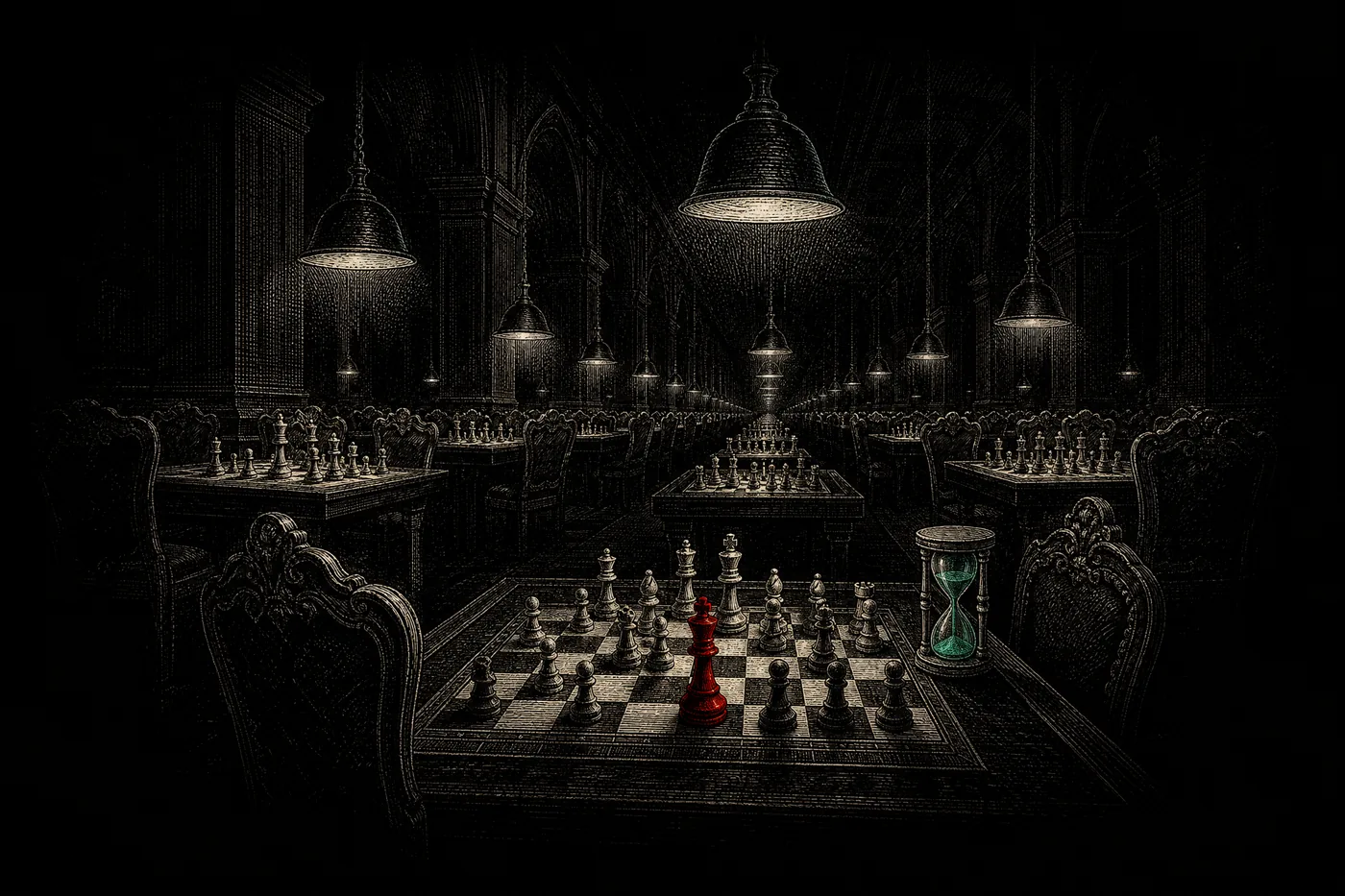
The Chess Olympiad is the biggest team event in the whole chess world. Forget one champion facing another across a single board — this is nations against nations, hundreds of countries sending their best players to fight for their flag. It’s run by FIDE, held every two years, and split into an Open section and a Women’s section. As of July 2026, the reigning champions are India, who pulled off something no country had ever done before: winning gold in both sections at the same Olympiad, in Budapest 2024.
Quick facts
- Governing body: FIDE · Type: team event (Open + Women’s sections)
- First held: 1927 (London) · Frequency: every 2 years
- Team size: 4 players + 1 reserve · Format: 11-round Swiss, scored by match points
- Reigning champions: India — Open and Women’s gold (won 2024) — as of July 2026
- Next edition: the 46th Olympiad, Samarkand, Uzbekistan, 15–27 September 2026
What is the Chess Olympiad?
Think of it as the World Cup of chess, except almost every chess-playing country on Earth turns up. Each national federation enters a team, and those teams grind through eleven rounds over roughly two weeks. Nearly 200 nations compete in each section — the 2024 edition in Budapest drew a record 197 teams in the Open and 183 in the Women’s event, representing 196 federations in all.
Crucially, the Olympiad is not where the individual World Champion is crowned — that’s a separate one-on-one match. The Olympiad is about country pride: a team can carry a below-form star because a teammate steps up, and a tiny federation can punch far above its rating. That’s what makes it chess’s most emotional, flag-waving fortnight.
How does the Chess Olympiad work?
- Two sections: an Open event (open to everyone, though in practice mostly men) and a separate Women’s event, played side by side at the same venue.
- The team: each country fields four players per round plus one reserve — five players total — and the captain picks the line-up match by match.
- The rounds: eleven rounds using the Swiss system, so teams with similar records keep getting paired against each other. In each match, the four boards play their opposite numbers, and a team scores points based on the result.
- Scoring: since 2008, standings are decided first by match points — 2 for winning your match, 1 for a tie, 0 for a loss — with board points and tiebreaks sorting out the rest.
- Individual glory too: on top of team medals, board medals go to the players with the best rating performance on each board. That’s how a single player can become a breakout star even if their team doesn’t top the podium.
- The Gaprindashvili Cup goes to the nation with the best combined result across the Open and Women’s sections — a prize India has made its own in recent years.
A short history of the Olympiad
- 1927–1939: the event kicks off in London 1927, won by Hungary. Between the wars the trophy bounces between Hungary, Poland, the United States (a four-time winner in the 1930s), and Germany.
- 1952–1990: the Soviet Union era — flat-out dominance. Powered by a conveyor belt of world champions, the USSR won the Open gold 18 times, losing it only twice in four decades (to the USA in 1976 and Hungary in 1978).
- 1990s–2000s: after the USSR dissolved, Russia picked up the baton (six straight Open golds), before the field blew wide open — Ukraine, Armenia (three golds in the 2000s–2010s), China, and the United States all took turns on top.
- 2020s: the sport’s new powers arrive. Uzbekistan shocked everyone with Open gold in 2022, and India — long a chess superpower in the making — finally broke through in a big way in 2024.
The latest edition: 2024 (Budapest)
The 45th Chess Olympiad was held in Budapest, Hungary, from 10–23 September 2024, and it belonged entirely to India. For the first time in the event’s history, one country won gold in both sections at the same Olympiad.
In the Open, India’s young guns were untouchable, finishing on 21 match points ahead of the United States (silver) and Uzbekistan (bronze). The squad — Gukesh Dommaraju, Rameshbabu Praggnanandhaa, Arjun Erigaisi, Vidit Gujrathi and Pentala Harikrishna — even swept individual board golds, with Gukesh topping board 1 and Arjun topping board 3.
In the Women’s event, India took gold on 19 match points, with Kazakhstan silver and the United States bronze. The team of Harika Dronavalli, Vaishali Rameshbabu, Divya Deshmukh, Vantika Agrawal and Tania Sachdev finished the job they’d started at home in 2022 (when they came agonisingly close). Divya Deshmukh and Vantika Agrawal grabbed board golds of their own.
What’s next: 2026 (Samarkand)
The 46th Chess Olympiad heads to the ancient Silk Road city of Samarkand, Uzbekistan, running 15–27 September 2026, with around 200 teams expected in each section. India arrive as double defending champions — but Uzbekistan on home soil, plus the USA, China and a resurgent Europe, will all be gunning for them (as of July 2026).
Famous moments
- The Soviet machine (1952–1990): eighteen Open golds and near-total control — the most dominant run any country has managed in a global chess event.
- 2022 — Chennai: the Olympiad landed in India for the first time, relocated to Chennai after the original host was dropped. Uzbekistan stunned the field for Open gold, Ukraine took the Women’s title, and a 16-year-old Gukesh announced himself with a board-1 gold, scoring 9/11.
- 2024 — India’s double: the moment a rising chess nation became the sport’s team to beat, sweeping both sections in Budapest.
How to follow it
The Olympiad is broadcast live for its full two weeks on the official FIDE channels, Chess.com, and YouTube, usually with round-by-round commentary, live boards and engine evals. Because it’s a Swiss with eleven rounds, the drama builds like a league table — check the standings each morning, then watch your country’s four boards fight it out in the afternoon.
FAQ
Who won the Chess Olympiad in 2024? India — and they won both sections, Open and Women’s, for the first time in the event’s history, in Budapest.
How often is the Chess Olympiad held? Every two years. The next one is the 46th edition in Samarkand, Uzbekistan, in September 2026.
Is the Chess Olympiad the same as the World Championship? No. The Olympiad is a team event between countries; the World Chess Championship is a one-on-one match that crowns the individual world champion.
Which country has won the most Chess Olympiads? The Soviet Union, by a mile — 18 Open golds and 11 Women’s golds. See the full winners list.
How many players are on a Chess Olympiad team? Four players per round plus one reserve — five in total — per section.
Explore more
See every gold-medal nation in the full list of Chess Olympiad winners · Compare it with the individual World Chess Championship · Meet the players who won it for India.
Researched and fact-checked by the Chess Lab Academy Editorial Team · Verified against FIDE and Wikipedia · Latest edition and 2026 details current as of July 2026 · Last verified 2026-07-11 · How we verify content.
