
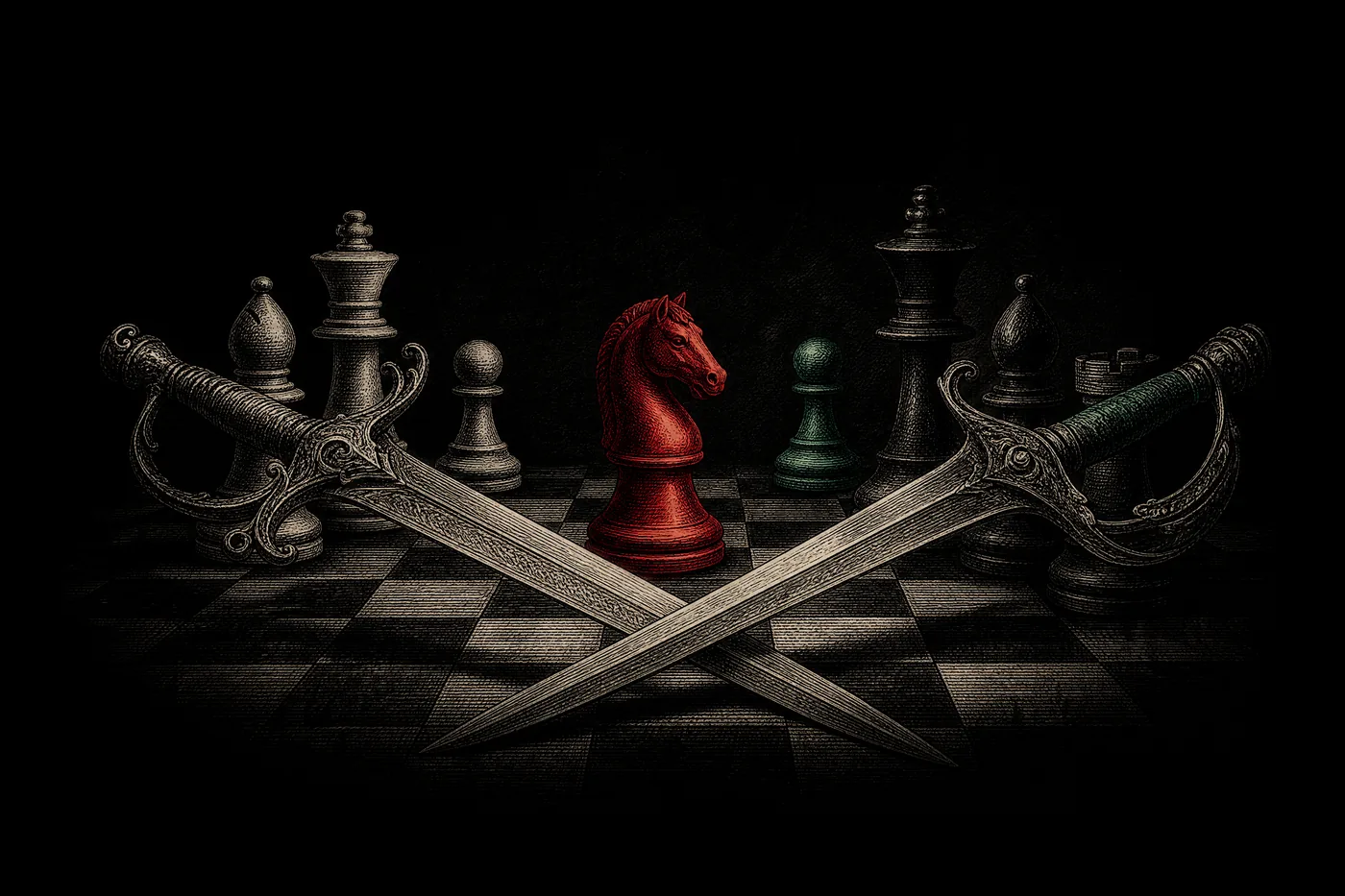
A zwischenzug (German for “in-between move,” pronounced roughly TSVISH-en-tsoog) is a sneaky tactic where, instead of playing the move your opponent is expecting — usually an “obvious” recapture — you slip in a different, more forcing move first, typically a check or a hard threat. Your opponent has to deal with the surprise, and only then do you go back and make the move they thought was coming. That little detour can completely flip the result of a sequence.
Let’s unpack how the in-between move works, why it’s so easy to overlook, and how to start finding your own.
The 10-second version
- A zwischenzug = an “in-between move” inserted before an expected reply (often a recapture).
- It works because the in-between move is more forcing — usually a check or a big threat — so it can’t be ignored.
- After the opponent answers the surprise, you go back and make the “expected” move anyway — but now you’ve gained something.
- Also called an intermezzo (Italian for the same idea).
What is a zwischenzug in chess?
Most chess sequences run on autopilot. You capture my knight, I capture yours back. You attack my queen, I move it. These “forced” replies feel automatic — and that’s exactly the assumption a zwischenzug exploits.
The trick is to ask, before making the expected move: “Do I have something even more urgent first?” If you can insert a move the opponent must respond to — a check, a capture, or a threat bigger than the one on the table — you get a free turn to improve your situation. Then you return to the “obvious” move, but on better terms.
The reason it works comes down to forcing moves. A check forces a reply; the opponent can’t just ignore it to carry out their own plan. By inserting that check in between, you hijack the sequence. The expected recapture isn’t going anywhere — pieces don’t run away mid-combination — so you can afford the detour.
How does the in-between move work? (A famous example)
This position comes from the Petrov Defence, one of the oldest opening traps in the book. The moves were 1.e4 e5 2.Nf3 Nf6 3.Nxe5 Nxe4 — both sides have grabbed a central pawn with a knight, and the position looks symmetrical and harmless. Black is hoping White will just continue developing.
Instead, White plays the zwischenzug 4.Qe2! — an in-between move that quietly attacks the knight on e4 and lines the queen up on the e-file behind it.
Now Black is in trouble. The “natural” move is to scurry the knight back to safety with 4…Nf6?? — but that walks into a brutal in-between of White’s own: 5.Nc6+! The knight leaps forward and uncovers a discovered check from the queen on e2 down the e-file to Black’s king. Black must answer the check, and however they do, White’s knight gobbles the queen — Nxd8 after a block like …Be7, or Nxe7 if Black tries to interpose the queen itself. The “harmless” symmetrical position just cost Black the queen.
(Black’s best is actually to also play carefully here — for instance 4…Qe7, pinning back — but White keeps the upper hand. The lesson stands: 4.Qe2, the in-between move, turned a sleepy position into a trap.)
Why is the zwischenzug so easy to miss?
Because our brains love shortcuts. When a piece is captured, we reach to recapture before we’ve even finished thinking. That reflex — “he took, I take back” — is precisely the autopilot a zwischenzug ambushes. The expected move feels so forced that we never pause to ask whether something better is available right now.
The other reason: the in-between move often looks like it ignores a “crisis.” You’ve got a piece hanging, your opponent expects you to save it — and instead you play a check somewhere else entirely. It takes confidence (and calculation) to trust that your hanging piece will still be there after the dust settles. Beginners feel they must address the immediate threat; stronger players know that a more forcing move buys them the time to address it later, on better terms.
How do you spot a zwischenzug?
Build this one question into your routine, especially before any recapture:
“Before I make this ‘forced’ move — do I have a check, a capture, or a bigger threat first?”
Here’s the checklist:
- Notice the autopilot move. Whenever you’re about to recapture or make any “obvious” reply, pause. That’s the prime moment for an in-between.
- Scan all forcing moves. Look at every check you have, every capture, and every threat heavier than the one you’re facing. (Checks first — they’re the most forcing.)
- Confirm the expected move survives. The whole idea relies on the “obvious” move still being available after your detour. Make sure the piece or recapture won’t vanish.
- Compare the outcomes. Does inserting the in-between move win a pawn, a piece, or the initiative compared to playing the expected move immediately? If yes — you’ve found a zwischenzug.
The zwischenzug pairs beautifully with other ideas: an in-between check can be the timing trick that makes a clearance sacrifice work, or that wins a piece you’ve x-rayed.
A fun bit of history
The word zwischenzug comes straight from German — zwischen (“between”) plus zug (“move”) — and it entered international chess vocabulary because so much foundational chess theory was written in German in the 1800s and early 1900s. English-speaking players adopted it wholesale rather than translating it, which is why you’ll hear strong players casually drop “zwischenzug” mid-conversation as if it were an everyday English word. The Italian-derived intermezzo means exactly the same thing and shows up in some books. However you say it, the concept is universal: never assume a sequence is forced until you’ve checked for a more forcing move first.
Common mistakes to dodge
- Recapturing on reflex. The number-one cause of missed zwischenzugs. Train the pause: before every recapture, scan for a more forcing move.
- Trusting the in-between when the expected move won’t survive. If your hanging piece can actually escape or your recapture target can move away during the detour, the zwischenzug falls apart. Verify the “obvious” move is still there afterward.
- Inserting a check that achieves nothing. A check is only a zwischenzug if it improves your position — wins a tempo, a pawn, or a piece. A pointless check just helps the opponent.
- Forgetting your opponent has them too. The Petrov example cuts both ways: assume your opponent might have an in-between move waiting before their “forced” recapture.
Key takeaways
- A zwischenzug is an in-between move slipped in before an expected reply, usually a recapture.
- It works because the in-between move is more forcing — a check or a serious threat the opponent can’t ignore.
- After the opponent answers, you return to the “obvious” move, now having gained material or tempo.
- It’s also called an intermezzo.
- The cure for missing them: pause before every recapture and scan for checks, captures, and bigger threats.
Keep climbing
The zwischenzug is all about forcing-move timing — the same timing that powers a well-aimed clearance sacrifice and that lets you cash in an x-ray attack at the perfect moment.
Next up: Browse all tactics · Also handy: what checkmate is and why king safety wins games.
Written and fact-checked by the Chess Lab Academy Editorial Team (AI-assisted, human-edited) · Every position verified with Stockfish 17 and checked against the FIDE Laws of Chess · Last verified 2026-06-25 · Sources · How we verify content.
