

So you want to actually play the Pirc, not just admire the hypermodern philosophy. Great. The opening has a reputation for being subtle, but the Classical main line is wonderfully logical — every move builds toward one idea: get your setup in place, then punch the center. Let’s walk the Classical from move one to the key tabiya, with the why behind each move.
The line we’re learning: 1.e4 d6 2.d4 Nf6 3.Nc3 g6 4.Nf3 Bg7 5.Be2 O-O 6.O-O c6 7.a4 Nbd7 This is the Classical Pirc — the calm, flexible backbone of the whole opening.
Step through the line
Move by move — press Next to advance, Back to rewind.
The Classical Pirc main line — fianchetto, castle, then prepare the central counterstrike.
Move by move
1.e4 d6 — the quiet invitation
White grabs the center; Black answers with the modest 1…d6. It doesn’t fight for the center yet — it just keeps options open and prepares to restrain White’s pawns. Black is happy to let White build big.
2.d4 Nf6 — pressure on e4
White builds the duo with 2.d4, and Black develops with 2…Nf6, immediately putting a question to White’s e4-pawn. This forces White to defend it, which is why the next move is almost automatic.
3.Nc3 g6 — the defining moment
White protects e4 with 3.Nc3, and Black plays the move that names the opening: 3…g6, preparing to fianchetto the dark-squared bishop. This is the Pirc tabiya — the defining position.
4.Nf3 Bg7 — the star piece comes out
White develops naturally with 4.Nf3 (the Classical), and Black completes the fianchetto with 4…Bg7. This bishop is the soul of the Pirc: from g7 it rakes the long diagonal, eyeing d4 and the queenside. Protect this piece — it’s your best one.
5.Be2 O-O 6.O-O — king safety first
White develops the bishop modestly with 5.Be2 and both sides castle: 5…O-O 6.O-O. The Pirc is a counterattacking opening, so getting the king tucked away early is important — you can’t counterpunch if your own king is in danger.
6…c6 — preparing the break
Black plays the flexible 6…c6. It gives the queen a route to c7 or a5, supports a future …b5 on the queenside, and — crucially — keeps the d5-square covered so Black can later play …e5 without worrying about a White knight jumping in. It’s a small move with big future plans.
7.a4 Nbd7 — the tabiya
White grabs queenside space with 7.a4 (stopping …b5), and Black develops the last minor piece with 7…Nbd7. This knight is heading for the center; from d7 it supports the all-important …e5 break.
The tabiya — and where it branches
That position is a genuine tabiya: a key crossroads master games reach all the time. Black’s whole plan now crystallizes around one move — …e5:
- …e5 challenges d4 directly. After d4xe5, Black recaptures and the long-diagonal bishop springs to life.
- If White holds the tension or pushes d5, Black gets a King’s-Indian-style game with play on the queenside (…c5, …b5) or a knight reroute to c5.
- …Qc7, …Re8, and …Bg4 are the natural supporting moves around the break.
White, meanwhile, has a small space edge and tries to prove Black’s setup is too passive. It’s a rich, maneuvering middlegame where understanding the break beats memorizing squares.
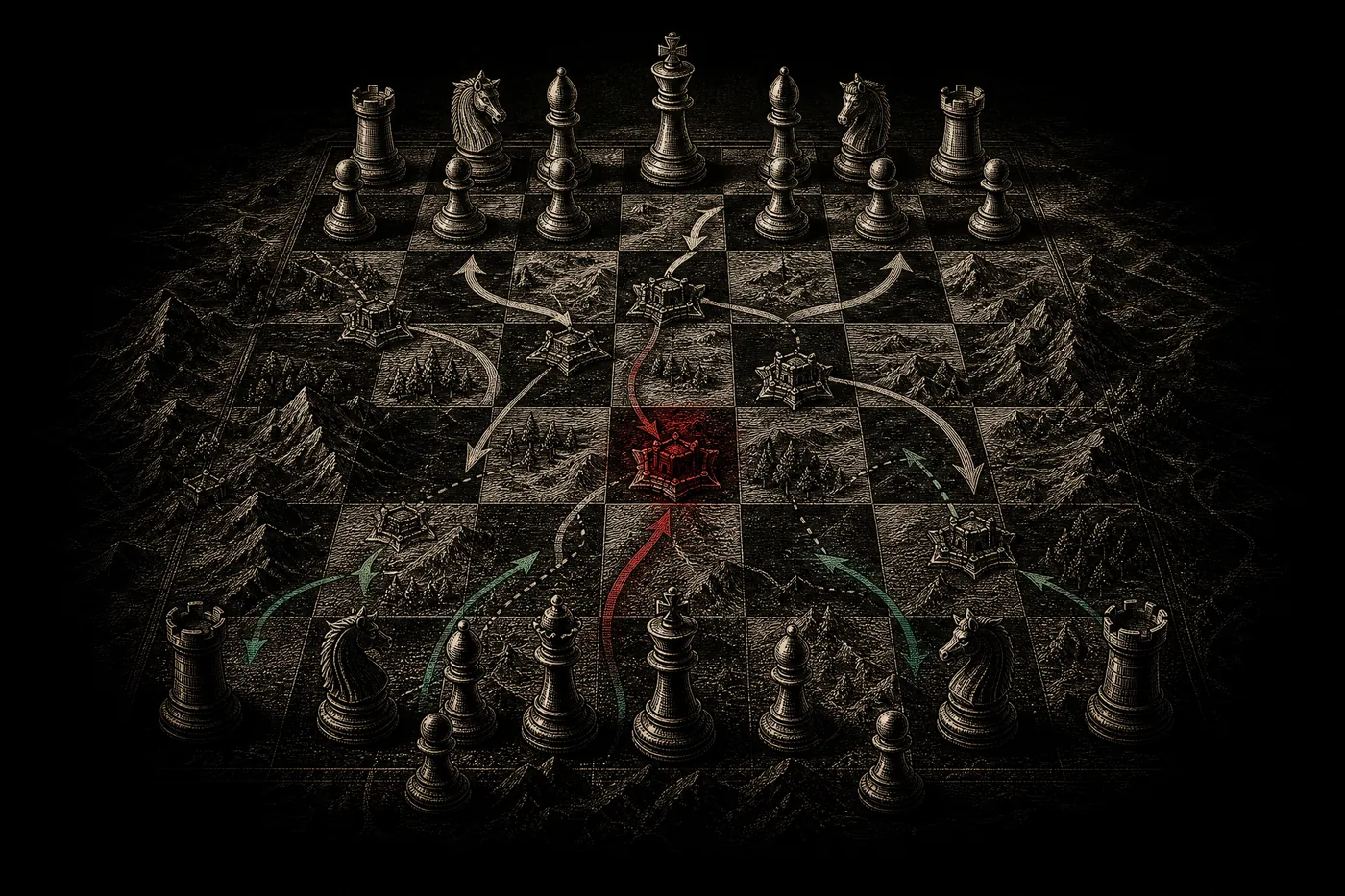
A quick word on when to play …e5. The break is strongest once Black’s pieces support it — that’s why the move order runs …c6 and …Nbd7 first. If you fire …e5 before the knights and queen are ready, White can answer with d5, gaining space and leaving Black cramped, or simply trade and exploit the slightly loose pawns. Played at the right moment, though, …e5 either forces White to release the central tension (after which the g7-bishop comes alive) or invites d5, at which point Black pivots to a King’s-Indian-style plan: …c5 and …b5 to attack on the queenside, or a knight reroute toward c5. Either way, Black gets exactly the active, asymmetrical game the Pirc is built for.
The one idea to carry through the whole line
If you remember nothing else, remember why Black went to all this trouble. Every move in this main line serves a single theme: build the fianchetto fortress, get safe, then counterattack the center. Black doesn’t try to out-occupy White’s pawns — that’s a losing race. Instead, Black sets up the g7-bishop and the …e5 lever, and waits for the moment White’s big center becomes a big target.
That’s also why the move order matters. Black plays …c6 before …e5 so that the center break is properly supported and White can’t exploit the d5-square. Little details like that are the difference between a smooth Pirc and a cramped, passive one — and they all flow from understanding the plan rather than memorizing moves.
For the full tour of the Austrian Attack, the 150 Attack, the Byrne, and the rest, head to our variations guide. New to all of this? Start gentle with the Pirc for beginners.
FAQ
What’s the main line of the Pirc Defense? The Classical: 1.e4 d6 2.d4 Nf6 3.Nc3 g6 4.Nf3 Bg7 5.Be2 O-O 6.O-O, usually continuing with …c6 and …Nbd7, then the …e5 break.
Why does Black play …g6 and …Bg7 instead of fighting in the center? That’s the hypermodern idea — Black controls the center from a distance with the fianchettoed bishop, lets White overextend, and then counterattacks with …e5 or …c5.
What is the most important move in the Pirc? The central break — usually …e5 (sometimes …c5). The whole opening is built to prepare and support that counterstrike against White’s center.
Do I have to memorize all these moves? No — understand the ideas (fianchetto, castle, prepare the break) and the move order feels natural. The Pirc is a system, not a memory test.
Keep climbing
Want the reasoning behind “develop, castle, then break the center”? Read the opening principles — the Pirc is a great example of bending the “occupy the center” rule while keeping the rest. And loop back to the Pirc overview or compare it with the King’s Indian Defense any time.
Written and fact-checked by the Chess Lab Academy Editorial Team (AI-assisted, human-edited) · Lines checked against mainstream opening theory and verified with Stockfish 17 · ECO B07–B09 · Last verified 2026-06-25 · Sources · How we verify content.
