

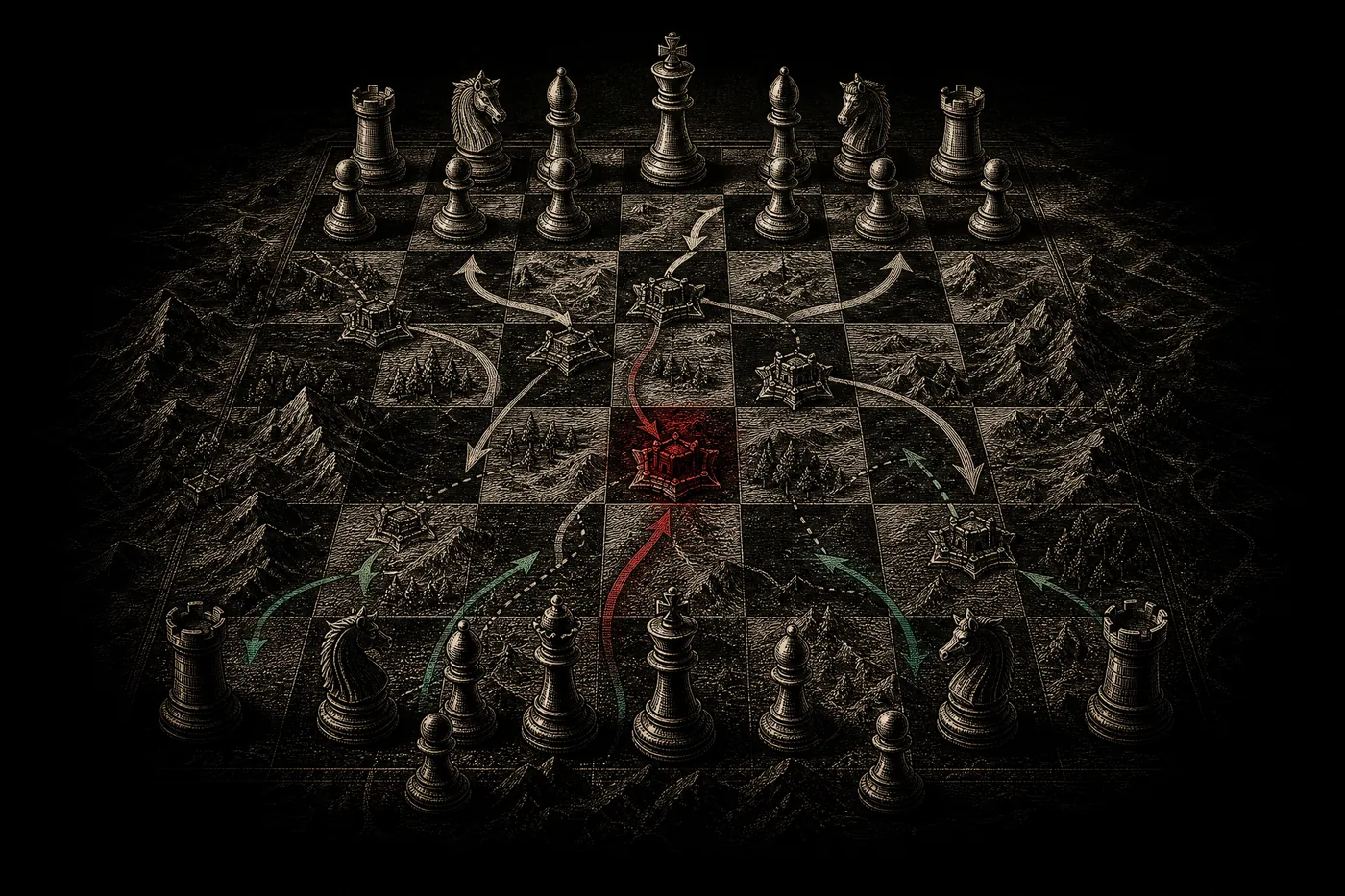
The French Tarrasch all begins with the same quiet move — 1.e4 e6 2.d4 d5 3.Nd2 — but Black’s reply splits the game into several very different worlds, spanning ECO codes C03 to C09. Some are open and full of piece play; some are locked French pawn chains. Here’s the whole map, with the moves, the core idea, and who each line favors.
The Tarrasch variations at a glance
Variation Key moves ECO Personality Verdict Open, …exd5 3…c5 4.exd5 exd5 C08–C09 Black isolated d-pawn Roughly equal Open, …Qxd5 3…c5 4.exd5 Qxd5 C07 White develops with tempo Small White pull Closed 3…Nf6 4.e5 Nfd7 C05–C06 French pawn chain Small White pull Universal 3…a6 C03 Flexible, waiting Roughly equal Guimard 3…Nc6 C04 Rare, blocks the c-pawn Pleasant for White Rubinstein-style 3…dxe4 4.Nxe4 C03 Solid liquidation Small White pull
The Open Tarrasch with 4…exd5 (C08–C09)
Black’s most principled choice: strike with 3…c5, and after 4.exd5, recapture with the pawn — 4…exd5.
The core idea: after the standard 5.Ngf3 Nc6 6.Bb5 Bd6 7.dxc5 Bxc5, Black is left with an isolated d-pawn — but with fast, active pieces and the two bishops. White blockades the pawn (a knight to d4 is ideal) and plays for the endgame; Black plays for piece activity and the …d4 break. This is the classic Tarrasch battleground, and the full walkthrough is on our move-by-move page. Roughly balanced — a real fight where good technique decides.
The Open Tarrasch with 4…Qxd5 (C07)
Instead of the pawn, Black can recapture with the queen: 4…Qxd5. It looks risky to bring the queen out early, but it’s completely sound, and it avoids saddling Black with the isolated pawn.
The core idea: White gains time by developing pieces that hit the queen (Bc4, Nb3), and often recaptures the c-pawn to reach a position with no isolani but a small, lasting development edge. Black, in turn, is very solid and finishes developing without long-term weaknesses. Engines give White a small, comfortable pull — the Tarrasch’s calling card.
The Closed Tarrasch (3…Nf6, C05–C06)
Black can instead develop and attack e4 with 3…Nf6. White defends the only way that keeps the tension — by pushing 4.e5 Nfd7 — and a genuine French pawn chain appears.
Step through the line
Move by move — press Next to advance, Back to rewind.
The Closed Tarrasch main line — 5.Bd3 c5 6.c3 Nc6 7.Ne2, with White rerouting the knight to guard d4 and later hop to f4 or g3.
The core idea: this plays like the French Advance. Black chips at the base of the chain with …c5 and …Nc6, White props d4 with c3 and reroutes the d2-knight via e2 (to f4 or g3). Later Black plays the second thematic break, …f6, to hit the head of the chain on e5. The bishop on c8 is the usual “bad French bishop,” and freeing it is Black’s long-term project. White keeps a small space edge — pleasant but far from winning.
The Universal System (3…a6, C03)
A flexible, modern try: Black plays 3…a6, taking away the b5-square (so White’s bishop can’t pin or swap on c6) and waiting to see White’s setup before committing.
The core idea: …a6 prepares …c5 under improved circumstances and keeps Black’s structure fluid. It’s a low-theory, high-flexibility way to meet the Tarrasch, and engines call it roughly equal. A great practical weapon for the Black player who wants to sidestep White’s preparation.
The Guimard Variation (3…Nc6, C04)
Black develops the knight to c6 first: 3…Nc6. The idea is to pressure d4 early, but there’s a real downside — the knight blocks Black’s own c-pawn, so the freeing …c5 break is harder to arrange.
The core idea: after 4.Ngf3 (and often e4–e5 later), White develops smoothly and keeps a pleasant edge. Our engine check gives White a clearly comfortable game here — this is the least testing of Black’s main tries, and a good line for White to know. A pleasant pull for White.
The Rubinstein-style liquidation (3…dxe4, C03)
Black can dodge the structural debate entirely by grabbing on e4: 3…dxe4 4.Nxe4, liquidating the center.
The core idea: exactly as in the French Defense Rubinstein, Black accepts a little less space in exchange for a clean, solid position — the light-squared bishop can develop freely, and there’s very little to memorize. White keeps a small, stable edge, but Black is famously hard to crack. The choice for French players who prize solidity over sharpness.
And a quick word on 3…Be7
You’ll also see the flexible 3…Be7, developing a piece and keeping every structural option open (Black can follow with …c5 or …Nf6 next). It usually transposes into the lines above and is another roughly equal, low-commitment path.
So which variation should you study?
- Playing Black and want the most principled equalizer? The Open Tarrasch with 3…c5 — either recapture is sound. Learn the isolated-pawn plans.
- Want maximum solidity and minimum theory? The Rubinstein-style 3…dxe4 or the flexible 3…a6.
- Love French pawn-chain play already? The Closed Tarrasch (3…Nf6) will feel like home.
- Playing White? Aim for the 4…Qxd5 and Closed lines, where you keep a small, comfortable pull — details in how to beat the French Tarrasch (written for Black, so you’ll know exactly what they’re trying to do).
FAQ
What is the difference between the Open and Closed Tarrasch? The Open Tarrasch (3…c5) opens the center and usually gives Black an isolated d-pawn with active pieces. The Closed Tarrasch (3…Nf6 4.e5 Nfd7) keeps a locked French pawn chain and revolves around the …c5 and …f6 breaks.
Should Black recapture 4…exd5 or 4…Qxd5? Both are fully sound. 4…exd5 leads to the classic isolated-pawn fight; 4…Qxd5 avoids the isolani but lets White develop with tempo. It’s a matter of taste.
Is 3…a6 a real variation or just a sideline? It’s a respected modern try — the “Universal System.” By ruling out Bb5 ideas and keeping the structure flexible, it sidesteps a lot of White’s preparation and equalizes comfortably.
Which Tarrasch line is best against a well-prepared opponent? For Black, the low-theory 3…a6 or 3…dxe4 lines dodge deep preparation. For White, the 4…Qxd5 and Closed lines keep a small, durable edge without heavy memorization.
Keep climbing
If the branches are blurring together, anchor yourself with the French Tarrasch overview and the parent French Defense, then sharpen your fundamentals with the opening principles. Curious how the Tarrasch compares to White’s other anti-French tries? See the sharp Winawer and the space-grabbing Advance.
Written and fact-checked by the Chess Lab Academy Editorial Team (AI-assisted, human-edited) · Lines checked against mainstream opening theory and verified with Stockfish 17 · ECO C03–C09 · Last verified 2026-07-11 · Sources · How we verify content.
