

The French Tarrasch is what happens after 1.e4 e6 2.d4 d5 3.Nd2 — White’s calm, clever way of meeting the French Defense without walking into its sharpest lines. That quiet knight move to d2 looks almost timid next to 3.Nc3, but it’s one of the most respected anti-French systems ever played. It was Anatoly Karpov’s favorite way to squeeze French players for years, and it still gives White a small, pleasant pull with almost no risk. Named after Siegbert Tarrasch, it’s the choice of players who’d rather understand a structure than memorize a Winawer novel.
The 30-second version
- Moves: 1.e4 e6 2.d4 d5 3.Nd2 · ECO: C03–C09 · You face it against the French; White plays it, Black must answer it.
- The point of 3.Nd2: it defends e4 like 3.Nc3, but the knight can’t be pinned by …Bb4 — so the whole Winawer disappears.
- The cost: the knight briefly blocks the c1-bishop and doesn’t hit d5, so White’s setup is a touch less aggressive.
- Two big roads: the Open Tarrasch (3…c5, often an isolated queen’s pawn) and the Closed Tarrasch (3…Nf6 4.e5 Nfd7).
- Best for: patient, positional White players who want a safe edge — and any French player who needs a plan against it.
Step through the line
Move by move — press Next to advance, Back to rewind.
The French Tarrasch — 3.Nd2 sidesteps the Winawer pin, and after 3...c5 4.exd5 the play flows toward an isolated-pawn middlegame.
What is the French Tarrasch?
The French Tarrasch is a variation of the French Defense, not a separate opening — so everything on our French Defense overview still applies. The difference is entirely White’s third move. After 1.e4 e6 2.d4 d5, White has to decide what to do with the attacked e4-pawn, and 3.Nd2 is the flexible, low-commitment answer.
Because this is White’s system, the reader on the White side wants to keep a small edge with minimal theory, and the reader on the Black side wants a clean, equalizing plan. We’ll cover both — and if you’re Black, you’ll want our dedicated pages on the main-line moves and how to beat the Tarrasch.
The big idea: why 3.Nd2 instead of 3.Nc3?
This is the whole story, so it’s worth slowing down. Both 3.Nc3 and 3.Nd2 defend the e4-pawn. The difference is what Black can do in reply.
After 3.Nc3, Black can pin the knight with 3…Bb4 — the famous Winawer:
The Winawer is thrilling but wildly theoretical, full of doubled c-pawns and poisoned pawns. 3.Nd2 quietly refuses to allow it. Put the knight on d2 and …Bb4 no longer pins anything — White would just answer …Bb4 with c3, kicking the bishop. So the entire Winawer vanishes, and with it a mountain of memorization.
There’s a second, subtler point. The knight on d2 keeps White’s c-pawn free. In the Nc3 lines the c-pawn is blocked, but in the Tarrasch White can later play c3 to build a rock-solid d4–c3 support chain — exactly what you want when you’re playing for a small, safe edge.
The trade-off is honest: the d2-knight briefly bottles up the c1-bishop, and unlike a knight on c3 it doesn’t add pressure to d5. So the Tarrasch is a little less ambitious than the Winawer or the Advance. White accepts “slightly pressing” instead of “swinging for a knockout.” Engines agree: the main Tarrasch tabiyas sit right around a small White pull — sound, comfortable, and never crushing.
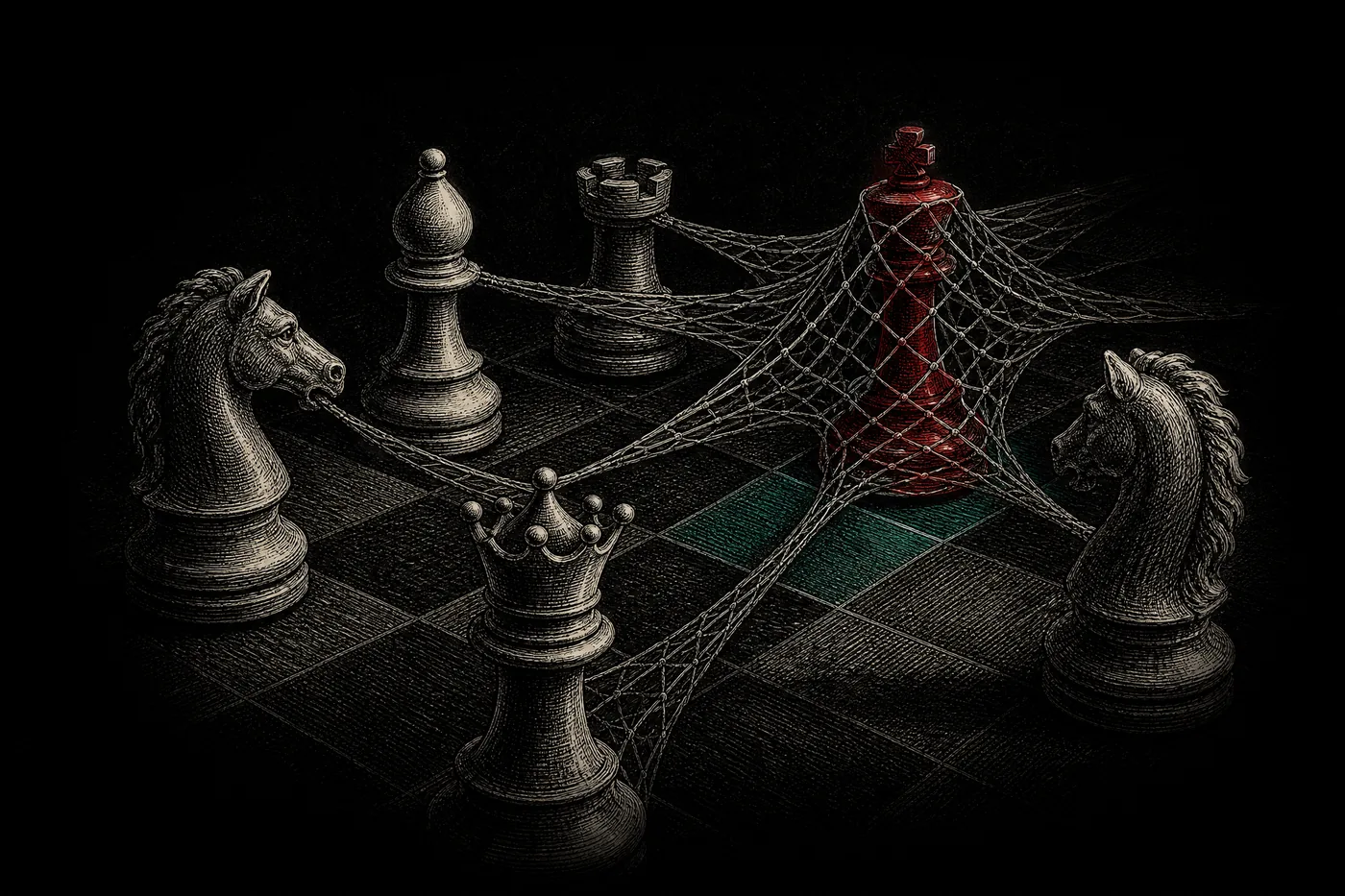
Two structures: the Open and Closed Tarrasch
Black’s reply to 3.Nd2 sends the game down one of two very different roads.
The Open Tarrasch (3…c5)
Black strikes the center at once with 3…c5, refusing to be cramped:
After 4.exd5, Black recaptures with either 4…exd5 (the pawn) or 4…Qxd5 (the queen). Both typically lead to an isolated queen’s pawn (IQP) somewhere on the board — often an isolated d-pawn for Black. IQP positions are the beating heart of the Tarrasch: the side with the isolated pawn gets active, free-flowing pieces, while the other side blockades it and plays for the endgame. Modern theory and engines call these positions dynamically balanced — a real, honest fight, not an advantage for either side.
The Closed Tarrasch (3…Nf6)
Black can instead develop and hit e4 with 3…Nf6, when White advances 4.e5 Nfd7:
This looks like a normal French pawn chain (d4–e5), and it plays like one: Black attacks the base with …c5, brings up …Nc6, and eventually strikes the head of the chain with …f6. It’s the more “French-flavored” of the two systems and a great fit for players who already love the Advance structures.
There are also flexible sidelines — 3…Be7, 3…a6 (the “Universal System”), 3…Nc6 (the Guimard), and 3…dxe4 (a Rubinstein-style liquidation). We cover all of them on the variations page.
Plans for both sides
For White:
- Complete easy development (Ngf3, Bd3 or Bb5, c3, 0-0) and keep a small, durable space edge.
- In the Open Tarrasch, blockade Black’s isolated d-pawn — often with a knight on d4 — and steer toward an endgame where the isolani is a weakness.
- In the Closed Tarrasch, hold the d4–e5 chain, expand on the kingside, and keep the c8-bishop bad.
For Black:
- Meet 3.Nd2 head-on with 3…c5, trade in the center, and get your pieces active around the isolated pawn — the IQP is a source of energy, not just weakness.
- In the Closed system, play the thematic breaks …c5 and …f6 to free the position and activate the light-squared bishop.
- Remember that the Tarrasch is White’s safe try, not their most dangerous — accurate, active play equalizes.
The main variations at a glance
| Line | Moves | ECO | Personality |
|---|---|---|---|
| Open Tarrasch (…exd5) | 3…c5 4.exd5 exd5 | C08–C09 | Black isolated d-pawn, active pieces |
| Open Tarrasch (…Qxd5) | 3…c5 4.exd5 Qxd5 | C07 | White leads in development, small pull |
| Closed Tarrasch | 3…Nf6 4.e5 Nfd7 | C05–C06 | French pawn chain, …c5/…f6 breaks |
| Universal (3…a6) | 3…a6 | C03 | Flexible, delays the central clash |
| Guimard (3…Nc6) | 3…Nc6 | C04 | Rare, a touch passive; pleasant for White |
The full tour — with the key moves and who each line favors — lives on the variations page.
Strengths and weaknesses
Why White plays it:
- No Winawer, ever. You dodge the French’s sharpest, most theory-heavy system entirely.
- Low risk, small edge. The structures are healthy and the plans are clear — perfect for positional players.
- It ages well. Karpov, Kasparov, and today’s elite have all trusted it; the ideas never go out of style.
Why it isn’t a knockout punch:
- It’s modest. The d2-knight doesn’t pressure d5, and the c1-bishop is briefly boxed in.
- Black equalizes with accuracy. The IQP positions are genuinely balanced; a prepared French player is fine.
- You must handle isolated pawns well. If IQP middlegames aren’t your thing, the Tarrasch will feel unfamiliar.
Who plays the French Tarrasch?
The name most tied to 3.Nd2 is Anatoly Karpov, who turned it into a positional weapon in the 1970s and 80s — including a famous run of French Tarrasch games in his 1974 Candidates final against Viktor Korchnoi. On the Black side, French specialists like Wolfgang Uhlmann and Viktor Korchnoi spent careers proving Black is fine. Garry Kasparov later used 3.Nd2 at the very top too. It’s an opening with a genuinely elite pedigree on both sides of the board — the model games are on our master games page.
Is the French Tarrasch right for you?
If you play White and you like solid, strategic chess — small edges, clean development, and endgames where good technique tells — the Tarrasch is a superb, lifelong anti-French. If you play Black and keep running into 3.Nd2, don’t panic: it’s White’s safest try, and a clear plan (usually 3…c5) equalizes cleanly. For the honest, level-by-level verdict, see is the French Tarrasch good?
Explore the French Tarrasch
- The French Tarrasch move by move
- French Tarrasch variations (Open, Closed, Universal & more)
- French Tarrasch traps and pitfalls
- The French Tarrasch for beginners
- Best French Tarrasch master games (Karpov & co.)
- How to beat the French Tarrasch (as Black)
- Is the French Tarrasch good?
Zoom back out to the French Defense overview, compare it with the sharp Winawer and the space-grabbing Advance, or return to the full openings hub.
FAQ
What is the French Tarrasch? It’s the variation of the French Defense where White plays 3.Nd2 (after 1.e4 e6 2.d4 d5). The knight defends e4 but avoids the …Bb4 pin, so White sidesteps the Winawer and plays for a small, safe edge.
Why does White play 3.Nd2 instead of 3.Nc3? To avoid the Winawer. On c3 the knight can be pinned by …Bb4; on d2 it can’t. The d2-knight also keeps White’s c-pawn free to support d4 later. The cost is that it briefly blocks the c1-bishop and doesn’t attack d5.
Is the French Tarrasch good for White or Black? White chooses it as an answer to Black’s French. It’s a White system — but it’s Black who must know a solid reply (usually 3…c5).
What is the difference between the Open and Closed Tarrasch? The Open Tarrasch (3…c5) opens the center and usually produces an isolated-queen’s-pawn middlegame. The Closed Tarrasch (3…Nf6 4.e5 Nfd7) keeps a locked French pawn chain and the thematic …c5/…f6 breaks.
Is the French Tarrasch better than the Winawer? Neither is “better” — they’re different tools. The Winawer is sharp and double-edged; the Tarrasch is calm and low-risk. White picks based on temperament.
Keep climbing
New to the French family? Start with the French Defense overview and the opening principles, then come back and the Tarrasch’s quiet logic will click. From here, dig into the move-by-move main line or the variations.
Written and fact-checked by the Chess Lab Academy Editorial Team (AI-assisted, human-edited) · Lines checked against mainstream opening theory and verified with Stockfish 17 · ECO C03–C09 · Last verified 2026-07-11 · Sources · How we verify content.
