
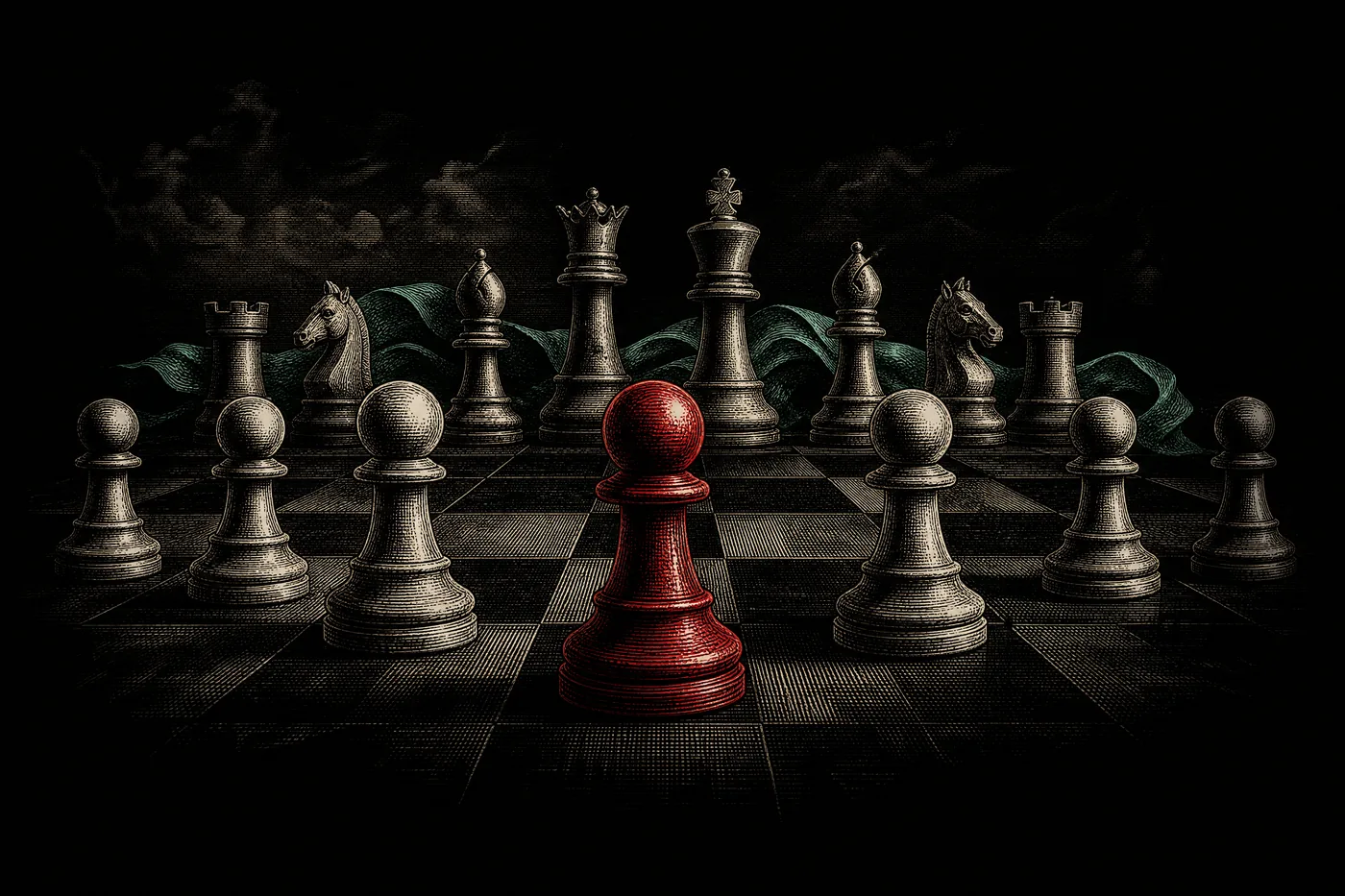
The best way to understand the Caro-Kann is to watch great players use it. The defense has shown every face over the years — from sharp attacks to the slowest, most patient positional squeezes ever recorded. Here are three instructive games, each teaching a different side of the opening. (We’ve kept the focus on the opening and the plans; click through the viewers to follow the ideas move by move.)
The three games
- Tal vs Botvinnik, 1961 — the Classical Caro-Kann, attacked with energy.
- Karpov’s Classical — the solid squeeze, defense as a weapon.
- A model Panov-Botvinnik Attack — initiative and the isolated queen’s pawn.
Game 1: Tal vs Botvinnik, World Championship 1961
When Mikhail Tal and Mikhail Botvinnik met for the world title, the Caro-Kann was on the board — and Tal, the great attacker, showed that even against the soundest defense you can play for fire. This Classical line saw Black recapture with 5…gxf6, accepting doubled f-pawns in exchange for the half-open g-file and central solidity.
Step through the line
Move by move — press Next to advance, Back to rewind.
Tal vs Botvinnik, 1961 — the Classical Caro-Kann with 5...gxf6, a fighting, double-edged structure.
What to learn: notice how even in this “solid” defense both sides get real chances. Black’s doubled f-pawns control key central squares (e5 and e4) and the half-open g-file gives counterplay, while White develops smoothly and eyes the slightly loosened black kingside. The takeaway: the Caro-Kann isn’t a draw machine — strong attackers like Tal happily played for the win against it, and Black still had a fully sound game. Sound doesn’t mean dull.
Game 2: Karpov’s Classical squeeze
If you want to feel why the Caro-Kann is the favorite of great positional players, look at how Anatoly Karpov handled it. Karpov made a career of taking solid, slightly passive-looking positions and slowly out-maneuvering everyone. The Classical Caro-Kann was a natural fit — here’s a representative treatment of the line.
Step through the line
Move by move — press Next to advance, Back to rewind.
The Karpov-style Classical Caro-Kann — trade off the light bishops, castle queenside, and settle in for a long, solid game.
What to learn: watch how little drama there is — and how that’s the point. Black trades off the light-squared bishops (the …Bxd3 swap removes White’s most dangerous attacker), tucks the king away with …0-0-0, and reaches a rock-solid structure with zero weaknesses. From positions like this, Karpov would simply improve his pieces, neutralize White’s space edge, and wait for the smallest inaccuracy. This is the Caro-Kann’s whole philosophy: a sound structure is a weapon. You don’t need to attack if your opponent can never attack you.

Game 3: A model Panov-Botvinnik Attack
The Caro-Kann isn’t always quiet. When White plays the Panov-Botvinnik Attack (named partly for Botvinnik, who helped popularize it), the game takes on a sharp, Queen’s-Gambit character — often with an isolated queen’s pawn and active pieces flying around.
Step through the line
Move by move — press Next to advance, Back to rewind.
A model Panov-Botvinnik Attack — White accepts an isolated queen's pawn for free-flowing piece activity.
What to learn: this is the Caro-Kann’s other personality. After 7.cxd5 Nxd5, White is left with the famous isolated queen’s pawn (IQP) on d4 — a structural weakness in the endgame, but a fountain of activity in the middlegame. White’s pieces get great squares (the Bd3/Bc2 battery aims at h7, the rook lands on e1, the knights eye e5 and g5), and the half-open files invite attack. Black, meanwhile, plays for the long game: blockade the d-pawn, trade pieces, and aim for a better endgame. The lesson: respect the Panov. It’s the one line where a passive Caro-Kann player gets steamrolled — Black has to play actively and precisely.
What these three games teach together
- The opening is flexible. One defense produced a sharp Tal attack, a glacial Karpov squeeze, and a dynamic IQP middlegame. That range is exactly why the Caro-Kann is so respected.
- Structure is a weapon. Karpov barely “attacked” at all — he just relied on a flawless pawn skeleton and out-played opponents over 40 moves.
- Solid doesn’t mean passive. Against the Panov especially, Black has to be active. The Caro-Kann rewards understanding, not just hiding.
Want to play these structures yourself? Start with the move-by-move main line, then explore the full variations.
FAQ
Who are the most famous Caro-Kann players? Anatoly Karpov and Tigran Petrosian — two of the greatest positional players ever — were famous for it, and Viswanathan Anand used it at the very top. It’s long been the defense of choice for elite technical players.
Why did positional players like Karpov love the Caro-Kann? Because it gives Black a sound, weakness-free structure with no bad bishop. That’s perfect for players who win by slowly out-maneuvering opponents rather than launching attacks.
Is the Caro-Kann only for defensive players? No — as the Tal and Panov games show, the resulting positions can be sharp and double-edged. But its reputation (and its best results) lean toward patient, structural players.
What’s the hardest line for a Caro-Kann player to face? Many find the Panov-Botvinnik Attack the most demanding, because it forces Black into active, precise play rather than the usual solid maneuvering.
Keep climbing
Studying master games is one of the fastest ways to improve — but it lands better once you know the opening principles and the main-line plans. Loop back to the Caro-Kann overview or browse the whole openings hub for more.
Written and fact-checked by the Chess Lab Academy Editorial Team (AI-assisted, human-edited) · Lines checked against mainstream opening theory and verified with Stockfish 17 · ECO B10–B19 · Last verified 2026-06-25 · Sources · How we verify content.
