

Ruslan Ponomariov’s best games are the games of a competitor — tense, high-stakes fights where the pressure was enormous and the nerve held. We’re telling these stories in prose — the setting and the ideas — rather than walking through move-by-move notation, so you get the flavor without a board in front of you and without us risking a single wrong move. Where you want to replay the moves yourself, the sources at the bottom link to full game records.
The board that keeps showing up
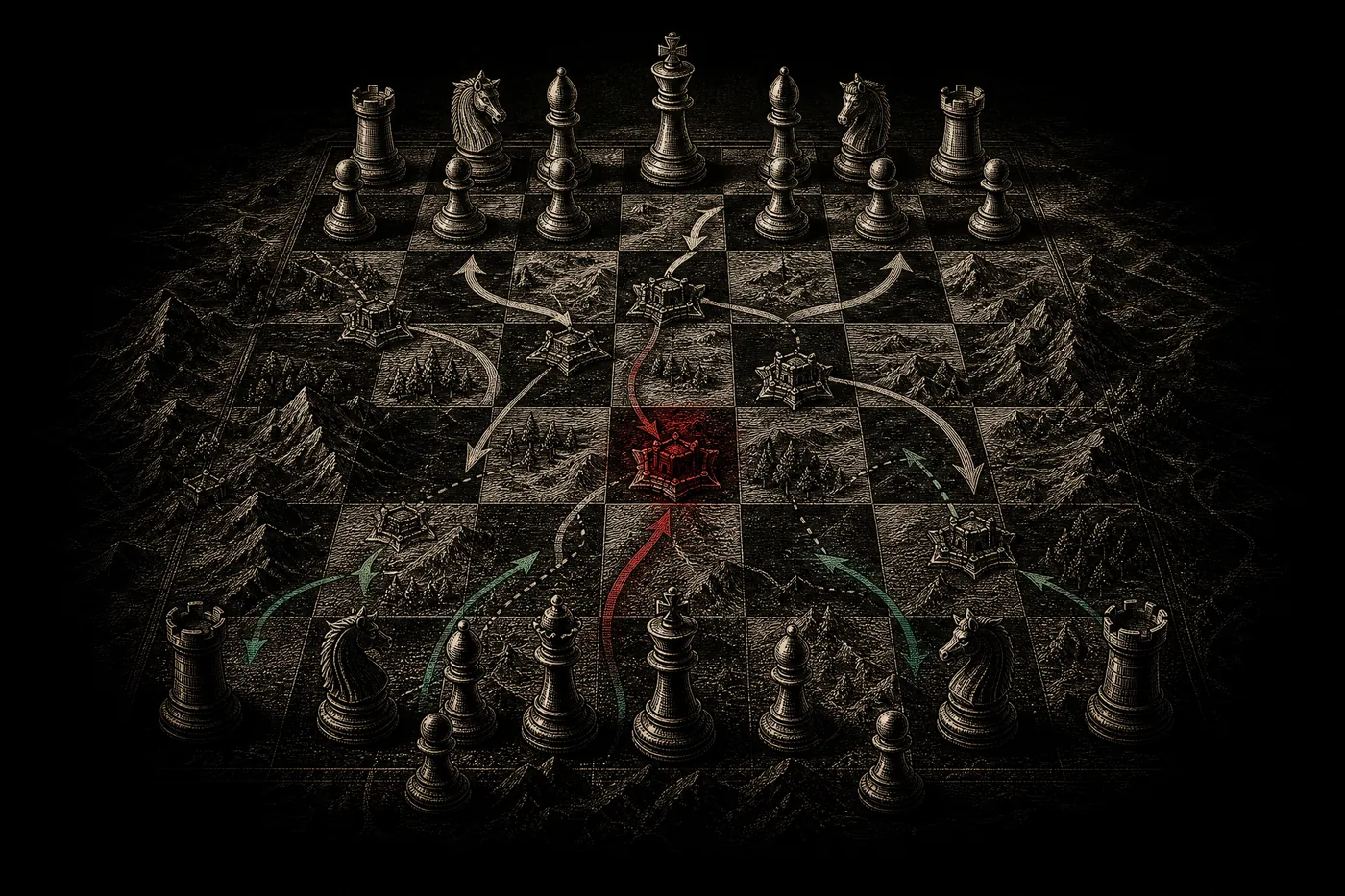
One position runs through the most talked-about game of his youth: the French Defense. Black answers 1.e4 with 1…e6, planning …d5 to challenge the center head-on and build a resilient, counter-punching structure. It’s exactly the sort of deep, classical middlegame Ponomariov grew up mastering — and it’s where an 18-year-old world champion once traded blows with the strongest player on the planet.
1. Ponomariov vs. Ivanchuk — FIDE World Championship final, Moscow 2002
This is the game — or rather the match — that defines his career. The FIDE World Chess Championship 2002 was a giant single-elimination knockout, and it came down to an all-Ukrainian final in Moscow: the 18-year-old Ponomariov against Vassily Ivanchuk, a former world No. 2 and one of the most feared players alive.
Ivanchuk had the experience, the reputation, and the fireworks. Ponomariov had ice in his veins. He took the lead by winning the very first game, and from there he did the hardest thing in match chess: he refused to crack. He won again later in the match and, crucially, never lost a single game — closing it out 4½–2½ to become the youngest FIDE World Champion in history at 18 years and 104 days.
What makes the match a masterclass isn’t a single flashy combination — it’s the control. Against an opponent famous for creative chaos, Ponomariov kept steering the games onto solid ground, neutralizing Ivanchuk’s ideas and pouncing when the older man overpressed. It’s the perfect illustration of why he became known as a knockout specialist: calm, prepared, and lethal when a result was on the line.
2. Kasparov vs. Ponomariov — Linares 2002
Not every great game is a win, and this one is a great game precisely because of who was on the other side of the board. At the elite Linares 2002 super-tournament, the freshly crowned teenage world champion sat across from Garry Kasparov — the highest-rated player on Earth and, for many, the greatest of all time.
Ponomariov met Kasparov’s 1.e4 with the French Defense (the Rubinstein Variation), inviting exactly the kind of deep, strategic middlegame both players loved. Kasparov, in trademark form, ratcheted up the pressure and won the game — he went on to take first place at Linares that year, undefeated. But the takeaway isn’t the scoreline; it’s that an 18-year-old walked into the lion’s den against the world’s best and played principled, top-level chess. Games like this are why Ponomariov was taken so seriously so young, and the encounter has been anthologized and analyzed ever since.
3. The scalps of a knockout specialist
Ponomariov’s résumé is stuffed with wins over elite opposition, because knockout chess rewards exactly his strengths. On his run to the 2002 world title he had to get past a murderer’s row of grandmasters — including a semifinal win over Peter Svidler — without the safety net a long round-robin gives you. One bad day and you’re out; he simply didn’t have bad days.
Over the years he’s also beaten former World Champion Vladimir Kramnik in their games and, in 2010, won the elite Dortmund Sparkassen tournament outright — one of the classical circuit’s crown jewels. Add two World Cup finals (runner-up in 2005 and 2009) and two Chess Olympiad team golds with Ukraine (2004 and 2010), and you get the portrait of a player who was dangerous whenever the format turned into a straight fight.
What these games teach us
Look across them and a theme emerges: Ponomariov wins with temperament and preparation more than with one signature haymaker. Against Ivanchuk he out-steadied a genius; against Kasparov he stood his ground against the best in the world; across a decade of knockouts he made his solidity into a weapon. That “sport-first” mentality — treat every game as a contest to be won on the day — is the thread running through his whole career.
We dig into the mechanics of it in Ponomariov’s playing style, and we map the systems that produce these positions in his openings.
Where to replay the moves
We’ve kept this page to prose so we’re not risking a single wrong move in transcription. To play through the full games yourself, the records are collected across the major chess databases — search each event (FIDE World Championship 2002, Linares 2002, Dortmund) and you’ll find annotated versions on the sites linked in our sources below.
Keep exploring
More on the champion behind the games: his full profile · his playing style · his opening repertoire · or read about his 2002 final opponent, Vassily Ivanchuk · or browse all chess players.
Written and fact-checked by the Chess Lab Academy Editorial Team · Facts and game details verified against Wikipedia, his FIDE profile, and Chess.com, as of July 2026 · Last verified 2026-07-10 · How we verify content.
