

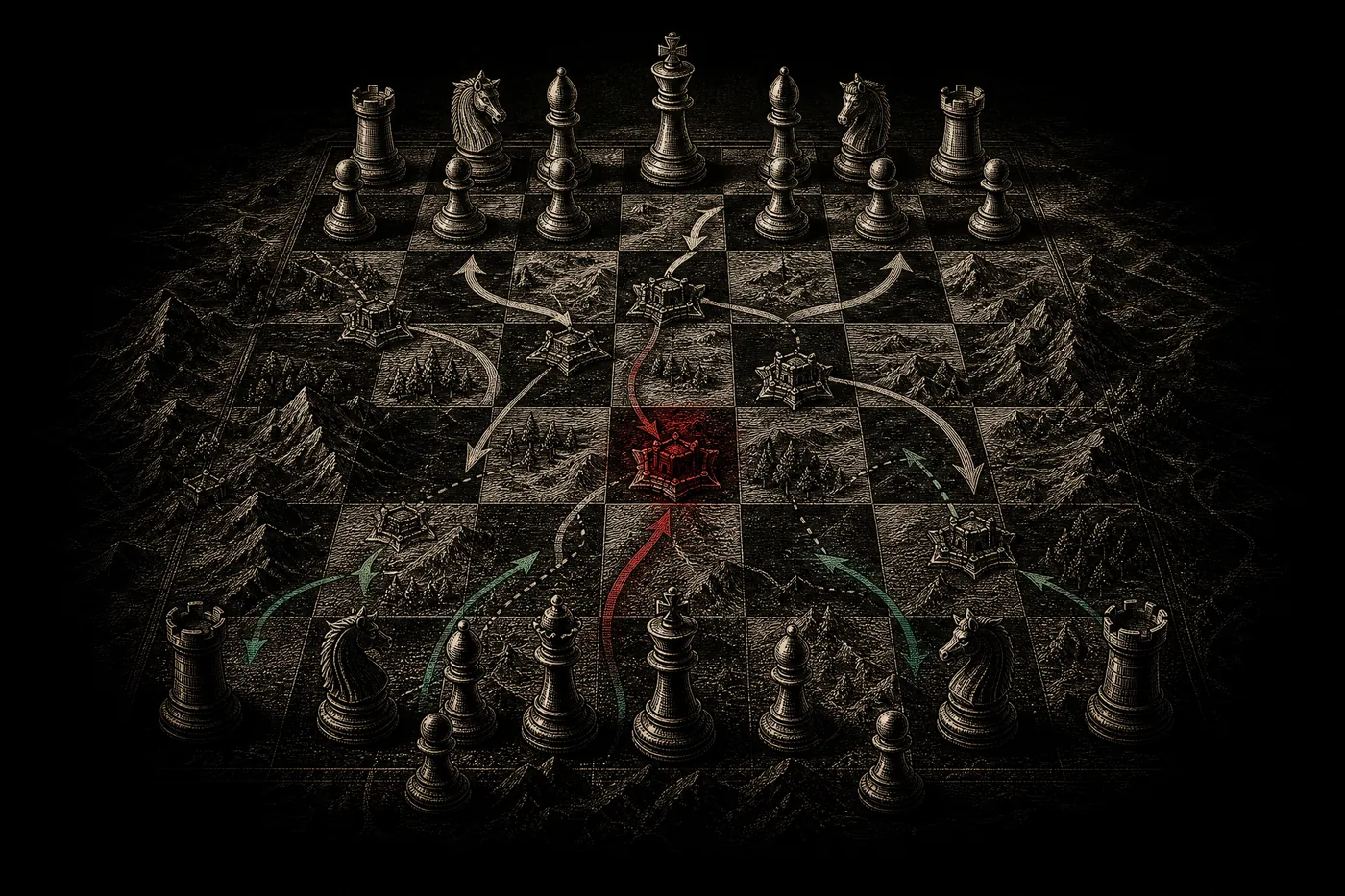
The Sicilian isn’t one opening — it’s a sprawling family of them, and the family reunion is loud. Below are the major named variations, each with its moves, its core idea, and who it tends to favor. Think of this as the map you pull out before deciding which Sicilian to make your own.
The 30-second version
- The big split is Open Sicilian (White plays 2.Nf3 + 3.d4) vs. Anti-Sicilians (White avoids it).
- Inside the Open Sicilian, Black’s setup names the variation: …a6 (Najdorf), …g6 (Dragon), …e5 (Sveshnikov), …e6 (Scheveningen), …Nc6 (Classical), and the …e6 cousins Taimanov & Kan.
- Sharper = more theory and bigger risk/reward; flexible = lower maintenance.
Step through the line
Move by move — press Next to advance, Back to rewind.
The Najdorf — the most famous Sicilian variation of them all.
The variations at a glance
| Variation | Defining moves | Core idea | Style |
|---|---|---|---|
| Najdorf | 5…a6 | Flexibility; prepares …e5/…e6 and …b5 | Sharp/maneuvering |
| Dragon | 5…g6 + …Bg7 | Fianchetto firing at the queenside | Very sharp |
| Sveshnikov | …e5 (via …Nc6) | Active pieces for a backward d-pawn | Sharp/dynamic |
| Classical | 5…Nc6 | Natural development | Flexible |
| Scheveningen | …e6 + …d6 | The “small center,” maneuvering | Solid/sharp |
| Taimanov | …e6 + …Nc6 | Flexible piece play, …Qc7 | Flexible |
| Kan | …e6 + …a6 | Low-theory, hedgehog-ish setups | Flexible |
All of these branch from the Open Sicilian crossroads (after 1.e4 c5 2.Nf3 + 3.d4 cxd4 4.Nxd4 + Nc3). For the move-order details, see the moves page.
Najdorf (5…a6)
Moves: 1.e4 c5 2.Nf3 d6 3.d4 cxd4 4.Nxd4 Nf6 5.Nc3 a6
The most celebrated Sicilian, full stop. The little …a6 controls b5 and prepares both …e5 (grabbing space) and …e6 (transposing toward Scheveningen structures), plus a later …b5. White’s sharpest tries are the English Attack (6.Be3, then f3, Qd2, g4, and queenside castling for a kingside storm) and the old main lines with 6.Bg5 or 6.Bc4. Favored by Fischer and Kasparov; it favors a Black player who’s done their homework and loves dynamic, double-edged positions.
Dragon (5…g6)
Moves: 1.e4 c5 2.Nf3 d6 3.d4 cxd4 4.Nxd4 Nf6 5.Nc3 g6, followed by …Bg7.
Black builds a “dragon” pawn formation and fianchettoes the dark-squared bishop, which then snipes all the way to White’s queenside. White’s most feared response is the Yugoslav Attack: Be3, f3, Qd2, then castle queenside and hurl the h- and g-pawns at Black’s king. Both sides castle opposite and sprint to mate — it’s the purest opposite-wings race in all of chess. The Dragon favors brave tacticians who don’t blink first.
Sveshnikov (…e5 lines)
Moves: 1.e4 c5 2.Nf3 Nc6 3.d4 cxd4 4.Nxd4 Nf6 5.Nc3 e5
Once considered “anti-positional,” now a top-level mainstay. Black plays the bold …e5, shoving the d4-knight away (6.Ndb5) and accepting a backward d-pawn and a hole on d5 in exchange for fast, active piece play and the bishop pair. Magnus Carlsen used it in his 2018 World Championship match. It favors players who value dynamic activity over a pristine pawn structure — and who don’t mind some sharp theory.
Classical (5…Nc6)
Moves: 1.e4 c5 2.Nf3 Nc6 3.d4 cxd4 4.Nxd4 Nf6 5.Nc3 (knight already on c6)
The most natural-looking Sicilian: get the knights out and figure out the rest later. It can transpose into Richter–Rauzer lines (after White’s Bg5) and other structures. Solid, principled, and a fine choice if you want a Sicilian that respects ordinary development.
Scheveningen (…e6 + …d6)
The famous “small center”: pawns on d6 and e6 form a modest but flexible wall. Black keeps things compact and maneuvers behind it, ready to break with …d5 or …b5. White’s most testing try is the Keres Attack (an early g4). The Scheveningen is solid yet full of dynamic potential — Kasparov was a great exponent. Note that many players reach Scheveningen structures through the Najdorf move order (5…a6 then …e6), which is part of its appeal.
Taimanov & Kan (the …e6 cousins)
Taimanov: 1.e4 c5 2.Nf3 e6 3.d4 cxd4 4.Nxd4 Nc6 5.Nc3 Qc7 — flexible piece development with an early …Qc7 eyeing the c-file and e4.
Kan: 1.e4 c5 2.Nf3 e6 3.d4 cxd4 4.Nxd4 a6 — a low-theory, super-flexible setup that often morphs into a hedgehog. Great for players who want the Sicilian’s fighting spirit without memorizing 25 moves of Najdorf.
Both favor players who like understanding-based chess over heavy memorization.
Anti-Sicilians (when White dodges)
Not every White player wants to enter the Open Sicilian’s theory minefield. Common detours:
- Alapin (2.c3): White prepares d4 with pawn support, aiming for a big center.
- Closed Sicilian (2.Nc3 + g3): White fianchettoes and plays a slow, kingside-oriented game.
- Grand Prix Attack (2.Nc3 + f4): White goes straight for a kingside attack with f4.
- Smith-Morra Gambit (2.d4 cxd4 3.c3): White sacrifices a pawn for fast development and open lines.
We cover all of these in detail — from White’s side — on the how to beat the Sicilian page.
How the variations actually differ (in one breath)
It’s easy to drown in names, so here’s the mental model. Every Open Sicilian shares the same DNA — the …cxd4 trade, the half-open c-file, queenside counterplay against a kingside-leaning White. What changes from variation to variation is how Black arranges the kingside and center:
- …g6 (Dragon) puts the bishop on the long diagonal — maximum firepower aimed at White’s queenside, maximum sharpness.
- …e5 (Sveshnikov) grabs central space and the bishop pair at the cost of a backward d-pawn — dynamic and concrete.
- …e6 (Scheveningen, Taimanov, Kan) builds a flexible, compact wall and keeps things maneuvering — solid and idea-based.
- …a6 (Najdorf) delays the commitment, keeping all of those options open for one more move — which is precisely why it’s the most popular.
Once you see it that way, the “dozen openings” collapse into a single question: how aggressive do you want your kingside and center to be, and how much theory are you willing to learn for it? Answer that, and your Sicilian chooses itself.
Which variation should you pick?
- Want maximum flexibility and prestige? Najdorf — but bring your study shoes.
- Love wild attacking chess? Dragon.
- Like dynamic piece play and don’t fear a backward pawn? Sveshnikov.
- Prefer solid and maneuvering? Scheveningen or Classical.
- Want the Sicilian with less theory? Kan or Taimanov.
See these systems in real action on the master games page.
FAQ
What’s the best Sicilian variation? There’s no single “best” — the Najdorf and Sveshnikov are the most respected at the top, but the right one depends on your style and how much theory you want to learn.
Which Sicilian variation is easiest to learn? The Kan and Taimanov are the most forgiving for newer players because they’re idea-based rather than memorization-heavy.
Are the Dragon and Najdorf risky? They’re sharp and double-edged. Played well they’re fully sound; played carelessly they can blow up fast, especially the Dragon’s Yugoslav Attack.
Written and fact-checked by the Chess Lab Academy Editorial Team (AI-assisted, human-edited) · Lines checked against mainstream opening theory and verified with Stockfish 17 · ECO B20–B99 · Last verified 2026-06-25 · Sources · How we verify content.
