

The Queen’s Indian isn’t one rigid line so much as a small family of related systems — its ECO range runs from E12 to E19. The character of the game is mostly set by how White meets the fianchetto, and within that Black gets a major choice between …Ba6 and …Bb7. Here’s the map.
The variations at a glance
Variation Key moves Personality Who it favors Fianchetto, …Ba6 4.g3 Ba6 Pokes c4, modern main line Balanced Fianchetto, …Bb7 4.g3 Bb7 Classical long-diagonal play Solid, equalish Petrosian 4.a3 Restrains …Bb4, big center Slight space, White 4.Nc3 4.Nc3 Bb7/Bb4 Central, can go Nimzo-like Double-edged 4.e3 4.e3 Bb7 Quiet, flexible Roughly equal
The Fianchetto Variation with 4…Ba6 — the modern main line
After 4.g3, the sharpest modern try is 4…Ba6, hitting the c4-pawn before White can comfortably defend it. White usually answers with 5.b3 (or 5.Qc2, 5.Nbd2).
The point is to make White slightly clumsy in defending c4, then reroute the bishop (often via b7 later) and strike with …d5 or …c5. This is the line you’ll see most in modern grandmaster play — see the full walk-through in our move-by-move guide.
The Fianchetto Variation with 4…Bb7 — the classical road
The original and most natural plan: develop the bishop straight to b7 on the long diagonal, then complete development with …Be7 and …0-0. A typical sequence is 4.g3 Bb7 5.Bg2 Be7 6.0-0 0-0 7.Nc3 Ne4.
Step through the line
Move by move — press Next to advance, Back to rewind.
The classical Fianchetto — Black plants a knight on e4 to fight for the central light squares.
The thematic 7…Ne4 is the heart of Black’s idea: the knight occupies the very square the b7-bishop is fighting for, often offering trades that ease Black’s slightly cramped position. It’s solid, principled, and aims for a clean equality.
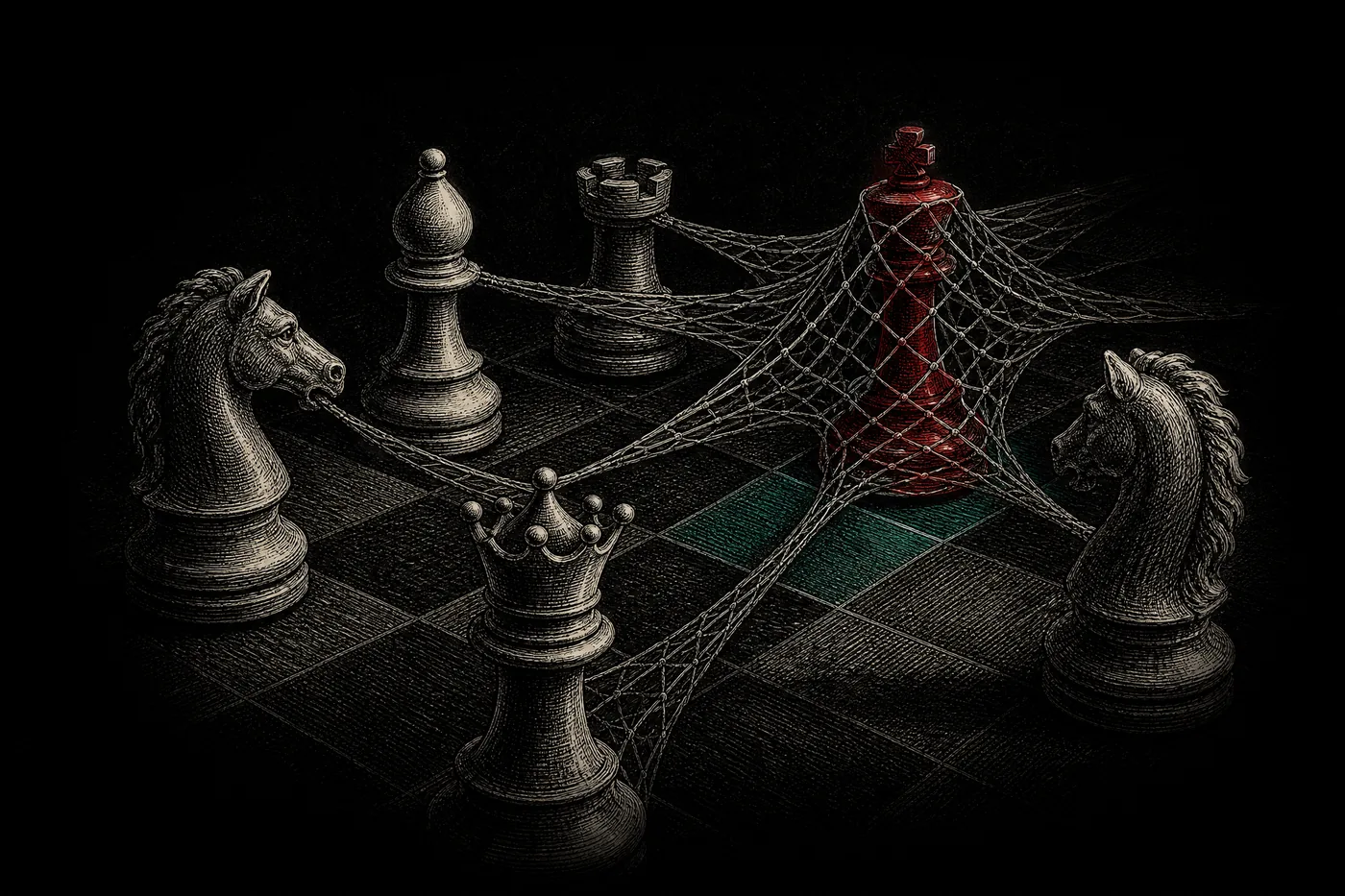
The Petrosian Variation (4.a3)
Named for world champion Tigran Petrosian, this prophylactic move is one of White’s most respected tries. With 4.a3, White quietly prevents any …Bb4 and prepares to throw up a big center with Nc3 and e4.
A common continuation is 4…Bb7 5.Nc3 d5, when Black challenges the center before White can play e4. White gets a little extra space; Black gets a sound, resilient structure. It’s a battle of restraint versus counterpunch — exactly Petrosian’s style.
The 4.Nc3 lines
White can also just develop the knight to its best square. After 4.Nc3, Black has two roads:
- 4…Bb4 transposes toward Nimzo-Indian-style play, pinning the knight after all.
- 4…Bb7 keeps it a pure Queen’s Indian, when 5.Bg5 pressures the f6-knight and the e4-square.
This is the most flexible meeting point between the Queen’s Indian and the Nimzo-Indian — proof of how naturally the two openings blend.
The 4.e3 system
The quietest option: White plays 4.e3 and develops modestly with Bd3 and 0-0. After 4…Bb7 5.Bd3 the game is calm and flexible, and often transposes into other structures.
It won’t trouble a prepared Black, but it sidesteps theory and keeps a small, comfortable game for White.
The one idea that ties it all together
Across every one of these variations, the whole game revolves around a single square: e4. White wants to plant a pawn or piece there and dominate the center; Black uses the b7-bishop, the …Ne4 jump, and timely pawn breaks to deny it. Once you see that, the variations stop feeling like separate openings and start feeling like different routes to the same fight.
- In the Fianchetto, White’s g2-bishop and Black’s b7-bishop duel directly over the long diagonal — and over e4.
- In the Petrosian, White restrains Black first (4.a3), then tries to occupy e4 with a pawn.
- In the 4.Nc3 lines, the knight supports a future e4, so Black pressures it with …Bb4 or …Bb7.
Keep that square in mind and you’ll always know what both sides are really arguing about.
So which variation should you study?
- Playing Black and want the modern main line? Learn the Fianchetto with 4…Ba6 — it’s today’s top choice.
- Want something simpler and classical? The 4…Bb7 fianchetto is rock-solid and easy to understand.
- Playing White and want a strategic edge? The Petrosian (4.a3) gives you space and restraint.
- Like flexibility? The 4.Nc3 lines let you blend Queen’s Indian and Nimzo ideas.
Curious how White tries to squeeze the Queen’s Indian? See how to beat the Queen’s Indian. And don’t miss the traps page — even this solid opening hides a couple of pitfalls.
FAQ
What is the most popular Queen’s Indian variation? The Fianchetto Variation (4.g3) is the main line, and within it the modern 4…Ba6 is today’s top choice at grandmaster level, with the classical 4…Bb7 close behind.
What is the Petrosian Variation? 4.a3 — a prophylactic move named after Tigran Petrosian that prevents …Bb4 and prepares White to build a big center with Nc3 and e4.
What’s the difference between …Ba6 and …Bb7? …Ba6 immediately attacks the c4-pawn and provokes a small concession; …Bb7 develops the bishop straight to the long diagonal for classical, solid play. Both are fully sound.
Can the Queen’s Indian transpose into the Nimzo-Indian? Yes — after 4.Nc3, Black can play 4…Bb4 and reach Nimzo-style positions. The two openings are natural partners.
Keep climbing
If the names are blurring together, anchor yourself with the Queen’s Indian overview and the broader opening principles. Then return to the openings hub to compare the Queen’s Indian with its cousins like the Nimzo-Indian.
Written and fact-checked by the Chess Lab Academy Editorial Team (AI-assisted, human-edited) · Lines checked against mainstream opening theory and verified with Stockfish 17 · ECO E12–E19 · Last verified 2026-06-25 · Sources · How we verify content.
