

The Nimzo-Indian spans ECO codes E20 to E59, which is a big hint: there’s a lot of theory here, and it all branches on move four. White picks how to handle the b4-bishop’s pin, and each choice gives the game its own personality — from quiet, flexible positional play to sharp, big-center battles. Here’s the map.
The variations at a glance
Variation Key moves Personality Who it favors Rubinstein 4.e3 Flexible main line Balanced Classical (Capablanca) 4.Qc2 Avoids doubled pawns Slight pull White Kasparov 4.Nf3 Flexible, QID-flavored Balanced Sämisch 4.a3 Bxc3+ 5.bxc3 Big center vs. doubled pawns Double-edged Leningrad 4.Bg5 Pin meets pin Double-edged Hübner setup 4.e3 c5 5.Bd3 Nc6 6.Nf3 Bxc3+ Fixed-pawn blockade Balanced
The Rubinstein (4.e3) — the main road
This is the main line. With 4.e3, White opens the f1-bishop, keeps everything flexible, and plans to untangle the pin with a3 at a good moment. It’s the most-played Nimzo at every level.
Step through the line
Move by move — press Next to advance, Back to rewind.
The Rubinstein main line to a balanced move-10 middlegame — White's bishop pair versus Black's pressure on the doubled c-pawns.
The core idea: Black challenges the center with …d5 and …c5, then trades …Bxc3 to leave White with doubled c-pawns and plays against them. White gets the bishop pair and central play in return. It’s the gold standard and an absolute schooling in handling imbalances. (See the move-by-move guide for the step-by-step.)
The Classical / Capablanca Variation (4.Qc2)
The most principled response to the pin’s whole point. With 4.Qc2, White prepares to recapture on c3 with the queen, so that if Black plays …Bxc3+, White avoids the doubled pawns entirely and keeps a clean structure plus the bishop pair.
The cost is development time, and Black has several good tries — 4…d5, 4…c5, and 4…0-0 — using the tempo White spent on the queen to grab central or queenside play. A typical line shows Black hitting back fast:
Step through the line
Move by move — press Next to advance, Back to rewind.
The Classical with 4...d5 — Black gains time with ...Ne4 and ...c5 before White can consolidate the bishop pair.
It’s a fighting line where White accepts a small developmental lag for a structurally cleaner long game.
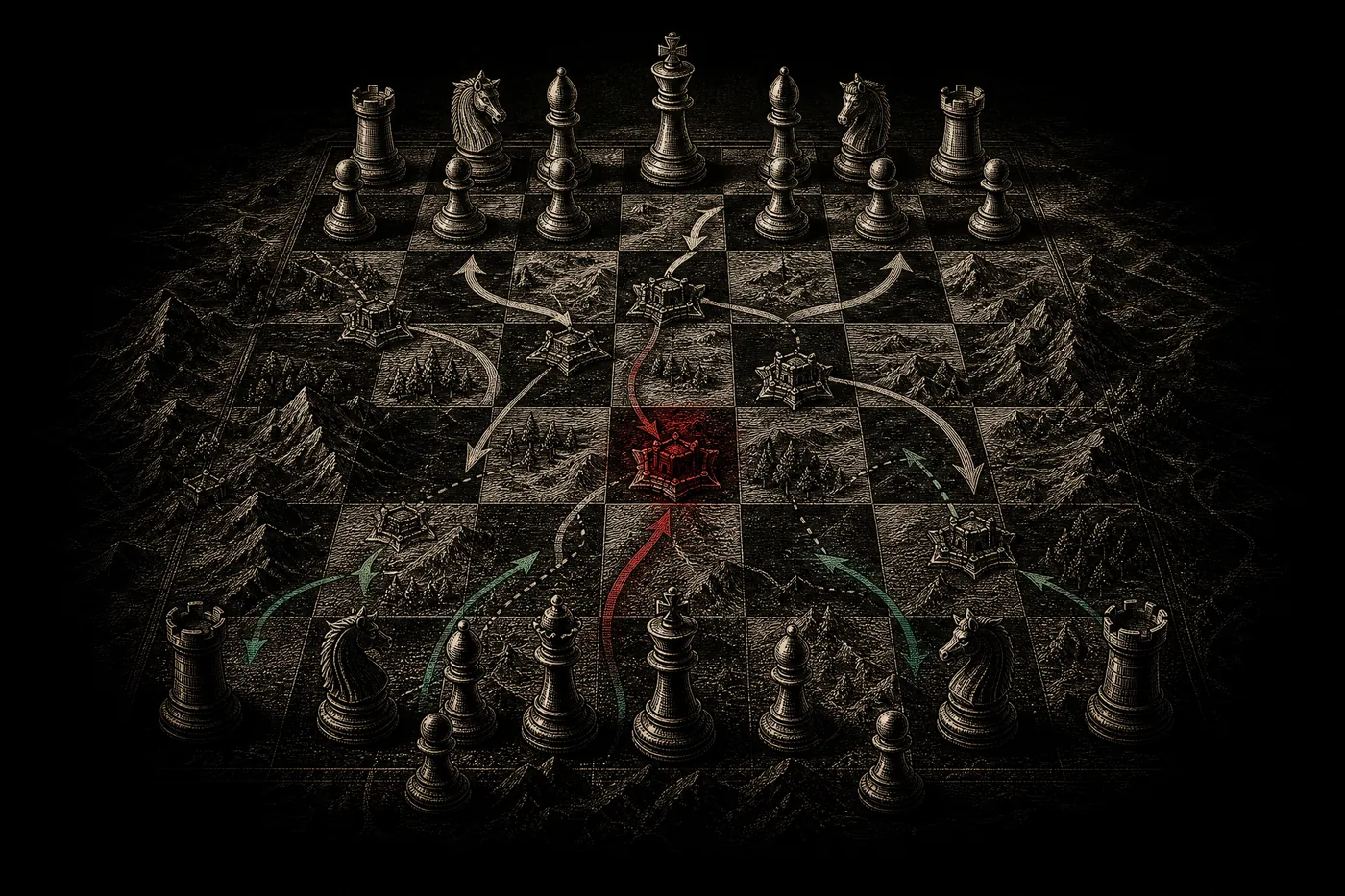
The Kasparov Variation (4.Nf3)
White develops naturally with 4.Nf3, sidestepping immediate structural commitments and keeping options open. It often steers toward Queen’s-Indian-style play when Black answers with …b6 and …Bb7.
Step through the line
Move by move — press Next to advance, Back to rewind.
The Kasparov 4.Nf3 with ...b6 — a flexible, Queen's-Indian-flavored Nimzo.
It became a top-level main line during Kasparov’s era precisely because it’s so flexible. Black has many sound setups, and the play tends to be rich and balanced.
The Sämisch Variation (4.a3)
The most direct try. With 4.a3 Bxc3+ 5.bxc3, White spends a tempo to force the trade immediately, voluntarily taking the doubled pawns to grab the bishop pair and build a big center with f3 and e4.
This is the sharpest, most double-edged main system. White wants to prove the two bishops and the big center; Black wants to blockade the doubled pawns, target c4, and prove the structure tells in the long run. A genuine fight where both sides know what they want.
The Leningrad (4.Bg5) and the Hübner setup
Two more notable systems:
- Leningrad Variation (4.Bg5): White answers the pin with a pin of its own, attacking the f6-knight. It’s aggressive and double-edged — Black often hits back with …h6 and …c5 to break the tension.
- Hübner Variation (4.e3 c5 5.Bd3 Nc6 6.Nf3 Bxc3+ 7.bxc3 d6): a specific Rubinstein setup where Black trades on c3 early and locks the center with …d6 and …e5, building a blockade against the fixed doubled pawns.
Step through the line
Move by move — press Next to advance, Back to rewind.
The Hübner Variation — Black trades early and blockades the doubled c-pawns with a fixed central structure.
A quick word on move orders
One thing that trips people up: the Nimzo only exists if White plays 3.Nc3. If White starts 3.Nf3 instead, there’s no knight on c3 to pin, and the game usually heads into Queen’s-Indian or Bogo-Indian territory. That’s why most Nimzo players pair it with the Queen’s Indian (3.Nf3 b6) — together they cover everything White can throw at the 1.d4 Nf6 2.c4 e6 move order. Keep that partnership in mind as you build a repertoire: learning the Nimzo’s variations is only half the job.
It’s also worth knowing that many of these systems transpose. A 4.Nf3 Kasparov line can melt into a Queen’s Indian; a 4.e3 Rubinstein can reach the same doubled-pawn structures as the Sämisch if Black trades early. Don’t memorize each as a sealed box — recognize the structures (doubled c-pawns, the bishop pair, the …d5/…c5 breaks) and you’ll navigate the whole forest by feel.
So which variation should you study?
- Playing Black and want the full experience? Learn the Rubinstein — it’s the heart of the opening.
- Want fewer headaches? Know your antidote to the Classical (4.Qc2) and the Kasparov (4.Nf3); they’re the most common at higher levels.
- Facing the Sämisch? Get a clear blockading plan ready — it’s the sharpest line where White comes straight at you.
- Surprised by 4.Bg5? Know the simple …h6/…c5 reply and you’ll be fine.
Curious how White tries to crack the Nimzo? See how to beat the Nimzo-Indian. And don’t miss the traps page — some of these lines hide nasty tricks.
FAQ
What is the most popular Nimzo-Indian variation? The Rubinstein (4.e3) is the most-played and most flexible main line. The Classical (4.Qc2) is the principled try to avoid the doubled pawns, and both appear constantly at the top level.
What is the Sämisch Variation? It’s White’s most direct try: 4.a3 Bxc3+ 5.bxc3, forcing the trade to grab the bishop pair and a big center — accepting doubled c-pawns as the price.
Why does White play 4.Qc2 in the Classical? So that after …Bxc3+, White can recapture with the queen (Qxc3) instead of a pawn — avoiding the doubled c-pawns entirely while keeping the bishop pair.
What’s the difference between the Rubinstein and the Sämisch? In the Rubinstein (4.e3), White keeps things flexible and only breaks the pin later; in the Sämisch (4.a3), White forces the …Bxc3+ trade immediately and goes all-in on the bishop pair and center.
Keep climbing
If the names are blurring together, anchor yourself with the Nimzo-Indian overview and the broader opening principles. Then return to the openings hub to compare the Nimzo with its partner the Queen’s Indian.
Written and fact-checked by the Chess Lab Academy Editorial Team (AI-assisted, human-edited) · Lines checked against mainstream opening theory and verified with Stockfish 17 · ECO E20–E59 · Last verified 2026-06-25 · Sources · How we verify content.
