

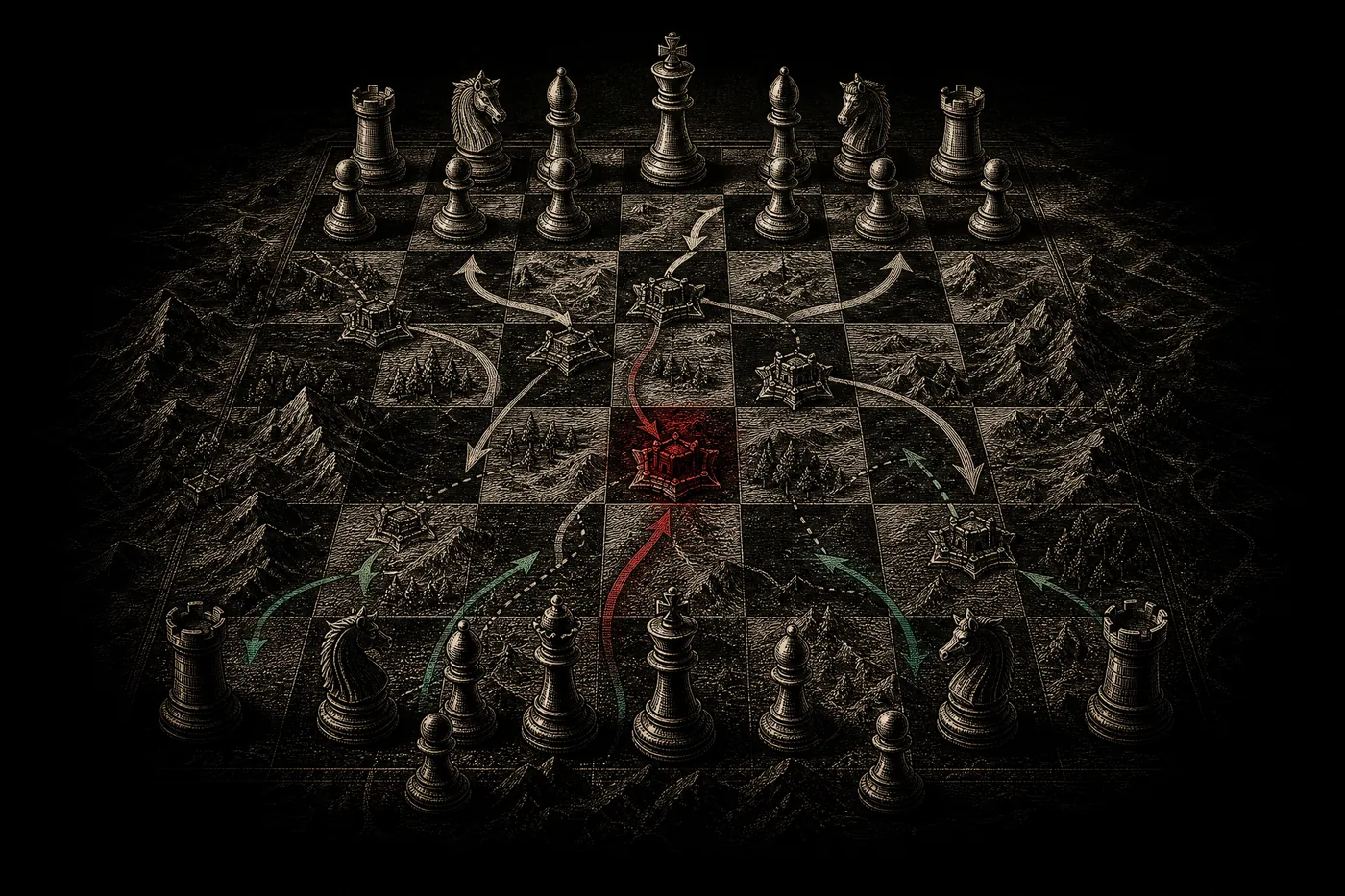
The Modern sits under ECO code B06, and because Black commits to so little early, the variety lives almost entirely on White’s side: White picks how to treat that big center, and each choice gives the game its own flavor — from an all-out kingside avalanche to a calm maneuvering battle. Here’s the map. (And because the Modern is so transpositional, several of these flow straight into Pirc or King’s Indian structures once the knights come out.)
The variations at a glance
Variation Key moves Personality Who it favors f4 big-center push 2.d4 Bg7 3.Nc3 d6 4.f4 Aggressive, space-grab Sharp; White scores well Be3 + Qd2 (150-style) 4.Be3, Qd2, f3, Bh6 Pawn-storm vs. fianchetto Double-edged, attacking Classical 4.Nf3 Calm, maneuvering Balanced, slight pull White c4 systems 3.c4 (KID-flavor) Big space, structural Comfortable space for White
The f4 big-center push — the critical test
This is the line every Modern player must respect. After 2.d4 Bg7 3.Nc3 d6 4.f4, White builds the biggest center imaginable — pawns on d4, e4, and f4 — and plans to roll the kingside with f5 and e5. It’s the most aggressive try and the one where White scores best. (Once Black adds …Nf6, this is the Pirc’s Austrian Attack — the openings simply merge.)
Step through the line
Move by move — press Next to advance, Back to rewind.
The f4 big-center setup — White builds a huge pawn front and develops, ready to storm the kingside.
Black’s job is to prove that big center is overextended before it becomes a steamroller. The two main counter-plans:
- …c5, hitting d4 immediately and opening lines for the g7-bishop.
- …e5, the classic central strike, often after …Nc6 or …Nbd7.
Here’s a direct …c5 break in action — Black refuses to sit and wait:
Step through the line
Move by move — press Next to advance, Back to rewind.
A direct ...c5 against the f4 center — Black challenges d4 at once, exactly the right energy against White's big pawn front.
It’s genuinely double-edged: White’s space and attacking chances vs. Black’s counterpunch. Get the timing wrong and you’re crushed; get it right and you’re the one attacking.
The Be3 + Qd2 setup (150-style)
A nasty, hugely popular club weapon — the same plan that terrorizes Pirc players. White develops Be3, plays Qd2, props the center with f3, and aims Bh6 to trade off Black’s beloved fianchetto bishop, then castles queenside and storms the kingside with h4–h5.
Step through the line
Move by move — press Next to advance, Back to rewind.
The Be3 + Qd2 setup — White lines up the dark-square plan (f3, Bh6, 0-0-0, h4) while Black grabs queenside space with ...a6 and ...b5.
The point is to remove Black’s best piece (the g7-bishop) and open the h-file at Black’s king. It’s a low-theory, plan-based attacking scheme that’s easy to play and hard to face. Black counters by racing on the queenside with …a6, …b5, …b4 before White’s storm lands.
The Classical Variation (4.Nf3)
The natural, solid developing move. White just plays good chess — Nf3, Be2, 0-0 — and keeps a small space edge without committing to anything sharp.
Step through the line
Move by move — press Next to advance, Back to rewind.
The Classical Modern — calm development on both sides; once ...Nf6 appears this is effectively a Classical Pirc.
The core idea: White maneuvers patiently and tries to prove Black is a touch cramped, while Black completes the setup and aims for …e5 or …c5 to free the position. It’s the most flexible, least forcing line — perfect if you like understanding over memorization. Note how naturally it transposes into the Pirc’s Classical once Black commits the knight to f6.
The c4 systems (King’s-Indian flavor)
White plays an early c4 — for example 3.c4 — claiming even more space and steering the game toward King’s-Indian-style structures. Black answers with …d6, …Nf6, and …0-0, reaching positions that rhyme directly with the King’s Indian Defense.
White gets a comfortable space advantage and a clear plan; Black gets the familiar King’s-Indian counterplay, breaking with …e5 (and …f5) or …c5 depending on how White sets up.
So which variation should you study?
- Playing Black? Spend most of your time on the f4 big-center push — it’s the critical test and the line where preparation matters most. Then learn your antidote to the Be3 + Qd2 setup, which you’ll meet constantly at club level.
- Want the calmest game? The Classical is the most maneuvering and the easiest to play on understanding.
- Facing c4 systems? Lean on your King’s-Indian knowledge — the structures and breaks are the same.
Curious how White tries to crack the Modern? See how to beat the Modern Defense. And don’t miss the traps page — these sharp lines hide some real tricks.
FAQ
What is the most aggressive line against the Modern? The f4 big-center push (2.d4 Bg7 3.Nc3 d6 4.f4), where White grabs maximum central space and plans a kingside pawn storm. It’s the most testing line and the one where White scores best.
What is the 150-style setup against the Modern? It’s White’s plan of Be3, Qd2, f3, and Bh6, aiming to trade Black’s fianchetto bishop, castle queenside, and storm the kingside. It’s the same low-theory attacking scheme that’s popular against the Pirc.
Does the Modern transpose into the Pirc? Constantly. The moment Black plays …Nf6 in many of these lines, the position becomes a Pirc. The Modern’s whole point is to delay that commitment and keep extra options.
Why does White sometimes play c4 against the Modern? To claim even more space and steer toward King’s-Indian structures, where White’s broad pawn front can be a long-term asset. Black responds with standard King’s-Indian counterplay.
Keep climbing
If the names are blurring together, anchor yourself with the Modern overview and the broader opening principles. Then return to the openings hub to compare the Modern with its commit-early cousin the Pirc Defense and the 1.d4 fianchetto King’s Indian Defense.
Written and fact-checked by the Chess Lab Academy Editorial Team (AI-assisted, human-edited) · Lines checked against mainstream opening theory and verified with Stockfish 17 · ECO B06 · Last verified 2026-06-25 · Sources · How we verify content.
