

So you’ve heard the Benoni Defense is a fighting, win-with-Black weapon against 1.d4, and you want to try it. Here’s the good news: even though the Benoni has a sharp reputation, the basic setup is wonderfully logical. Every move has one clear job, your pieces almost place themselves, and once you understand the handful of ideas below, you’ll know what you’re doing in every game. Let’s keep this friendly.
The beginner’s cheat sheet
- Play: 1.d4 Nf6 2.c4 c5 3.d5 e6 (challenge the center, then trade on d5)
- The idea: give White central space in exchange for active piece play — the e-file, the g7-bishop, and the …b5 break.
- Don’t: panic about being cramped — your counterplay is real.
- Remember: fianchetto (…g6, …Bg7), castle, put a rook on e8, and prepare …a6 and …b5.
Step through the line
Move by move — press Next to advance, Back to rewind.
A clean, beginner-friendly Benoni setup — challenge the center, fix the structure, fianchetto, castle, and load the e-file.
The 4 ideas to remember
You don’t need 20 moves of memorization. You need these four ideas.
1. You’re trading space for activity (on purpose)
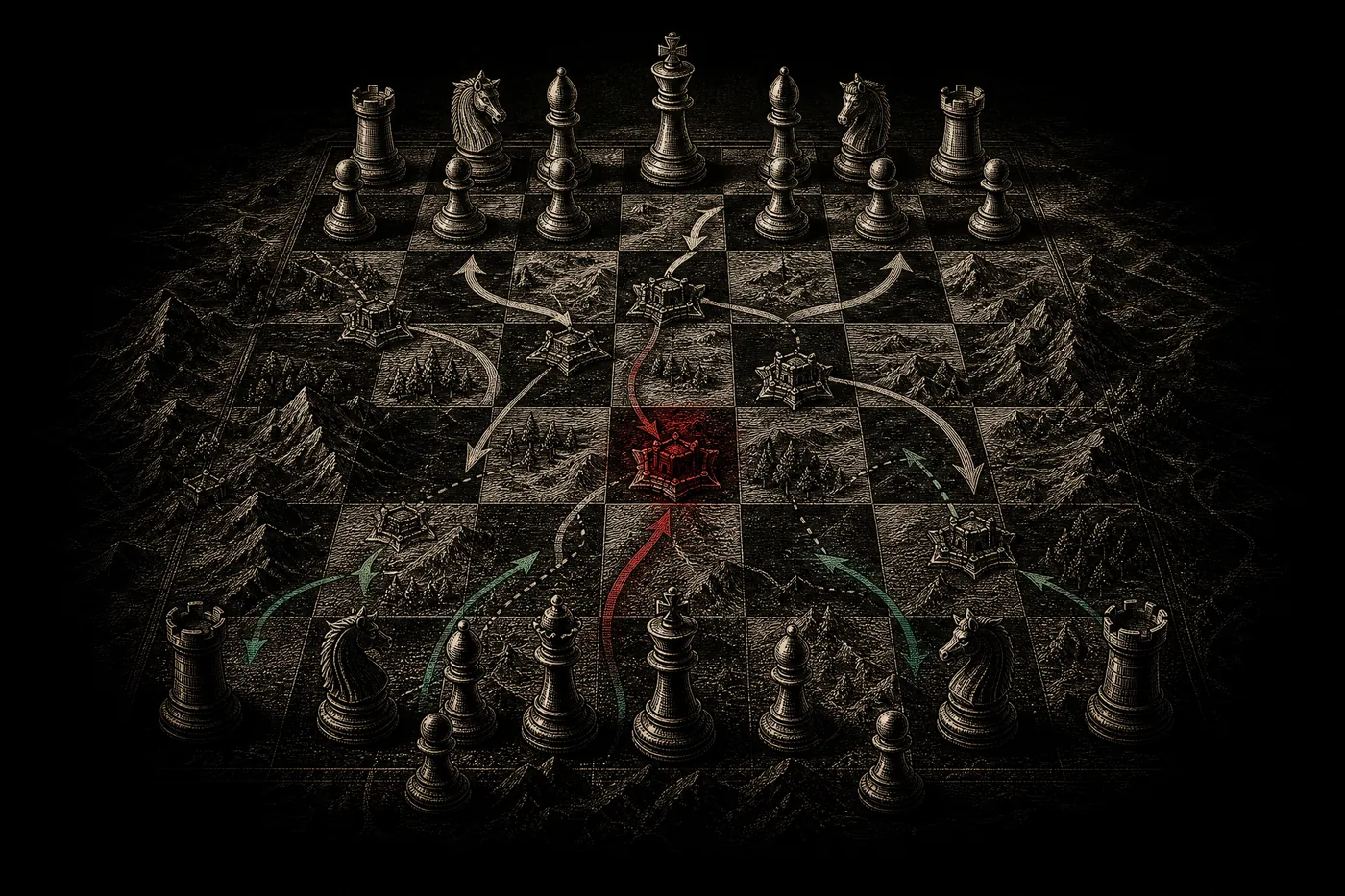
When you let White build that big d5/e4 center, you are not making a mistake — you’re making a deal. You hand over central space, and in return you get a queenside pawn majority, a half-open e-file, and a monster bishop on g7. Once you stop worrying about being cramped and start counting your active pieces, the Benoni makes total sense. Space is nice; activity wins games.
2. Fix the structure with …exd5 and …d6
After 3…e6 4.Nc3 exd5 5.cxd5 d6, you’ve locked in the famous Benoni structure: White’s d5-wedge against your queenside majority and open e-file. This is the position you want. The …d6 pawn supports your center and opens the road for your bishop.
3. Fianchetto the dark-squared bishop
Play …g6 and …Bg7. This puts your bishop on the long diagonal, where it rakes straight across the board toward White’s queenside and the key d4/e5 squares. It’s the heart and soul of the Benoni — keep its diagonal open and it becomes your most powerful piece. Then …0-0 tucks your king away safely.
4. Rook to e8, then break with …b5
This is the payoff. Put a rook on e8 to lean on White’s e4-pawn, then prepare the …b5 break with …a6 (often …Nbd7 and …Rb8 too). When …b5 lands with support, your queenside majority starts rolling and White has to scramble. That’s the Benoni dream: White defends, you attack.
The simplest move order to play
Here’s a beginner-proof sequence as Black. You can play this almost on autopilot:
- …Nf6 — develop, control e4.
- …c5 — challenge White’s center right away.
- …e6 — offer to trade a pair of central pawns.
- …exd5 — fix the structure you want.
- …d6 — support the center, open the diagonal.
- …g6 and …Bg7 — fianchetto your best piece.
- …0-0 — castle, king safe.
- …Re8 — load the e-file, eye e4.
- …a6, then …b5 — prepare and play the break.
That’s it. Challenge, fix the structure, fianchetto, castle, then break on the queenside. You’re playing real Benoni chess. For the full reasoning behind each move, see our move-by-move guide.
Common beginner mistakes (and how to fix them)
Mistake #1: Panicking about the space. New players feel cramped and start shuffling pieces aimlessly. Fix: trust your plan. Finish the setup, get …Re8 and …a6 in, and your counterplay will come. Cramped is not the same as worse.
Mistake #2: Breaking with …b5 too early. Playing …b5 before …a6 and supporting pieces just drops a pawn — White takes and stays solid. Fix: prepare the break first (…a6, often …Nbd7 and …Rb8), then play …b5. Timing is everything (see our traps page).
Mistake #3: Blocking the wrong way against the Bb5+ check. If White plays the sharp 7.f4 and 8.Bb5+, block with …Nfd7, not …Nbd7 — the wrong knight lets White’s e5 break crash through. Fix: memorize this one little detail; it’s the Benoni’s most important move-order trap.
Mistake #4: Burying the g7-bishop. Don’t block your own bishop’s diagonal or trade it off for no reason — it’s your best piece. Fix: keep the long diagonal open and let the bishop breathe; trade it only when it concretely wins something.
Should beginners even play the Benoni Defense?
Honest answer: yes, with eyes open. The ideas are clear and the setup is easy to learn — that part is genuinely beginner-friendly. The catch is that the Benoni is sharp and theory-heavy in the critical lines (especially the Taimanov, where White scores well), so you’ll need to learn a few precise responses rather than playing purely on autopilot.
If you love a fighting, imbalanced game and don’t mind learning a little theory, the Benoni is a fantastic teacher of dynamic chess. If you’d rather a gentler ride, the related Benko Gambit (with …b5 instead of …e6) has simpler, more forgiving plans, and the King’s Indian Defense is a flexible cousin that can transpose to Benoni-style positions.
FAQ
Is the Benoni Defense too hard for beginners? The setup and ideas are clear, so the basics are beginner-friendly. The catch is the sharp critical lines (especially the Taimanov) where you need to know a few precise moves. Learn the ideas first, then the key responses.
What’s the easiest way to remember the Benoni Defense? Challenge the center (…c5, …e6), trade on d5 (…exd5), fianchetto (…g6, …Bg7), castle, put a rook on e8, and prepare …a6 and …b5. The plan is always the same.
Won’t I just get squashed by White’s space? Only if you sit passively. The Benoni trades space for activity — your job is to use the e-file, the g7-bishop, and the …b5 break. Played actively, your counterplay balances White’s space.
Benoni or Benko for a beginner? Both are good. The Benko Gambit sacrifices a pawn but has simpler, more repeatable plans; the Benoni keeps the pawn but is sharper and more central. Many beginners find the Benko a touch easier to handle at first.
Keep climbing
Make sure the fundamentals are rock-solid first — read the opening principles, then come back and the Benoni’s “trade space for activity” idea will click. From here, level up with the move-by-move main line, peek at the traps, or head back to the Benoni overview and the openings hub.
Written and fact-checked by the Chess Lab Academy Editorial Team (AI-assisted, human-edited) · Lines checked against mainstream opening theory and verified with Stockfish 17 · ECO A56–A79 · Last verified 2026-06-25 · Sources · How we verify content.
