

Alekhine’s Defense is what you get after 1.e4 Nf6 — and it’s one of the cheekiest replies in all of chess. Instead of meeting White’s pawn in the center, Black develops a knight that attacks the e4-pawn right away. White’s natural reaction is to shove the pawn forward and chase the knight around the board. That’s exactly what Black is hoping for. It’s a provocative, hypermodern defense built on a single bold bet: let White grab a huge pawn center, then tear it down.
The 30-second version
- Moves: 1.e4 Nf6 · ECO: B02–B05 · You play it as: Black.
- The idea: provoke White into overextending. Black invites 2.e5, 3.d4, 4.c4 — a big pawn center — then undermines it with …d6, …dxe5, …c5, and piece pressure.
- Main lines: the Four Pawns Attack (4.c4 Nb6 5.f4, maximum space), the Modern/Main Line (4.Nf3), and the Exchange Variation (after …dxe5 / exd6).
- Best for: fighters and surprise-weapon fans who like double-edged, unconventional positions.
Step through the line
Move by move — press Next to advance, Back to rewind.
Alekhine's Defense — Black pokes at e4 immediately and invites White's pawns to chase the knight.
What’s the big idea behind Alekhine’s Defense?
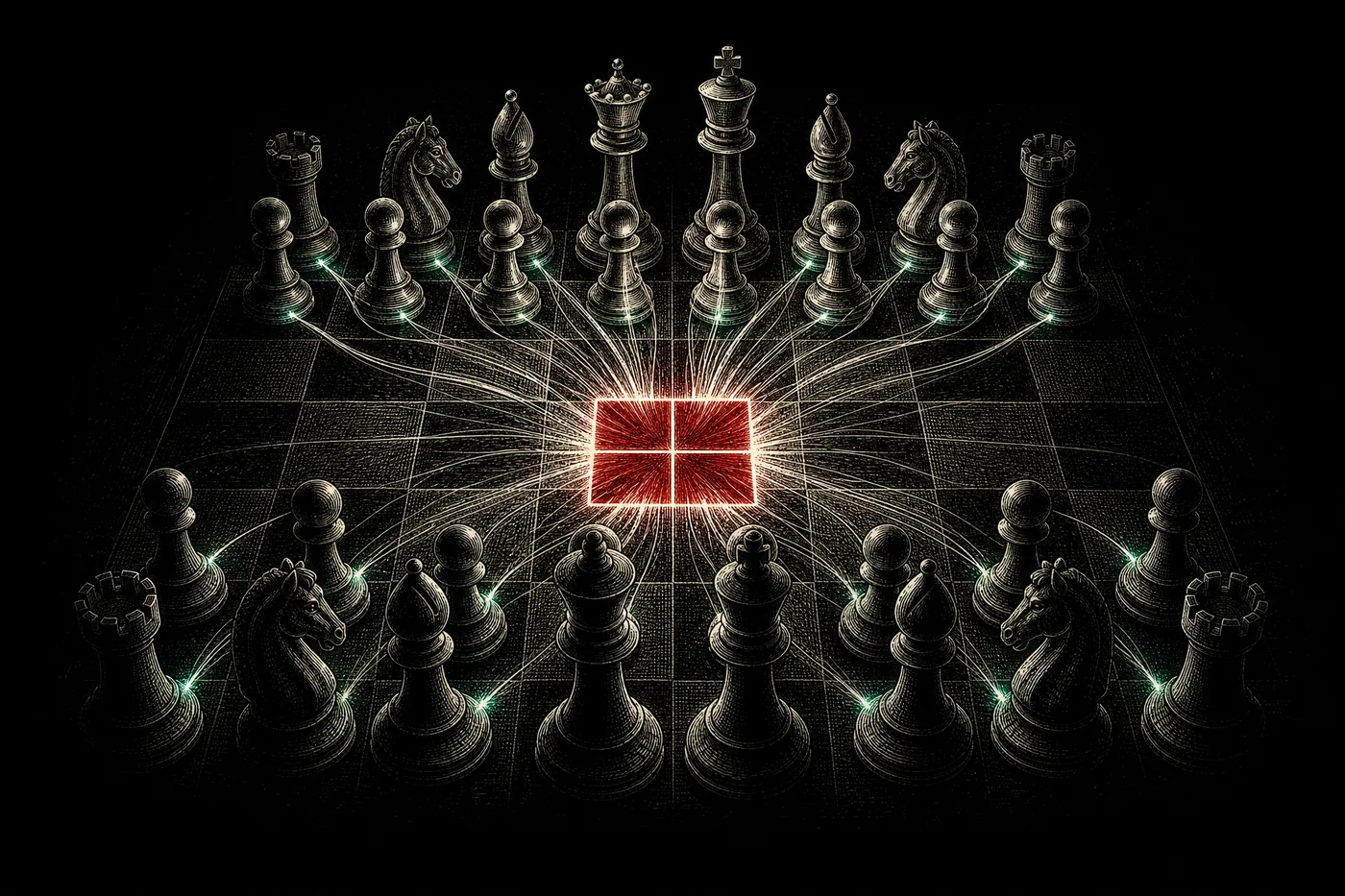
Most openings teach you to occupy the center with pawns. Alekhine’s Defense flips that on its head. It’s a hypermodern opening — the idea is that a big pawn center isn’t automatically strong. It can become a target.
When Black plays 1…Nf6, White is practically dared to kick the knight with 2.e5, then keep going with 3.d4 and often 4.c4. The knight gets shoved from f6 to d5 to b6, losing a little time. In exchange, Black gets something valuable: White has committed a row of pawns far up the board, and those pawns now need defending.
From there, Black’s whole plan is undermining:
- Hit the center with …d6, challenging the e5-pawn directly.
- Trade and target. After …dxe5, the center loosens; Black piles up on d4 and e5 with …c5, …Nc6, …Bg4, …Bf5.
- Let White overextend. If White grabs too much space, the pawns become weaknesses Black swarms in the middlegame.
The gamble is real, and it cuts both ways — which is exactly why it’s such a fun fighting weapon.
What are the main variations?
After 1.e4 Nf6 2.e5 Nd5, White chooses how aggressively to push. That choice defines the game. For the full tour, see our variations guide.
4.c4 Nb6 5.f4 — the Four Pawns Attack
The most ambitious, space-grabbing try. White builds a wall of pawns on c4, d4, e5, and f4.
It looks crushing, and if Black is passive it is crushing. But the whole point of Alekhine’s is to attack exactly this kind of center, usually with …dxe5, …c5, …Nc6, …Bf5. Sharp and double-edged.
4.Nf3 — the Modern (Main) Line
Today’s most respected approach. Instead of grabbing everything, White develops sensibly and keeps a healthy space edge.
This is the line that gives Black the fewest easy targets, which is exactly why it’s the modern main road.
The Exchange Variation (4.c4 Nb6 5.exd6)
White can also just clarify the center by trading on d6. After 5.exd6, Black recaptures with …cxd6 (active) or …exd6 (solid). White gets a small, comfortable space edge without the risk of overextending.
There are sharper sidelines too — the Chase Variation (3.c4 Nb6 4.c5) and various Two Pawns tries — all covered in the variations guide.
What are the plans for both sides?
For Black:
- Provoke the pawn advances, then immediately challenge them with …d6 and …dxe5.
- Develop actively — …Bg4 or …Bf5 for the light-squared bishop, often a kingside fianchetto with …g6 and …Bg7.
- Target d4 and e5 with …c5 and …Nc6, and pounce if White’s center cracks.
For White:
- Use the space advantage — the e5-pawn cramps Black and gains a tempo on the knight.
- Develop solidly (the Modern line) rather than over-grabbing, and try to prove Black is just a touch passive.
- In the Four Pawns, support the big center and aim for a direct attack before Black undermines it.
Strengths and weaknesses
Why you’ll love it:
- It’s a fighting surprise weapon. Most 1.e4 players have deep prep against the Sicilian or French — far less against Alekhine’s. You drag them onto your turf.
- It’s principled in a hypermodern way. You’re not breaking rules; you’re applying a different, perfectly sound philosophy of the center.
- It’s never boring. The positions are unbalanced and full of ideas.
The catch:
- It’s double-edged. If White doesn’t overextend and just develops, Black can end up cramped and a little passive.
- That knight gets chased. Spending early tempi shuffling the knight is a real concession if your counterplay doesn’t materialize.
- It’s offbeat, not mainstream — you trade theoretical depth for surprise value.
Who plays Alekhine’s Defense?
It’s named after the fourth World Champion, Alexander Alekhine, who introduced it in a tournament in 1921 and showed the chess world it was a serious idea, not a joke. Bobby Fischer memorably reached for it on occasion — including in his 1972 World Championship match against Spassky — which gave the defense a lasting cult following. It’s never been a top-level mainstream choice, but as a fighting, surprise weapon it has genuine pedigree.
A fun bit of history
When Alekhine first wheeled out 1…Nf6 in the 1920s, classical players were horrified — letting White build a giant pawn center seemed to violate everything the textbooks preached. But that was the point: the hypermodern school argued you could invite a big center precisely so you could attack it. Alekhine’s Defense became one of the banner openings of that whole revolution in chess thinking. A century later, engines confirm it’s perfectly playable — offbeat, yes, but absolutely sound.
Is Alekhine’s Defense right for you?
If you’re a fighter who loves unbalanced positions and enjoys taking opponents out of their comfort zone, Alekhine’s Defense is a brilliant surprise weapon. If you’re a total beginner, you can play it on ideas (start with our beginner’s guide) — just know that the rock-solid Caro-Kann or the simpler Scandinavian are gentler ways to meet 1.e4. For the honest, level-by-level verdict, see is Alekhine’s Defense good?
Explore Alekhine’s Defense
- Alekhine’s Defense: the main line move by move
- Alekhine’s Defense variations (Four Pawns, Modern, Exchange & more)
- Alekhine’s Defense traps (including the Nxf7 fork)
- Alekhine’s Defense for beginners
- Best Alekhine’s Defense master games
- How to beat Alekhine’s Defense (as White)
- Is Alekhine’s Defense good?
Back to the full openings hub.
FAQ
Why is it called Alekhine’s Defense? It’s named after Alexander Alekhine, the fourth World Chess Champion, who introduced 1…Nf6 as a serious defense in a 1921 tournament and championed its hypermodern ideas.
Is Alekhine’s Defense a good opening for Black? It’s a sound, fully playable fighting defense — engines confirm it’s fine — but it’s offbeat and double-edged rather than a rock-solid mainstream choice. It shines as a surprise weapon.
Why does Black let White build a big pawn center? That’s the hypermodern idea. Black invites the pawns forward so they become targets, then undermines them with …d6, …dxe5, …c5 and active pieces.
Is Alekhine’s Defense for White or Black? It’s a Black defense — Black chooses it by answering 1.e4 with 1…Nf6. White then decides how to chase the knight (2.e5) and how much space to grab.
Alekhine vs Scandinavian — which should I learn? The Scandinavian (1…d5) is simpler and more forcing; Alekhine’s is trickier and more provocative. Both are good surprise weapons against 1.e4.
Keep climbing
New to openings? Ground yourself in the opening principles first — then you’ll appreciate exactly which “rule” Alekhine’s Defense is bending (and why it gets away with it).
Written and fact-checked by the Chess Lab Academy Editorial Team (AI-assisted, human-edited) · Lines checked against mainstream opening theory and verified with Stockfish 17 · ECO B02–B05 · Last verified 2026-06-25 · Sources · How we verify content.
