
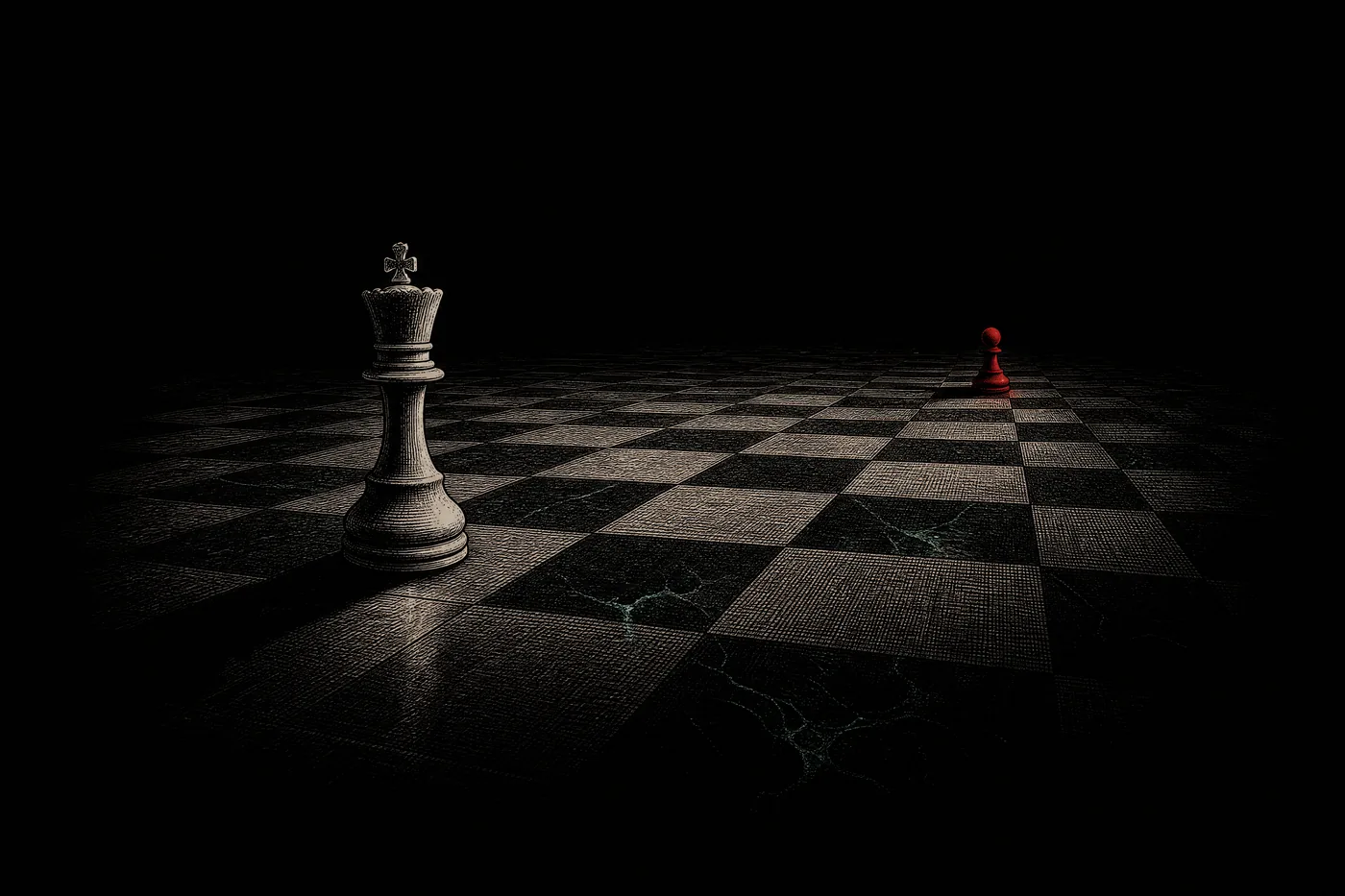
Zugzwang (German for “compulsion to move”) is the cruel chess situation where it’s your turn, every legal move makes your position worse, and the rules force you to play one anyway. You’d love to “pass” — but in chess you can’t. That obligation to move is the entire weapon. Zugzwang lives mostly in the endgame, and learning to spot it turns drawn positions into wins and lost positions into heartbreak (for your opponent).
If only you could skip your turn, you’d be fine. That’s the tell: whenever you catch yourself thinking “I wish I didn’t have to move,” you’re probably looking at zugzwang.
The 20-second version
- Zugzwang = any move you make damages your position, but you’re forced to move.
- It mostly appears in endgames, where there are few pieces and few safe “waiting” moves.
- Mutual zugzwang = whoever is on move loses; the trick is making it the opponent’s turn.
- It’s the engine behind king-and-pawn wins and the opposition.
- You can’t pass in chess — that single rule is what makes zugzwang possible.
What is zugzwang in chess, exactly?
In most positions, having the move is an advantage — you get to improve something, make a threat, grab a square. Zugzwang flips that completely: it’s a position where being forced to move is a disadvantage. If you could legally say “I pass,” you’d hold or even win — but the rules forbid passing, so you must touch a piece and damage your own position.
It works because chess has no “skip turn” button. Every single turn you must make a legal move. When all your good waiting moves run out and every option weakens you — your king has to abandon a key square, or a pawn push creates a fatal hole — you’re in zugzwang.
Look at the position above. Black’s king is bravely blocking White’s path. But it’s Black’s move, and the king has to step somewhere — and every step loosens the grip, letting White’s king march forward and shepherd the pawn to promotion. Black isn’t losing because of a blunder; Black is losing simply because it’s Black’s turn. That’s zugzwang in its purest form.
Why does zugzwang only really show up in the endgame?
Because earlier in the game you’ve almost always got a useful or at least harmless move to make. With a full board, you can shuffle a rook, nudge a pawn, improve a knight — there’s always something that doesn’t hurt. “Waiting moves” are everywhere.
Strip the board down to a few pawns and kings, though, and those safe moves vanish. Suddenly the only legal moves are ones that lose ground:
- A king that must abandon the square it’s guarding.
- A pawn that must advance into a weakness (pawns can’t move backward — once pushed, the square behind is gone forever).
- A piece that must leave its perfect post.
That scarcity of safe moves is why zugzwang is an endgame specialty. Fewer pieces means fewer escape hatches, and eventually you run out entirely. It’s also why the bishop’s ability to make a quiet “pass” along a diagonal — and the knight’s inability to do so — matters so much in minor piece battles.
What is mutual zugzwang (and the trébuchet)?
The deadliest form is mutual zugzwang: a position where whoever is to move loses. Both sides would happily pass — but only one is forced to. The entire game then becomes a fight over whose turn it is when the critical position arrives.
The cleanest example is the famous trébuchet: each side has one pawn and a king, the kings stare each other down, and whoever’s on move must abandon their pawn and lose.
In this position, it’s White to move — and White is lost. The white king is the only thing guarding its d4 pawn while eyeing Black’s pawn on d5; the moment it has to move, it either steps off the defense (so Black grabs d4) or lets Black’s king escort the d-pawn home. If it were Black’s move instead, the exact mirror happens and Black loses. Same board, opposite results, decided entirely by whose turn it is. That’s mutual zugzwang in one tidy package.
This is also the secret engine behind the opposition — the king-versus-king standoff where the side not on the move controls the key squares. Opposition is really just “how to make sure the zugzwang lands on your opponent.”
How do you actually use zugzwang to win?
You can’t always wave a wand and create it, but you can hunt for it. The practical recipe:
- Get all your pieces to their ideal squares first. Improve everything you can while you still have good moves to make.
- Run the opponent out of useful moves. Once your position is maxed out, look for whether their only remaining moves all hurt.
- Use a “waiting move” or a tempo trick to hand the turn back to them at the critical moment. In pawn endings this often means taking the opposition; with a bishop it might mean a quiet diagonal shuffle.
- Watch for triangulation — a king maneuver that loses a tempo on purpose (the king walks a little triangle to arrive at the same square but with the opponent now on move). It’s the classic tool for transferring zugzwang.
The mental switch is to stop asking “what’s my best move?” and start asking “can I make it so that they have no good move?”
A fun bit of history
The word “zugzwang” entered English chess literature in the early 1900s, borrowed straight from German, because no English word captured it as neatly. The concept itself is far older — players have been engineering “you must move and it’ll hurt” traps for centuries. It even reaches beyond chess: game theorists use “zugzwang” to describe any game where being forced to act is a disadvantage. Fun aside: in Go, the equivalent idea exists, but because passing is allowed in Go, pure zugzwang can’t really happen there. Chess’s no-passing rule is what makes the whole beautiful, agonizing trap possible. One little rule, endless suffering.
Common mistakes to dodge
- Rushing your pieces forward before maxing out your position. Improve everything while you have free moves; then go hunting for zugzwang.
- Forgetting you might be the one in zugzwang. If all your moves look bad, check whether you can pass the turn back instead — or change the structure to avoid it.
- Missing triangulation. When a direct approach fails by one tempo, see if your king can lose a move with a little triangle walk.
- Confusing it with stalemate. Zugzwang means every move is bad; stalemate means there’s no legal move at all (and that’s a draw). Different beasts.
- Pushing a pawn just to “do something.” That’s often exactly the self-weakening move zugzwang wants from you. Sometimes the best move is the most patient one.
Key takeaways
- Zugzwang = you must move, and every move worsens your position.
- It thrives in endgames, where safe waiting moves are scarce.
- Mutual zugzwang (like the trébuchet) means whoever is on move loses — fight for the turn.
- Triangulation and the opposition are the tools for putting the zugzwang on your opponent.
- It only exists because you can’t pass in chess.
Keep climbing
Zugzwang and the opposition are two sides of the same coin — master one and the other clicks. The king-and-pawn endgames are where you’ll use both constantly.
Next up: The opposition explained · Also great: king and pawn endgames, fortresses, and the endgames hub.
Written and fact-checked by the Chess Lab Academy Editorial Team (AI-assisted, human-edited) · Positions checked with Stockfish 17 and rules verified against the FIDE Laws of Chess · Last verified 2026-06-25 · Sources · How we verify content.
